
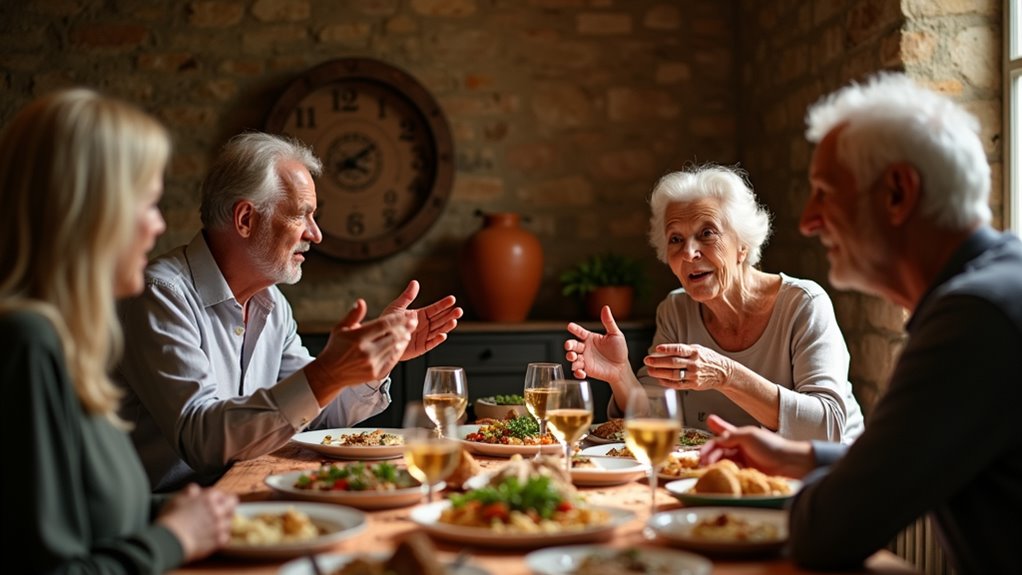
Start with proper greetings like “Buongiorno” in shops and “Piacere di conoscerti” for introductions. You’ll need “Prendo questo” when ordering food and “Hai le porzioni dei bambini?” for kids’ meals. Ask “Dov’è…?” for directions and “Quanto costa?” while shopping. Essential phrases include “Mi sono perso/a” when lost and “Può aiutarmi?” for help. Don’t forget “Grazie mille” for genuine appreciation. Master these basics and you’ll discover how to turn simple interactions into meaningful connections.
- Basic Greetings for Meeting New People
- Polite Expressions Every Family Should Know
- Ordering Food at Restaurants With Children
- Asking for Directions to Tourist Attractions
- Shopping for Souvenirs and Essentials
- Booking Hotels and Accommodations
- Using Public Transportation With Kids
- Emergency Phrases for Peace of Mind
- Interacting With Locals and Making Friends
- Navigating Airports and Train Stations
- Asking for Help When You’re Lost
- Expressing Gratitude and Saying Goodbye
- The Sum Up
Basic Greetings for Meeting New People

How do you make a genuine connection when meeting locals during your Italian family vacation? Start with the right greeting for each situation. Use “Ciao” with people your age or younger, but switch to “Buongiorno” (until 3-4 PM) or “Buonasera” (after afternoon) when meeting older adults or in professional settings.
When entering shops, always greet with “Buongiorno” to show proper manners. If you’re unsure about the formality level, “Salve” works as a social safety net for uncertain situations while maintaining respectfulness.
For introductions, say “Piacere di conoscerti” (informal) or “Piacere di conoscerla” (formal) to express “nice to meet you.” If someone says it first, respond with “Piacere mio” (pleasure is mine).
Remember the Lei form for elders and professionals—it’s essential for showing respect. Expect handshakes during first meetings, with cheek kisses reserved for warmer relationships that develop later.
Polite Expressions Every Family Should Know
Practice addressing family members properly using Lei for formal situations and Tu within family settings, ensuring you’re always respectful. During family gatherings, especially those involving extended family members like cousins, aunts, and uncles, knowing the appropriate level of formality helps you navigate social customs with confidence.
Ordering Food at Restaurants With Children

When you’re seated at an Italian restaurant with your children, mastering a few key ordering phrases will transform what could be a stressful experience into an enjoyable family meal. Start with “Prendo questo” (I’ll have this) while pointing at menu items—it’s simple and effective for kids to learn.
Ask “Hai le porzioni dei bambini?” (Do you have children’s portions?) to ensure appropriate serving sizes.
For dietary needs, use “Sono allergico/a a…” (I’m allergic to…) to communicate restrictions clearly.
When you need extras, try “Possiamo avere del pane in più, per favore?” (May we’ve more bread, please?). Remember that contorni are separate from main dishes, so you’ll need to order sides like vegetables or potatoes individually if your children want them alongside their protein.
If you’re unsure what to order, “Cosa consiglia?” (What do you suggest?) helps you discover child-friendly options the staff recommends.
Asking for Directions to Tourist Attractions
After mastering restaurant conversations, you’ll find that getting around Italy with your family requires equally important communication skills. Start any direction request with “Scusi” (excuse me) to politely approach locals.
Use “Dov’è…?” (Where is…?) for basic location questions, or try “Come si va a…?” (How do I go to…?) when heading to specific attractions like the Colosseum.
Essential destinations include “la stazione” (train station), “il museo” (museum), and “il centro” (downtown). Always ask “È lontano?” (Is it far?) to determine if walking’s feasible with kids.
Listen for directional responses like “sempre dritto” (straight ahead), “a sinistra” (left), or “a destra” (right). Italians often give directions with landmarks, so expect references to churches, squares, or notable buildings as reference points.
When verbal directions aren’t clear, simply ask “Può mostrarmi dov’è?” (Can you show me where it is?).
Shopping for Souvenirs and Essentials
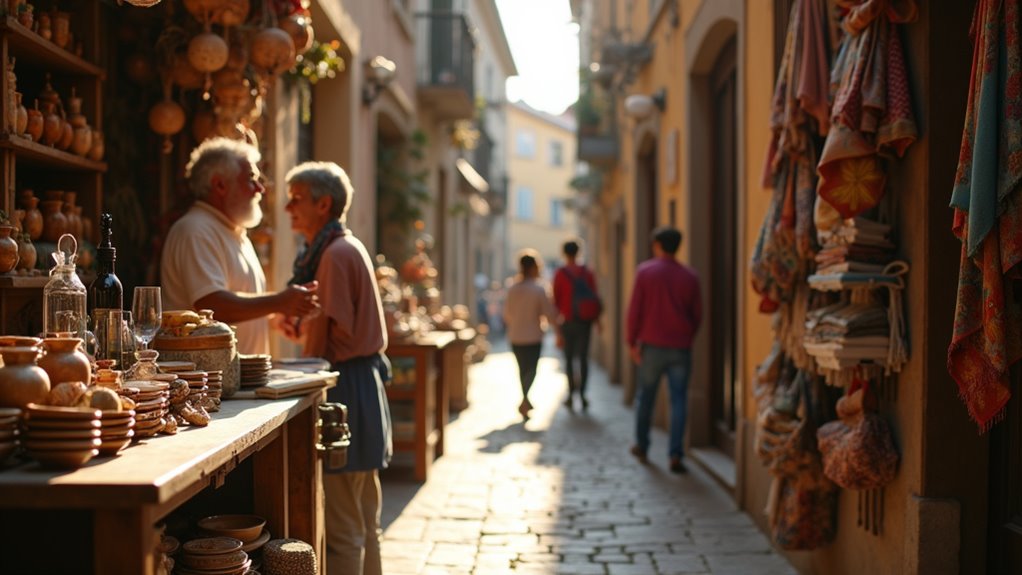
While exploring Italy’s charming shops and bustling markets with your family, you’ll discover that a few key phrases transform potentially stressful shopping encounters into delightful cultural exchanges.
Start with “Sto cercando…” (I’m looking for…) to communicate specific needs, or “Posso dare un’occhiata?” (Can I have a look?) when browsing.
When pricing becomes a concern, “Quanto costa?” (How much does it cost?) gets straight answers, while “È troppo caro” (It’s too expensive) opens negotiation opportunities. Remember that Italians use commas for cents in price formatting, so €2,50 means two euros and fifty cents.
Express interest with “Mi piace” (I like it) or politely defer with “Grazie, ci penso” (Thanks, I’ll think about it).
For payments, specify “La carta di credito” (credit card) or “I contanti” (cash), and don’t forget to request “Lo scontrino” (receipt) for your purchases.
Booking Hotels and Accommodations
Beyond acquiring treasures and necessities, you’ll need comfortable lodging that serves as your Italian home base. Start with “Ho una prenotazione” (I have a reservation) when checking in, or ask “Avete una camera disponibile?” if you’re seeking last-minute accommodation.
Specify your needs clearly: “camera singola” for solo travelers, “camera matrimoniale” for couples, or “camera tripla” for families. Always inquire “Quanto costa per notte?” to understand pricing before committing.
Don’t hesitate to request “Posso vedere la stanza?” to inspect your room first. Essential questions include “C’è il Wi-Fi?” and “La password del Wi-Fi, per favore” for staying connected. Many accommodations offer colazione inclusa as part of the booking, which adds excellent value to your stay.
Remember check-in typically starts at 2:00 PM, while checkout’s usually by 11:00 AM.
Using Public Transportation With Kids
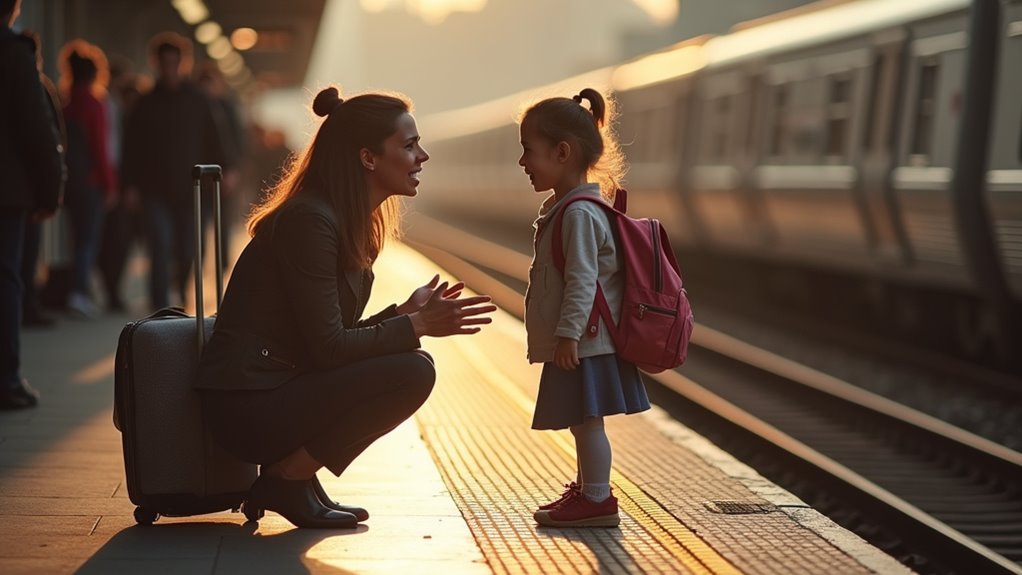
How do you navigate Italy’s extensive public transportation network while keeping your children happy and comfortable? Start by mastering key phrases like “Dov’è l’ascensore?” (Where’s the elevator?) when managing strollers and luggage at multi-level stations. You’ll save money with Italy’s family-friendly policies—children under 4 travel free on Trenitalia, while “Bimbi Gratis” and Italo’s “Famiglia” offers provide additional discounts.
Book tickets through apps to avoid station queues, and always choose reserved seating over regional trains when traveling with kids. Ask “Quanto costa un biglietto famiglia?” (How much is a family ticket?) for local buses. Remember that Florence offers free bus travel for children under 1 meter tall, and daily family passes cost just €6 for unlimited city travel. Keep in mind that bus rules vary by region, so don’t hesitate to ask the driver directly if you’re uncertain about children’s fare policies.
Emergency Phrases for Peace of Mind
What happens when your peaceful Italian family vacation takes an unexpected turn? Don’t panic—knowing key emergency phrases will give you confidence to handle any situation.
Start with “Aiuto!” (Help!) or “Ho bisogno di aiuto” (I need help) to get immediate attention.
For medical emergencies, memorize “Chiamate un’ambulanza!” (Call an ambulance!) and “Ho bisogno di un medico” (I need a doctor).
If you’re feeling unwell, say “Non mi sento bene.”
Save these essential numbers: 112 for general emergencies, 118 for medical help, and 113 for police.
If something’s stolen, use “Mi hanno rubato…” (They stole my…).
Practice “È urgente” (It’s urgent) and “Dove siamo?” (Where are we?) beforehand.
When calling emergency services, speak slowly and clearly, stating the emergency first to ensure immediate crisis response.
Having these phrases ready transforms scary moments into manageable ones.
Interacting With Locals and Making Friends

While emergency phrases provide security during unexpected situations, connecting with locals transforms your family vacation from a simple tourist experience into meaningful cultural exchange.
Start conversations with “Ciao!” for casual encounters or “Salve, come va?” to ask how someone’s doing. When meeting new people, try “Come ti chi chiami?” to learn names or “Sei di qui?” to discover if they’re locals.
Show politeness with “Per favore” and “grazie,” while “Permesso!” helps you navigate crowded spaces respectfully. When introducing yourself, simply say “Sono” followed by your name to start friendly conversations naturally.
For deeper connections, ask “Che cosa fai nella vita?” about their work or suggest “Andiamo a bere qualcosa!” to grab drinks together.
Remember cultural courtesies: use “Buongiorno” in shops during morning hours and “Buonasera” later in the day.
Navigating Airports and Train Stations
Train stations require different vocabulary. Ask “Dov’è la stazione?” to locate facilities. Then, ask “A che ora parte il treno?” for departure times. Request tickets with “Un biglietto, per favore” and clarify platform details: “Da quale binario parte?” Don’t forget validation—look for “convalida” machines.
Once aboard, use “Questo posto è libero?” to check if seats are available before settling your family in.
These essential phrases will keep your family moving confidently through Italy’s bustling transportation networks.
Asking for Help When You’re Lost

Getting lost during a family vacation happens to everyone, but knowing how to ask for help in Italian transforms a stressful moment into a manageable situation.
Start with “Mi sono perso/a” (I’m lost), using “perso” if you’re male or “persa” if you’re female.
Begin conversations politely with “Mi scusi” (excuse me) before asking “Può aiutarmi?” (can you help me?). Your effort to speak Italian shows interest in the local culture and will be appreciated by locals.
For specific destinations, use “Dov’è…?” (where is…?) followed by your target location like “Dov’è la stazione?” (where’s the station?) or “Dov’è il centro?” (where’s the center?).
If you’re struggling with comprehension, try “Mi dispiace, non capisco” (I’m sorry, I don’t understand) or “Non parlo italiano” (I don’t speak Italian).
Always remember “grazie” (thank you) when receiving help.
Expressing Gratitude and Saying Goodbye
After you’ve received help or enjoyed wonderful hospitality during your Italian family holiday, expressing genuine gratitude creates lasting connections and shows respect for local customs. Start with “grazie” for basic thanks, but elevate your appreciation with “grazie mille” or “molte grazie” when someone goes above and beyond.
For heartfelt moments, use “grazie di cuore” to express thanks from your heart.
When thanking hosts formally, “la ringrazio molto” shows proper respect. Don’t forget “grazie per l’invito!” when appreciating dinner invitations.
Compliment the meal—food is central to Italian family culture, and recognizing culinary efforts deepens your gratitude. Remember that love is measured in the dishes prepared for you, as Italians believe cooking reflects genuine affection and care.
For farewells, remember that Italians value companionship. Your sincere appreciation, combined with warm goodbyes, honors their tradition of treating guests like family.
The Sum Up
You’ll find these phrases become second nature once you start using them with your family in Italy. Don’t worry if your pronunciation isn’t perfect – locals appreciate the effort and will often help you improve. Keep this list handy on your phone or print it out for easy reference. Most importantly, encourage your kids to try speaking Italian too. They’ll pick it up quickly and create wonderful memories connecting with the culture and people around them.