

You’ll keep your family safe by securing proper car seats in forward-facing positions with lap-and-shoulder belts, installing smoke and carbon monoxide detectors throughout your RV, and checking tire pressure monthly with heavy-duty gauges. Master safe towing by staying within weight limits, maintain your propane systems with annual inspections, and always complete pre-departure checklists covering everything from fluid levels to securing interior objects. Plan routes around weather conditions and keep emergency equipment easily accessible for unexpected situations ahead.
- Ensure Proper Seat Belt and Car Seat Safety for Children
- Install Comprehensive Fire Prevention and Detection Systems
- Perform Daily Tire Maintenance and Inspection
- Master Safe Towing Practices and Weight Management
- Complete Your Pre-Departure Checklist Every Time
- Verify Vehicle Clearance for All Routes
- Adopt Defensive Driving Practices for RV Operation
- Maintain Safe Speeds and Avoid Fatigue
- Secure All Interior Objects Before Travel
- Inspect Propane Systems and Fluid Connections
- Plan Your Route Around Weather and Road Conditions
- Keep Emergency Equipment Accessible Throughout Your RV
- The Sum Up
Ensure Proper Seat Belt and Car Seat Safety for Children

When you’re planning that dream family RV adventure, ensuring your children’s safety during travel isn’t just important—it’s legally required in most states. Your car seats must be installed in forward-facing seats with proper lap-and-shoulder belts attached directly to the chassis frame.
RV couches and side-facing bench seats won’t cut it, regardless of available seat belts.
Class C motorhomes with crew cabs offer the safest option, providing pickup truck-style back seats. If you’re stuck without rear seating, the front passenger seat works only if you can deactivate the airbag.
Remember that federal seat belt standards do not apply to vehicles over 10,000 pounds, which means many larger RVs fall outside these safety requirements.
Install Comprehensive Fire Prevention and Detection Systems
Beyond keeping everyone safely secured in their seats, you’ll need to protect your family from one of RV travel’s most serious threats: fire. Since most RV fires start from electrical malfunctions, install smoke detectors in living areas and near bedrooms, plus carbon monoxide alarms at least five feet from the ground near sleeping areas.
Place two multi-purpose fire extinguishers strategically—one near your main exit and another in the bedroom area. For thorough protection, consider automatic fire suppression systems like THIA devices that use FM-200 gas. These activate automatically when exposed to high temperatures and suppress fires in milliseconds without leaving residue.
Test all detection devices monthly and inspect your electrical systems regularly. Pay special attention to aging components like absorption-style refrigerators, which can develop cracked heat exchangers that release flammable hydrogen gas. This layered approach ensures you’re prepared for emergencies.
Perform Daily Tire Maintenance and Inspection
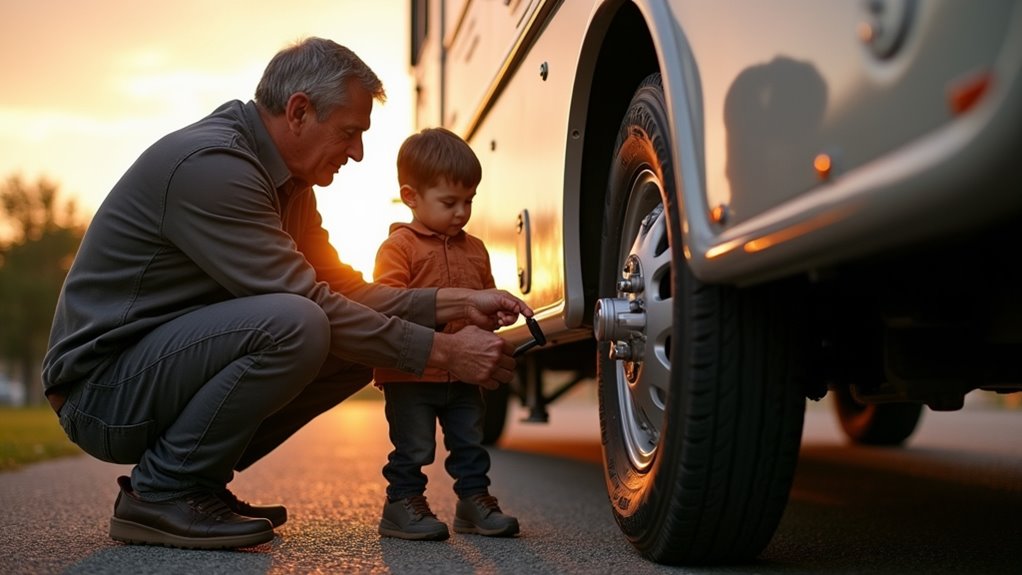
Since RV tires carry substantially more weight than standard car tires, they’re your first line of defense against catastrophic blowouts that can destroy your vehicle and endanger your family.
Check tire pressure monthly using a heavy-duty gauge—don’t trust the sidewall numbers, find specs in your doorjamb or manual.
Measure tread depth with a gauge or penny test; replace tires when Lincoln’s head shows. You can also use the quarter test to check if your tire tread has sufficient depth for safe driving.
Inspect sidewalls for cuts, bulges, or cracking that indicates dangerous dry rot.
Check manufacturing dates—tires over five years need professional inspection regardless of appearance.
Don’t forget lug nuts, valve stems, and wheel bearings.
Remove debris between dual tires immediately.
These simple checks prevent roadside disasters and keep your family adventures safe.
Master Safe Towing Practices and Weight Management
Your RV’s tires aren’t the only component that demands respect—your towing setup requires equally meticulous attention to keep your family safe on the road.
Start by never exceeding your vehicle’s towing capacity, remembering that passengers and cargo reduce your available limit. Double-check your hitch connection and safety chains before departure—runaway trailers cause over 50,000 accidents yearly.
Load heavier items toward the front and center of your trailer, avoiding rear overloading that’ll lift your vehicle’s front end and compromise steering. Invest in sway bars for crosswind stability, and always reduce your speed when towing.
Allow extra braking distance and make wider turns at corners. With 30,000 trailer accidents occurring annually, these precautions aren’t optional—they’re essential for protecting your loved ones. Many RV owners discover too late that their auto insurance covers liability but leaves them unprotected for trailer damages when accidents occur.
Complete Your Pre-Departure Checklist Every Time
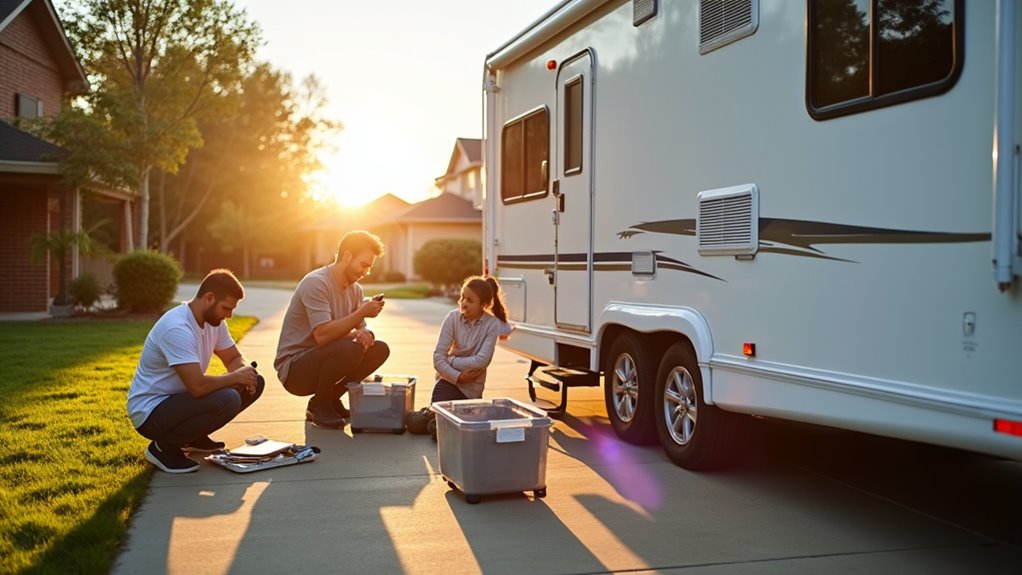
While towing safely gets you down the road, a thorough pre-departure checklist prevents those roadside emergencies that can turn your dream vacation into a nightmare. You’ll want to systematically inspect your vehicle systems—check tire pressure, test trailer lights, and verify fluid levels.
Don’t skip exterior components like your hitch, awning, and slide-out seals. Inside, secure all slide-outs and turn off your battery disconnect if equipped.
Pack essential tools including screwdrivers, tire gauge, and portable compressor. Your emergency kit should contain first aid supplies, flashlights, and roadside flares. Keep a reserve of oil on hand since RVs typically require at least 2 quarts extra for longer trips.
Load water hoses, electrical adapters, and surge protectors. Finally, secure important documents in waterproof bags, lock all exterior compartments, and do a final headcount of family and pets before hitting the road.
Verify Vehicle Clearance for All Routes
Even with a perfect pre-departure checklist, you’ll face a costly disaster if your RV doesn’t fit under bridges and overpasses along your route. Start by measuring your RV’s total height when fully loaded—including AC units and roof vents—since most rigs range from 10 to 13.5 feet tall.
Don’t trust standard GPS systems; they’ll lead you straight into trouble. Use RV-specific navigation apps that route around clearances under 13 feet 6 inches. Input your exact height measurements for customized routing. Installing an RV-specific GPS, like Rand McNally, helps navigate varying height, length, and width restrictions across different states and regions.
Always subtract six inches from posted clearance signs as your safety buffer. Remember that states like New York and New Jersey have parkways completely off-limits to RVs. Cross-reference multiple route sources and pre-plan detours before hitting the road.
Adopt Defensive Driving Practices for RV Operation
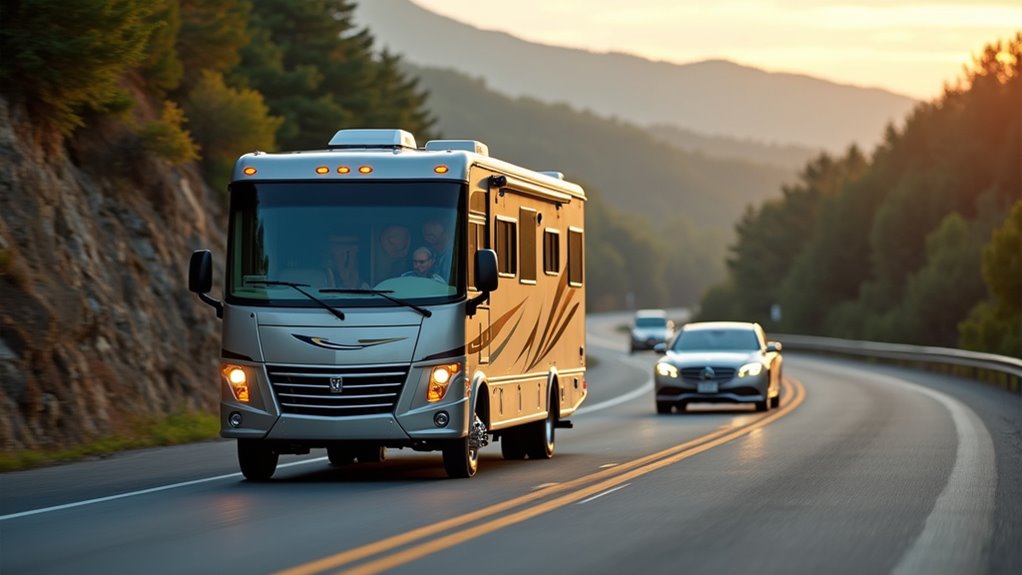
Since RVs handle fundamentally differently than passenger cars, you’ll need to adjust your driving habits before problems develop on the road. Maintain 4-6 seconds following distance instead of the typical 3 seconds, increasing to 6-8 seconds in poor weather. Your RV’s weight and trailer momentum require markedly longer stopping distances.
Night driving demands extra caution—40% of crashes occur after dark despite only 25% of driving happening then. Use headlights during any reduced visibility and reduce speed proactively approaching hills or curves. Fatigue is four times more likely to impair drivers than drugs or alcohol, particularly during dawn, dusk, and nighttime hours.
If trailer sway occurs, resist sudden braking. Instead, reduce speed gradually while maintaining steady steering, allowing the trailer to settle naturally.
Check mirrors continuously during lane changes, signal early, and always verify blind spots before maneuvering.
Maintain Safe Speeds and Avoid Fatigue
Because RVs require notably more time and distance to stop safely, maintaining appropriate speeds becomes essential for preventing accidents on the road. You’ll want to keep your speed between 55-60 mph on highways for better control and fuel efficiency.
Remember, your fully loaded RV needs 300 feet to stop at 65 mph—that’s an entire football field.
Don’t push yourself beyond safe driving limits. Follow the 3-3-3 rule: drive no more than 300 miles daily, arrive by 3 p.m., and stay three days.
Take 30-minute breaks every 3-4 hours and limit total driving to 10 hours maximum per day. Keep in mind that many states have specific speed limits for trucks and RVs that may be lower than regular car speeds, especially on urban interstates where limits often drop to 55 mph.
Never drive when you’re tired or drowsy—fatigue significantly increases your accident risk and reduces reaction time.
Secure All Interior Objects Before Travel
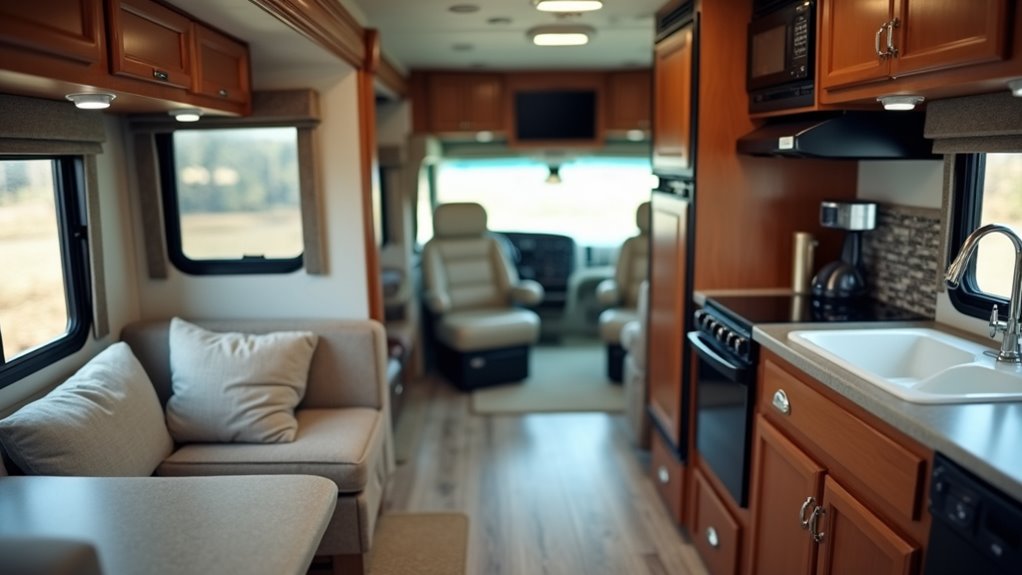
When your RV hits the road, every unsecured item becomes a potential projectile that can cause serious injury or damage during sudden stops or turns. You’ll want to latch all cabinets securely and lock drawers to prevent them from flying open.
Pack away everything from countertops and tables – place small appliances in sinks or other secured spots.
Position your TV on the floor with blankets for protection, and turn your refrigerator to transit mode.
Place fans and lightweight tables on beds for stability, using the mattress as a non-sliding base. Make sure your electrical cords and surge protectors are properly secured to prevent them from becoming loose during travel.
Don’t forget to close all windows, lock shower doors, and shut roof vents completely.
Double-check cabinet latches after your initial securing – it’s worth the extra minute.
Inspect Propane Systems and Fluid Connections
While your RV’s propane system powers essential appliances like your refrigerator, stove, and furnace, it also presents serious safety risks if not properly maintained. Start by inspecting your cylinders for rust, corrosion, or damage, ensuring they’re secured upright in ventilated areas.
Check that portable DOT cylinders get recertified every 10 years, then every 5 years afterward.
Replace two-stage regulators every 10-15 years since rubber diaphragms wear out, and examine flexible pigtails for cracks or stiffness.
Test all fittings with soapy water to spot leaks, and inspect supply lines for frays or damage from rubbing against sharp edges. Have a certified technician conduct annual inspections to check for leaks, rust, dents, and other potential hazards.
Schedule annual manometer pressure tests by certified technicians, and replace propane detectors every 5-7 years for maximum safety.
Plan Your Route Around Weather and Road Conditions

Since weather conditions can turn a relaxing family RV trip into a dangerous nightmare, you’ll want to leverage specialized apps that account for your vehicle’s unique vulnerabilities. Weather on the Way checks wind risks for rollover—a critical concern since high winds pose significant rollover risk for RVs and trailers.
SureRoute considers seven weather types specifically for high-profile RVs, while Drive Weather overlays radar showing light to heavy severity along your route. SureRoute uses vehicle size and weight restrictions to suggest safer, more enjoyable routes for families.
Don’t just check current conditions—plan timing around forecasts. Use Drive Weather’s slider to view conditions over several days and adjust your departure accordingly. Weather on the Way’s interactive slider helps you find the best time to leave.
Consider alternate routes when necessary, as SureRoute suggests routes balancing time with weather impacts for safer family travel.
Keep Emergency Equipment Accessible Throughout Your RV
Though your family RV provides comfort and mobility, emergencies can strike anywhere from remote mountain passes to busy interstate highways. You’ll want your emergency equipment strategically placed throughout your RV for quick access during critical moments.
Keep a first aid kit with bandages, antiseptic wipes, and medications in your main living area.
Store roadside safety gear like high-visibility vests, reflectors, and jumper cables in exterior compartments near your driver’s seat.
Place flashlights, extra batteries, and emergency radios in multiple locations so you’re never fumbling in the dark.
Don’t bury essential tools under camping gear. Position fire extinguishers, multi-tools, and emergency blankets where family members can reach them quickly. Install smoke detectors and carbon monoxide detectors throughout your RV and test them regularly to provide early warnings of potential hazards.
Smart placement means the difference between handling emergencies confidently and scrambling when seconds count.
The Sum Up
You’ve got the knowledge to keep your family safe on the road – now it’s time to put these tips into action. Don’t let the checklist overwhelm you; start with the basics and build your routine trip by trip. Remember, every experienced RVer was once a beginner who learned through practice. Trust your instincts, stay vigilant, and don’t hesitate to pull over if something doesn’t feel right. Your family’s safety is worth every precaution you take.