There’s a particular challenge that comes with visiting Rome for the first time: the city is so massive, so layered with history, and so easy to get lost in that many first-time visitors leave feeling overwhelmed rather than enchanted. We appreciate this golf cart tour because it solves that problem elegantly. You cover an impressive range of Rome’s most significant monuments in just 2.5 hours, and you do it from a comfortable seat rather than trudging through crowded streets on foot. The real standout here is the caliber of the guides—nearly every review mentions their guides by name and describes them as knowledgeable, funny, and genuinely passionate about the city.
One consideration worth noting: with only 5-10 minutes at most stops, you’re getting a curated overview rather than an in-depth experience at any single location. This tour works best as an orientation to the city, not as a substitute for deeper exploration of individual monuments. That said, if you’re arriving in Rome with limited time, or if you want to figure out which sites deserve a return visit, this is exactly what you need.
- What Makes This Tour Worth Your Time and Money
- The Route: A Strategic Tour Through Rome’s Heart
- The Pantheon and Piazza Colonna
- Trevi Fountain and the Spanish Steps
- Piazza del Popolo and the Mausoleum of Augustus
- Piazza Navona and the Historic Center
- Area Sacra di Largo Argentina and the Republican Temples
- The Capitoline Hill and Piazza Venezia
- The Monti Neighborhood
- The Practical Advantages of the Golf Cart Format
- The Guides: The Real Heart of This Tour
- What’s Included and What Isn’t
- Timing and Logistics
- When to Book and Weather Considerations
- Who This Tour Is Best For
- The Value Proposition
- FAQ: Practical Questions About the Golf Cart Tour
- The Best Of Rome!
- More Guided Tours in Rome
- More Tours in Rome
- More Tour Reviews in Rome
What Makes This Tour Worth Your Time and Money

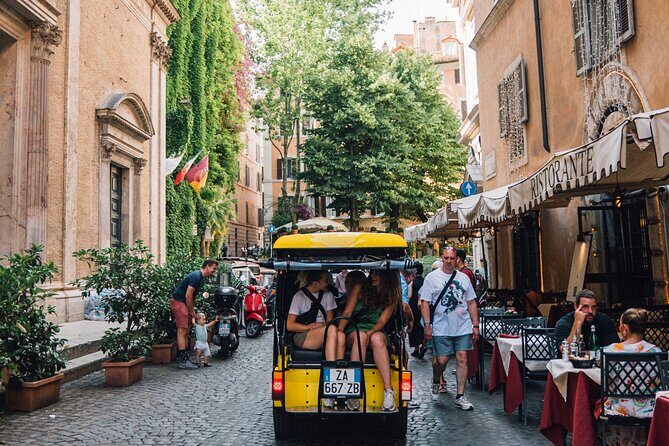
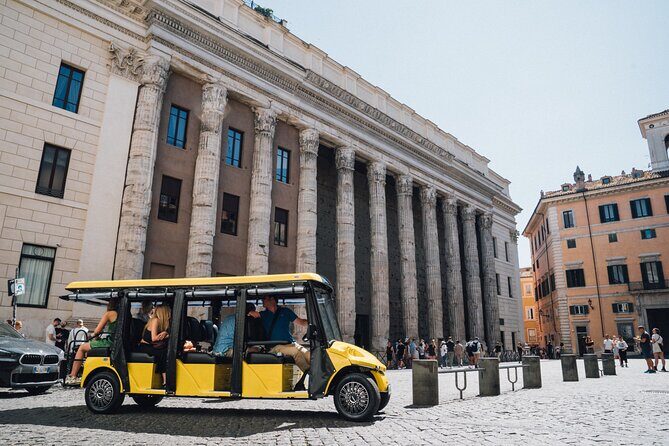
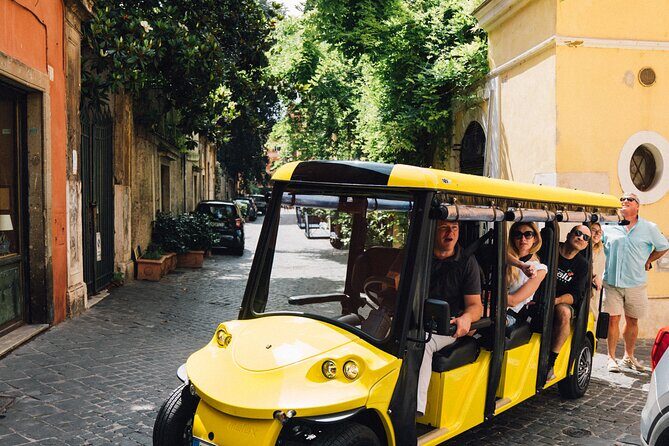
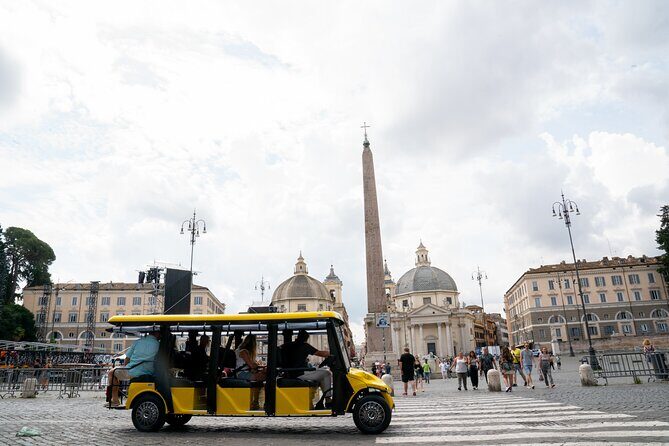
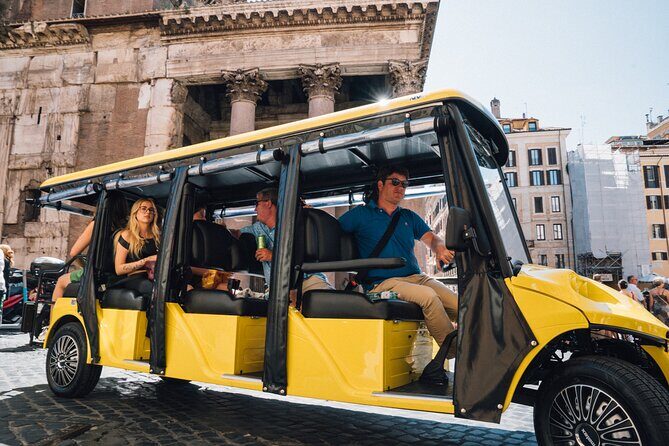
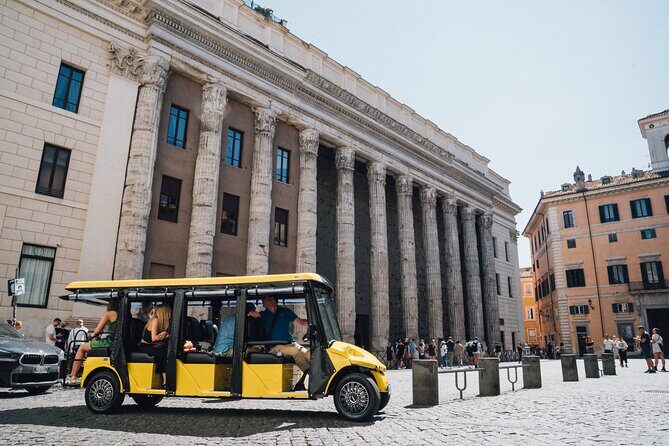
At $104 per person, this tour offers genuine value when you consider what’s included. You’re getting 2.5 hours of guided transportation, the expertise of a knowledgeable local, a complimentary gelato, bottled water, and wireless headsets so you can actually hear your guide over Rome’s chaotic traffic. The small-group format—limited to 14 people maximum, split between two golf carts—means you’re not herded through the city with 40 other travelers.
What we found particularly telling is the review consistency. With 907 reviews and a 4.9-star average, the feedback clusters around the same themes: guides who know their material cold, a comfortable and fun way to see the city, and an experience that feels personal rather than rushed. One traveler who was a solo participant mentioned having “a chance to see a lot of the city in a short time,” while another in their 70s called it “very relaxing—no stress—no rush.” That’s not accidental tour design; that’s a company that’s thought carefully about pacing and comfort.

👉 See our pick of the Discover 2 Great Tours In Rome
The Route: A Strategic Tour Through Rome’s Heart
The tour begins at the company’s central office on Via Monterone, then unfolds across 2.5 hours hitting nine major stops plus several drive-by moments where you pass significant sites from the cart.
You can also read our reviews of more guided tours in Rome


The Pantheon and Piazza Colonna
Your first substantive stop is the Pantheon, one of the most astonishing buildings anywhere on earth. Built nearly 2,000 years ago and still standing largely intact, it’s a building that photographs don’t quite prepare you for. The scale of the interior, the oculus opening to the sky, the way light moves across the space—these are things you need to experience in person. Your guide will give you the historical framework in about five minutes, which is enough to understand why this building matters without getting bogged down in architectural minutiae.
Nearby, you’ll pass the Column of Marcus Aurelius in Piazza Colonna, one of only two preserved triumphal columns in the city and dating back 1,800 years. From a golf cart, you get a perspective that walking travelers rarely experience—you can see the column in relation to the surrounding modern city, which actually makes the contrast more striking.
Trevi Fountain and the Spanish Steps
Trevi Fountain is next, and yes, it’s as crowded as you’ve heard. The advantage of arriving by golf cart is that you can hop out, toss your coin (the tradition is you’ll return to Rome), snap your photo, and leave without feeling pressured to stay longer than you want. One reviewer mentioned the guide took them “to a delicious gelato place” near the fountain, which suggests the guides have local knowledge about where to avoid the tourist traps.
The Spanish Steps come next—138 steps that link the Spanish embassy to the church of Trinità dei Monti. The steps are perpetually mobbed with travelers, but from the street level you can appreciate the architecture and the energy of the space. Your guide will explain the history in a few minutes, and then you’re back on the cart.
Piazza del Popolo and the Mausoleum of Augustus
Piazza del Popolo sits at what was historically the northern gateway to Rome, where the Via Flaminia—the crucial road north to Rimini—began. You’ll pass the Mausoleum of Augustus, a massive tomb built by the emperor himself in 28 BC and now largely enclosed by a modern building. These aren’t sites you’d necessarily visit on your own, but seeing them in context helps you understand Rome’s geography and historical layering.
Piazza Navona and the Historic Center
Piazza Navona is built on the site of Domitian’s stadium from the 1st century AD, and the plaza still follows the oval shape of the original athletic venue. The fountains, the baroque architecture, the street performers—it’s one of Rome’s most visually compelling spaces. Your guide will explain why the shape is unusual and what it tells you about Roman urban planning.
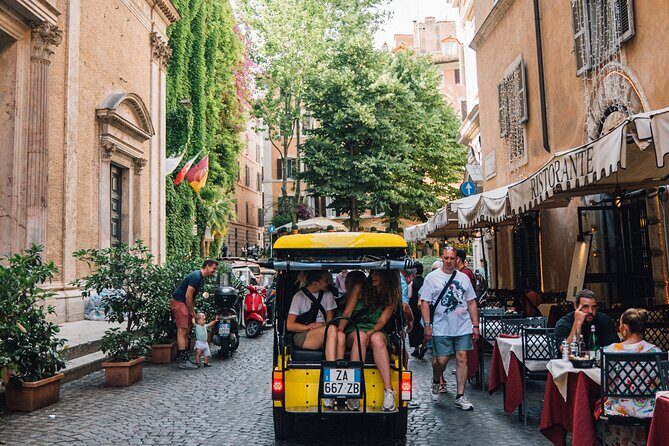
Between stops, you’ll drive through Rome’s historic cobblestone streets, including Via Giulia, an important street architecturally and historically. The golf cart winds through narrow passages that a full-sized bus could never navigate, and that’s when you start to feel like you’re actually seeing Rome rather than just seeing the monuments.
You can also read our reviews of more city tours in Rome



Area Sacra di Largo Argentina and the Republican Temples
Largo di Torre Argentina is where Julius Caesar was assassinated, and it’s also where four Republican-era temples were unexpectedly unearthed during 1920s construction. The site is partially sunken below modern street level, which gives it an eerie, archaeological quality. It’s also where Rome’s famous cat sanctuary is located, so there’s a decent chance you’ll see some of the hundreds of cats living among the ancient stones.
The Capitoline Hill and Piazza Venezia
You’ll stop briefly at the Campidoglio grand staircase on Capitoline Hill, the first square in modern Rome designed according to Michelangelo’s vision. This is where the ancient Roman village was located and where temples to Roman gods once stood. It’s a powerful reminder that Rome’s history isn’t just about the Colosseum or the Forum—it’s layered throughout the entire city.
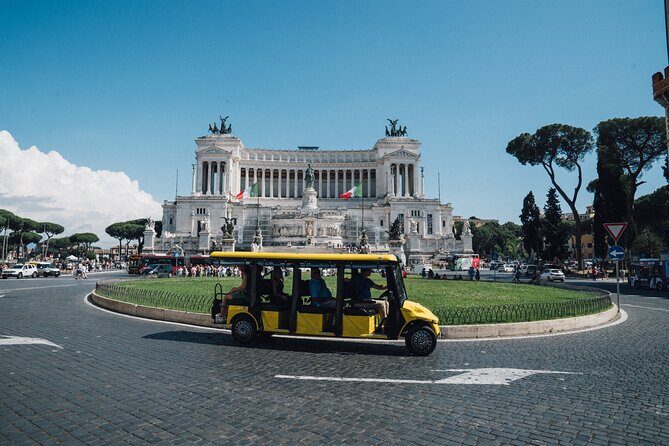
Piazza Venezia features the massive Monument to Victor Emmanuel II, also called the Altar of the Fatherland. It’s controversial among Romans (many think it’s too big and too white), but it’s undeniably impressive and tells you something about Italian nationalism and 19th-century urban ambitions.
The Monti Neighborhood
Finally, you’ll drive through the Monti neighborhood, described as “Rome’s first ward” and known for its mix of vintage shops, artisan studios, and excellent food. It’s a neighborhood that feels authentically Roman rather than touristy, and seeing it from the cart gives you a sense of where locals actually spend their time.
The Practical Advantages of the Golf Cart Format
What becomes clear as you read through the reviews is that the golf cart isn’t just a gimmick—it’s genuinely practical for how you experience the city. One traveler noted that the golf carts could “easily snake through side streets,” allowing you to see parts of Rome that tour buses can’t access. Another mentioned that the guide offered “plenty of time to take photos,” which suggests the tour isn’t relentlessly rushed despite the ambitious itinerary.
The wireless headsets are worth mentioning specifically. Rome is loud—traffic, travelers, street performers—and trying to hear a guide on a crowded street is usually frustrating. With headsets, you hear your guide clearly regardless of the ambient noise. One reviewer who had a temporary headset malfunction mentioned it as a significant problem, which actually underscores how much better the experience is when the technology works.
The group size matters too. With a maximum of 14 people split between two carts, you’re not competing with dozens of others for your guide’s attention. Several reviewers specifically mentioned their guides by name and described personal interactions—guides taking them to specific gelato shops, guides offering blankets when it got chilly, guides adjusting the tour to match the group’s interests. That level of service doesn’t happen on a 40-person walking tour.
The Guides: The Real Heart of This Tour
Perhaps the most striking pattern in the reviews is how consistently travelers mention their guides by name and describe them enthusiastically. Francesco, Andrea, Franco, Marco, Claire, Amber, Leo, Val—these aren’t anonymous tour operators; they’re individuals who’ve clearly invested in their work. One reviewer described their guide Andrea as “an archeologist” whose “love for ‘rocks and stones’ as he called them was infectious.” Another mentioned a guide named Franco who provided “details of each place…plus fun facts we would never have known about.”
The guides aren’t just knowledgeable—they’re entertaining. Multiple reviews use words like “funny,” “entertaining,” and mention guides who kept groups “laughing the entire time.” One traveler said the guide “had us ‘chillin’ like a villain,'” which suggests a guide who connects with people rather than delivering a scripted monologue. Another described their guide as having “energetic delivery” and making “the three hours fly by.”
This consistency across dozens of reviews suggests that Biga Tours has either hired exceptionally well or trained their guides to a very high standard. Either way, it’s a meaningful differentiator from other tour operators.
What’s Included and What Isn’t
The tour includes the electric golf cart, your English-speaking guide and driver, wireless headsets, one gelato per person, and bottled water. That’s a solid package. The gelato stop seems to be genuinely appreciated—multiple reviews specifically mention enjoying the gelato and one traveler even recommended specific flavors (“almond, orange jam and butter crumble”).
What’s not included is admission to any attractions (though the tour is designed so you don’t need to pay to enter anywhere—you’re viewing exteriors and public spaces), hotel pickup and drop-off, additional food and drink beyond the gelato, or gratuities for your guide. The lack of pickup and drop-off is worth knowing if you’re staying far from the meeting point on Via Monterone. However, the meeting location is near public transportation, so it’s accessible.
Timing and Logistics
The tour runs approximately 2.5 hours, which is enough time to hit the major highlights without feeling completely exhausted. The company books an average of 50 days in advance, which suggests these tours are popular and you should plan ahead if you have specific dates in mind.
The meeting point is centrally located on Via Monterone, and the tour ends outside the Colosseum. That endpoint is worth noting—it means you can head straight into the Colosseum area if you want to explore that neighborhood further, or grab dinner in one of the surrounding areas.
One important note from the company: they emphasize arriving early and allowing plenty of time to reach the meeting point, since the tour won’t delay for late participants. Rome traffic can be unpredictable, and getting lost in the city is genuinely easy for visitors, so this isn’t an unreasonable request—it’s them being realistic about Rome logistics.
When to Book and Weather Considerations
The tour operates at various times throughout the day, which is helpful for fitting it into your schedule. Several reviews mention doing the tour “at night,” which apparently offers a different perspective on the monuments with evening lighting. One traveler said “seeing it at night was perfect,” and another mentioned it was “a wonderful way to see the city sites at night.”
Weather can be a factor. One reviewer mentioned “it was a little chilly but they offer blankets,” which is a nice detail suggesting the company has thought about comfort in less-than-ideal conditions. Another mentioned heavy rain at the end of their tour but didn’t let it diminish their overall enthusiasm. The golf carts presumably have some weather protection, though the reviews don’t specify the exact setup.
Who This Tour Is Best For
This tour works exceptionally well if you’re arriving in Rome with limited time and want to get oriented to the city’s layout and major sites. It’s ideal for first-time visitors who want to identify which monuments deserve deeper exploration on subsequent visits. One reviewer called it “perfect to do on the first day in Rome,” and that’s spot-on guidance.
It also suits travelers who prefer not to walk extensively or who have mobility considerations. The combination of seated transportation and brief walking segments makes it accessible for people in their 70s and 80s (multiple reviews mention older travelers having a wonderful experience).
The tour is less ideal if you want to spend significant time at any single location or if you’re hoping for an in-depth archaeological deep dive. This is a highlights tour, not a specialized experience.
The Value Proposition
At $104 per person for 2.5 hours, a guide, wireless headsets, gelato, and water, you’re looking at roughly $40 per hour of guided service plus the inclusions. For Rome, where tourist prices are generally high, this is reasonable value. Compare it to a private guide (typically $80-150+ per hour) and you’re getting a group-tour price with what reviewers consistently describe as private-tour-quality attention.
The free cancellation policy up to 24 hours before the tour is also consumer-friendly, giving you flexibility if your plans change.
Golf Cart Small-Group Guided Tour: Rome City Highlights
FAQ: Practical Questions About the Golf Cart Tour
Q: What if I’m not very physically fit? Can I still do this tour?
A: Yes. You’re seated in a golf cart for most of the tour, and the walking segments are minimal—usually just 5-10 minutes at each stop to view the monuments. Multiple reviews mention older travelers (including people in their 70s) having a wonderful experience, and one reviewer specifically called it “very relaxing—no stress—no rush.”
Q: Do I need to buy tickets to enter any of the sites on this tour?
A: No. The tour is designed to view monuments from outside or from public spaces. You’ll see the Pantheon, Trevi Fountain, Spanish Steps, Piazza Navona, and other major sites, but you won’t need to purchase admission for any of them. If you want to go inside the Pantheon or other attractions, that would be a separate visit on your own time.
Q: How many people will be on the tour?
A: Maximum 14 people, split between two golf carts (7 people per cart). The carts travel together, and everyone listens to the same guide through wireless headsets. The small group size is one of the tour’s main advantages—it allows for more personalized attention than larger group tours.
Q: What should I wear for the tour?
A: Comfortable clothing and walking shoes are recommended. While you’re mostly seated, you’ll be getting in and out of the cart and walking to view monuments. The reviews mention that blankets are available if it’s chilly, so weather shouldn’t be a barrier. If it rains, the tour still operates, though you may want to bring a light rain jacket.
Q: What if I arrive late to the meeting point?
A: The tour won’t delay for late arrivals. The company is clear about this, so plan to arrive early. The meeting point is near public transportation and centrally located, but Rome traffic can be unpredictable, so give yourself extra time to get there.
Q: Is the tour offered at different times of day?
A: Yes. The tour operates at various times throughout the day. Reviews mention tours happening both during the day and in the evening, with some travelers specifically enjoying the nighttime experience when the monuments are lit up.
Q: Are tips included in the price?
A: No. The $104 price doesn’t include gratuities for your guide. Given how consistently reviewers praise their guides and how personalized the service appears to be, tipping is common and appropriate.
This golf cart tour represents one of the smartest ways to spend your first few hours in Rome. You’ll see the major monuments, understand the city’s geography, and have a guide who can answer questions and point out details you’d miss on your own. The combination of comfortable transportation, guides, small group size, and reasonable price makes this tour exceptional value for first-time visitors or anyone with limited time in the city. The 907 reviews averaging 4.9 stars aren’t inflated—they reflect genuine traveler satisfaction across a wide range of ages and travel styles. If you’re looking for an efficient, enjoyable, and authentically Roman introduction to the Eternal City, book this tour.