This guided exploration of Ravenna’s mosaic tiles deserves serious consideration if you’re heading to this often-overlooked corner of Italy. We’ve analyzed hundreds of traveler reviews, and what emerges is a consistently praised experience that manages to balance historical depth with genuine accessibility. The tour combines something increasingly rare in modern travel: knowledgeable local guides who actually love sharing their city, bundled with skip-the-line entry to some of Ravenna’s most important monuments—all for less than $35 per person.
What really sets this tour apart isn’t just the mosaics themselves, though they’re genuinely stunning. It’s that you’re getting expert interpretation of 1,500-year-old art and architecture that would be largely impenetrable without proper context. One traveler captured this perfectly: “Without the helpful guide, we would’ve missed some of the key elements of the mosaics.” That’s the real value here—understanding why these images matter, not just seeing them.
The practical benefit of having entrance tickets included cannot be overstated. You’ll skip the frustration of figuring out individual admission procedures at multiple churches, and you get guaranteed entry during specific time slots. This alone saves time and reduces the logistical headaches that often plague independent museum-hopping in Italian cities.
One consideration worth noting: this is a walking tour through churches, which means you need to be reasonably comfortable with moderate physical activity and prepared for the specific etiquette these spaces require. Also, Ravenna’s weather can be unpredictable—one traveler mentioned the cold made an extended tour challenging—so dressing appropriately matters more than you might initially think.
This experience works best for travelers who actually care about understanding history and art, not just photographing it. If you’re the type who reads plaques, asks questions, and appreciates when a guide explains the meaning behind what you’re seeing, you’ll get genuine value here.
- Understanding the Itinerary: Four Stops Through Ravenna’s Artistic Timeline
- Stop 1: Mausoleo di Galla Placidia—Where Simplicity Conceals Treasure
- Stop 2: Basilica di San Vitale—The Showstopper with Imperial Attitude
- Stop 3: Battistero Neoniano—Subtle Sophistication and Baptismal Theology
- Stop 4: Additional Stops (Likely Basilica di Sant’Apollinare Nuovo or Similar)
- What the Numbers Tell Us: Tour Quality and Reliability
- Practical Considerations for Planning Your Visit
- Group Size and Audio Equipment
- Duration and Pacing
- Meeting Point and Logistics
- What Travelers Really Value About This Experience
- The Reality Check: When This Tour Might Not Be Ideal
- Frequently Asked Questions
- The Bottom Line
- More Guided Tours in Ravenna
- More Tours in Ravenna
- More Tour Reviews in Ravenna
Understanding the Itinerary: Four Stops Through Ravenna’s Artistic Timeline
Stop 1: Mausoleo di Galla Placidia—Where Simplicity Conceals Treasure
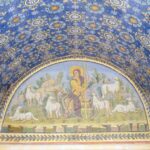
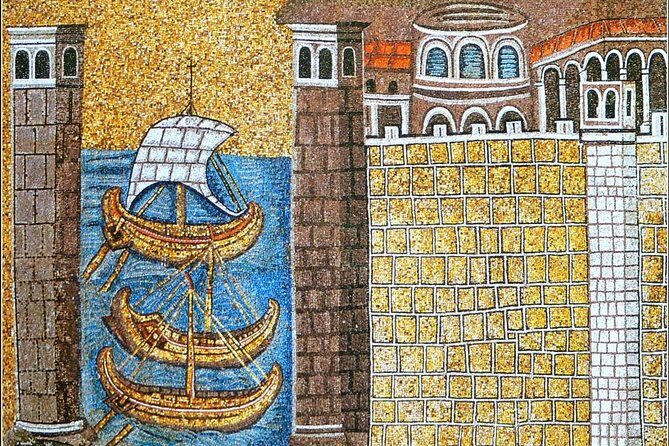
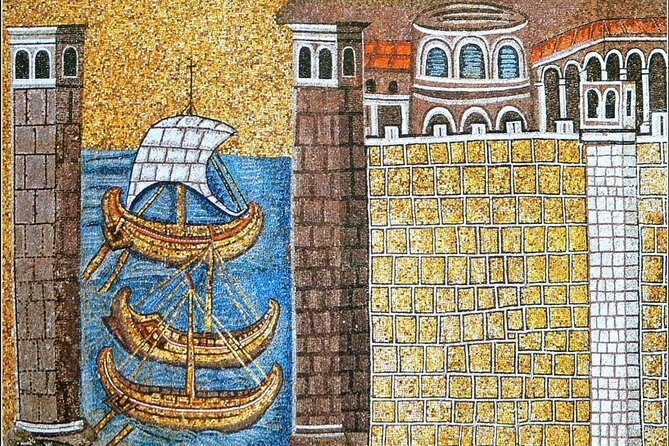
Your tour begins at the Mausoleo di Galla Placidia, and this first stop establishes the pattern you’ll follow throughout the morning: exterior restraint masking interior splendor. Built around 450 CE at the behest of Galla Placidia, the woman who essentially ruled the Western Roman Empire, this small Latin cross mausoleum looks almost austere from the outside. Brick and stone, nothing fancy. But step inside, and you enter a completely different world.
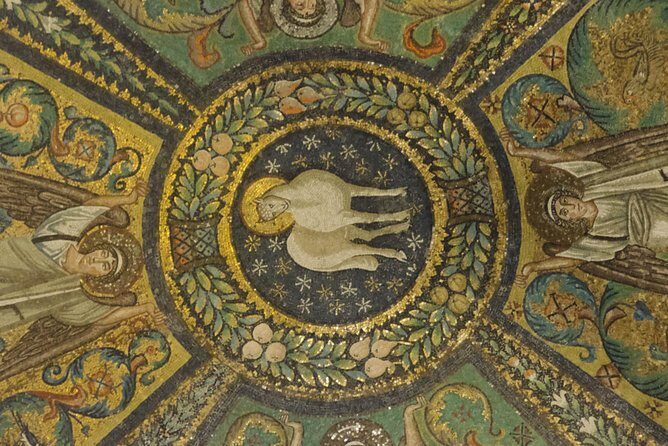
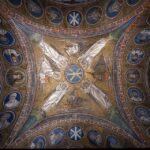
The dome above you explodes with stars—countless golden tesserae (those tiny mosaic tiles) against a deep blue background. This isn’t decorative frivolity; it’s theological statement. Those stars meant something specific to 5th-century Christians, and your guide will help you understand what. One reviewer noted that Dante Alighieri himself drew inspiration from these stars for passages in the Divine Comedy, which tells you something about their emotional and artistic power across centuries.
You’ll spend about 10 minutes here, and the admission is included. This stop sets expectations perfectly: these aren’t grand basilicas with soaring ceilings, but intimate spaces where the artistry demands close attention.
You can also read our reviews of more guided tours in Ravenna
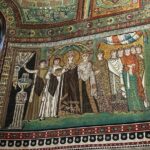
Stop 2: Basilica di San Vitale—The Showstopper with Imperial Attitude
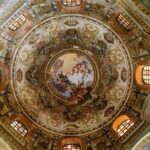
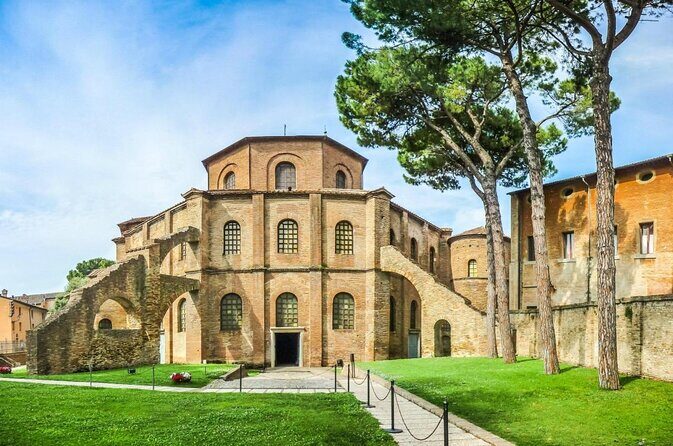
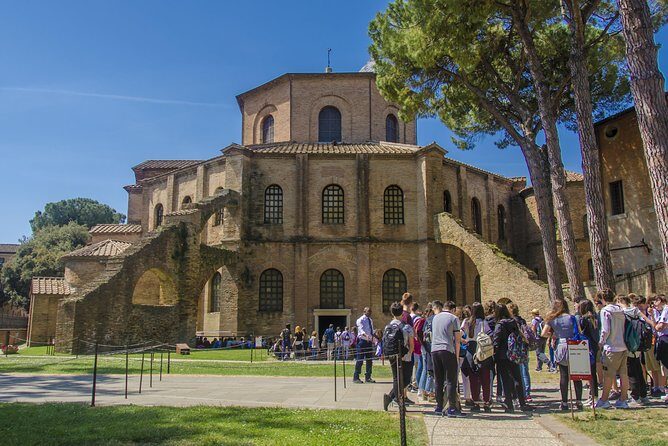
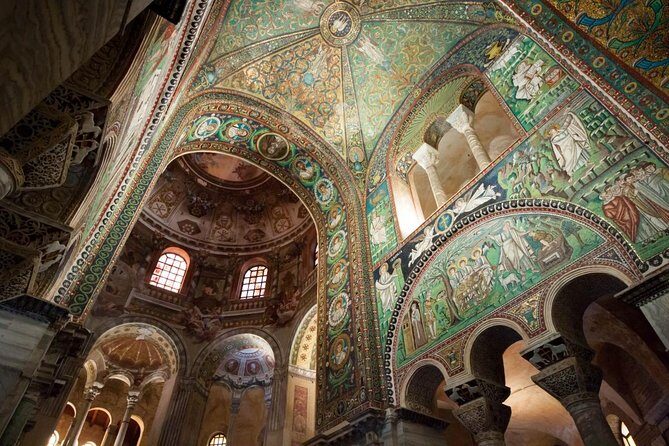
San Vitale represents the architectural and artistic high point of your tour, and most travelers agree it’s worth the journey to Ravenna by itself. Built in the sixth century and showing clear Eastern Byzantine influence, this octagonal basilica hits you differently the moment you enter. The space feels larger than it should, the dome seems impossibly high, and then your eyes catch the apse mosaics.
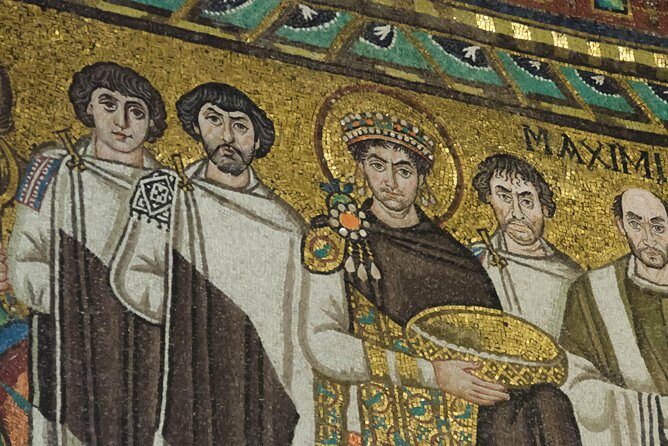
Here’s where things get genuinely impressive: you’re looking at detailed mosaics depicting the Byzantine Emperor Justinian and Empress Theodora with their full court processions. These aren’t abstract religious symbols like the stars in Galla Placidia. These are portraits of actual political power, rendered in millions of tiny colored tiles. The level of detail is remarkable—you can see individual faces, the texture of fabrics, the hierarchy expressed through positioning and size.
A traveler who visited with guide Chiara reported: “With Chiara’s almost endless knowledge of the town, its history, not just mosaic but history of different rulers and religion that made their impact on its churches and art within it… the 3 hours tour felt a breeze.” This is what separates a good tour from a great one—understanding not just what you’re looking at, but why an emperor and empress are depicted in a church in northern Italy in the 500s. That’s the kind of context that transforms a beautiful image into a meaningful historical moment.
You’ll spend about 30 minutes at San Vitale, and this is where many travelers say they could have spent longer. The mosaics genuinely repay close study.
Stop 3: Battistero Neoniano—Subtle Sophistication and Baptismal Theology
The Battistero Neoniano (also called the Battistero degli Ortodossi) takes you back slightly in time—mid-fifth century—and represents one of Ravenna’s oldest surviving monuments. From the outside, it’s unpretentious brick. Inside, you find marble, stucco, and mosaics with clear Hellenistic-Roman influence.
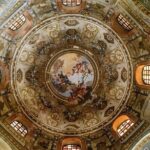
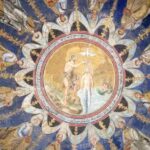
The visual focus here is the dome, commissioned by Bishop Neone, which depicts the Baptism of Christ surrounded by twelve Apostles in procession against a brilliant blue background. The craftsmanship is refined, almost delicate compared to the imperial grandeur of San Vitale. There’s also a Renaissance-era baptismal font still in place, maintaining the octagonal shape of the building’s plan, plus a fifth-century ambo (a raised platform for reading scripture) that’s still here after 1,500 years.
About 10 minutes at this stop, admission included. What matters here is understanding baptismal theology and how these images communicated spiritual concepts to early Christians. Your guide will explain how the arrangement of figures and the specific iconography relate to Christian belief about baptism and salvation.
Stop 4: Additional Stops (Likely Basilica di Sant’Apollinare Nuovo or Similar)
Based on several reviews mentioning five different mosaic sites during their tour, you’ll visit at least one more significant church beyond these three main stops. One reviewer noted: “The tour covered the must-see of Ravenna… Three hours did not feel long and we all wanted more!” This suggests the itinerary is carefully curated to hit the highlights without feeling rushed, though the exact fourth and fifth stops may vary depending on timing and your specific tour date.
What the Numbers Tell Us: Tour Quality and Reliability
With nearly 1,700 reviews and a 4.9-star average rating, this tour has been evaluated by a substantial number of travelers. The review breakdown is telling: roughly 90% of reviews are five stars, with most remaining reviews four stars. Even the single one-star review acknowledged the guide was “very friendly and knowledgeable”—the issue was a technical audio problem, not the tour itself.
This consistency matters. You’re not gambling on an unknown experience. Dozens of travelers have specifically praised individual guides by name—Elisabetta, Chiara, Marco, Francesca, Serena, Silvia—each noted for their knowledge and ability to bring the history alive. One visitor summed it up: “Elisabetta was amazingly knowledgeable and helpful. Her enthusiasm and ability to provide insight and historical context really transformed this experience from being a simple look at beautiful images on the wall to a fascinating and engaging life experience.”
The price point of $33.86 per person becomes genuinely reasonable when you factor in what’s included. You’re getting expert guide services, admission to multiple significant monuments (which would easily cost $20-30 separately), and the logistics of organized entry during busy times. For comparison, many Italian cities charge €15-20 per museum alone.

Practical Considerations for Planning Your Visit
Group Size and Audio Equipment
Tours max out at 28 travelers, though reviews mention groups of 20-25 being typical. This is large enough to feel like a proper tour operation but small enough that you’re not part of a cattle herd. Most importantly, the tour provides radio devices with earpieces for larger groups, which multiple travelers praised specifically. As one visitor noted: “We had a voice box and an earpiece so we didn’t miss anything. She walked at a reasonable pace and gave sufficient time for all 23 people on the tour to keep up.”
However, one traveler did report difficulty hearing the guide even with the audio equipment, so this isn’t universally foolproof. If you have hearing challenges, it’s worth mentioning when you book.
Duration and Pacing
The tour is advertised as 2-3 hours, and most reviews confirm this is accurate when conditions are normal. One traveler noted the tour extended to 4 hours on a particularly cold day, which affected their experience. The pace is generally described as “reasonable” and “easy,” with sufficient time at each stop. Your guide will likely keep things moving—one reviewer praised a guide for “keeping the tour on track” while still providing extensive information.
Dress appropriately for the season. This isn’t optional advice—it’s coming directly from traveler experience. Ravenna can be cold and damp, especially in winter months.
Meeting Point and Logistics
The tour starts at Piazza San Francesco 7, which houses the Tourist Information Office. Multiple reviews noted initial confusion about this meeting point, so here’s the key detail: you need to enter the Information Centre and check in before the tour begins. Not just arrive at the plaza—actually go inside. This has apparently caused some travelers to miss tours or arrive flustered. Factor in an extra 10 minutes for finding and checking in at the actual office.
The tour ends at a different location than it starts, which is typical for a walking tour through a city. You’re not returning to your starting point.
What Travelers Really Value About This Experience
Beyond the obvious appeal of seeing beautiful ancient mosaics, reviewers consistently highlight several less obvious benefits. First, there’s the educational transformation that happens when a guide contextualizes what you’re seeing. Multiple travelers mentioned learning about Ravenna’s historical importance—its role as a Roman capital, its significance in Byzantine history, the religious and political dynamics that shaped these monuments.
Second, there’s genuine relief at not having to figure out ticketing logistics independently. As one traveler put it: “It was a fascinating tour of the mosaics, which cut out the hassle of trying to source tickets.” In Italy, this matters more than you might think. Individual churches often have different hours, different ticket systems, and different rules about when you can enter. A guided tour eliminates that friction entirely.
Third, there’s the social aspect. While not explicitly marketed as a social experience, several reviews mention enjoying the group dynamic and the guide’s ability to engage everyone. One traveler noted their guide had “a good sense of humor,” and another praised the guide for being “very willing to answer any questions.”
The Reality Check: When This Tour Might Not Be Ideal
We should acknowledge the honest feedback from the minority of less-enthusiastic reviews. One traveler felt the group size (around 20 people) made it difficult to catch all the information, especially in the quiet church environments where everyone needs to be somewhat restrained. They also noted wishing for more architectural and construction history alongside the symbolism focus.
Another visitor experienced audio equipment that simply didn’t work well, which undermined their experience despite acknowledging the guide’s knowledge. These aren’t failures of the tour concept—they’re occasional technical or circumstantial challenges that can affect any group tour.
If you’re someone who needs absolute quiet and solitude to appreciate art, or if you struggle with group dynamics, this might be frustrating. If you’re intensely interested in architectural engineering details and less interested in historical context and symbolism, you might feel the guide’s focus misses what you came for. These are edge cases, but they’re worth considering honestly.
Frequently Asked Questions
Q: Are the entrance fees really included in the tour price?
A: Yes, admission to the major sites you visit (Mausoleo di Galla Placidia, Basilica di San Vitale, and Battistero Neoniano at minimum) are included in the $33.86 per-person price. This is a genuine value-add, as individual church admissions would cost considerably more if purchased separately.
Q: What language is the tour offered in?
A: The tour is offered in English. If you’re not a native English speaker, be aware that one traveler noted difficulty understanding a guide’s accent, though they acknowledged this was an individual circumstance rather than a systematic issue.
Q: Can I cancel if my plans change?
A: You can cancel up to 24 hours before the tour start time for a full refund. Cancellations within 24 hours forfeit your payment. The tour also requires a minimum number of participants—if it’s canceled due to insufficient bookings, you’ll be offered an alternative date or full refund.
Q: How far in advance should I book?
A: On average, travelers book about 30 days ahead. This suggests availability isn’t typically an issue, but booking a month in advance is a reasonable guideline. Given the free cancellation policy, there’s no penalty for booking early.
Q: Is this tour physically demanding?
A: The tour involves moderate walking through Ravenna’s streets and churches. Most travelers describe the pace as “easy” or “reasonable,” but you’ll be on your feet for 2-3 hours. If you have mobility limitations, you should mention this when booking so the operator can advise whether it’s suitable for your situation.
Q: What should I wear?
A: Comfortable walking shoes are essential. Weather-appropriate clothing is important—one traveler specifically mentioned cold weather making an extended tour challenging. Ravenna can be damp and chilly, even when other parts of Italy are warm. Also consider that you’ll be entering churches, which may have dress code expectations (covered shoulders, no excessively short shorts) and are often cooler inside.
Guided Tour of Mosaic Tiles in Ravenna
The Bottom Line
This is a genuinely solid tour that delivers real value for travelers interested in understanding Ravenna’s extraordinary artistic heritage. The combination of expert local guides, skip-the-line museum access, and a carefully curated itinerary makes it one of the better guided experiences available in this part of Italy at this price point. You’re paying for knowledge and convenience, and based on nearly 1,700 reviews, you’re consistently getting both. Book this if you care about understanding history and art in meaningful ways, if you appreciate having logistics handled for you, and if you’re willing to spend a morning walking through some of Europe’s most important early Christian monuments. Skip it if you prefer complete independence, absolute silence for art appreciation, or if you’re on a rushed schedule where every minute counts. For most travelers interested in Italian history and culture, this tour represents exactly the kind of authentic, educational experience that makes travel meaningful.