

When choosing family travel insurance, you’ll want to prioritize medical coverage limits of at least $100,000 for international trips and take advantage of free child coverage options offered by many providers. Compare single-trip versus annual policies based on your travel frequency, and purchase within 14-15 days of your initial deposit to maximize benefits like pre-existing condition waivers. Don’t forget to prepare essential documentation and notify your credit card companies before departure—there’s much more to contemplate for complete protection.
- Understand Core Coverage Areas Before You Buy
- Take Advantage of Free Child Coverage Options
- Choose the Right Policy Type for Your Travel Frequency
- Evaluate Medical Protection Limits and Benefits
- Consider Factors That Impact Your Premium Costs
- Time Your Purchase Properly for Maximum Coverage
- Gather Required Information and Documentation
- Compare Multiple Providers and Plans
- Review Pre-Existing Condition Exclusions for Children
- Keep Essential Documents Accessible During Travel
- Last Words
Understand Core Coverage Areas Before You Buy

Before you compare prices or read reviews, you’ll want to understand what family travel insurance actually covers. Medical emergencies form the foundation, providing up to $250,000 coverage per person for unexpected illnesses, accidents, and hospital stays.
You’ll also get 24/7 telehealth access for minor issues like sore throats.
Trip cancellation and interruption protection reimburses 100% of your prepaid, non-refundable costs when covered events like illness or severe weather disrupt your plans.
Emergency evacuation coverage becomes vital if you need medical transport or political evacuation, and it’ll even arrange guardian travel if you’re hospitalized and can’t care for your children.
Don’t overlook baggage protection for lost or stolen belongings, plus additional coverage for accidental death, legal fees, and adventure activities. Family policies typically cover 1-2 adults and up to 8 children under 18 living at the same address, making them more convenient and cost-effective than individual policies.
Take Advantage of Free Child Coverage Options
Why pay full price for every family member when many insurers offer free child coverage? You can save considerably by choosing policies that include children at no additional cost. Travel Insured International’s FlexiPAX covers up to nine children under 18 per adult—the most generous option available.
Berkshire Hathaway’s ExactCare covers two children per adult for an average premium of just $197, well below the $332 family plan average.
Most insurers cover children 17 and under free when they travel with a parent or grandparent. However, there’s a catch: the child’s trip cost can’t exceed the adult’s cost. Allianz, Travel Guard, and Travelex all offer kids-free pricing on select plans.
This coverage includes emergency medical, evacuation, and trip protection—giving your entire family all-encompassing protection without the premium price tag. With comprehensive coverage spanning trip cancellations, medical emergencies, delays, and baggage loss, families receive complete protection across all potential travel disruptions.
Choose the Right Policy Type for Your Travel Frequency

Once you’ve maximized those child coverage savings, you’ll need to match your policy type to how often your family hits the road. If you’re taking one vacation per year, single-trip policies offer the most bang for your buck. Options like Berkshire Hathaway ExactCare average $197 and provide solid coverage for infrequent travelers.
However, if your family travels multiple times annually, annual multi-trip policies become more cost-effective than purchasing separate single-trip coverage each time. These policies offer ongoing protection without repeated purchases.
Consider your destinations too. International trips require higher medical limits like $100,000/$500,000, while domestic travel policies offer affordable protection with features like primary emergency medical coverage and concierge services for streamlined support. Travel insurance also provides essential coverage for trip cancellation protection, safeguarding your family’s prepaid, non-refundable expenses against unforeseen events such as illness, natural disasters, or family emergencies.
Evaluate Medical Protection Limits and Benefits
When evaluating family travel insurance, you’ll discover that medical coverage limits vary dramatically between policies and can make or break your financial protection abroad. Atlas Travel plans offer up to $2 million per policy, while other insurers set limits per individual.
For a family of four on a 14-day Europe trip, upgrading from $50,000 to $2 million coverage costs just $49.84 extra—excellent value for $1.95 million additional protection.
Don’t overlook per-benefit limits that cap specific expenses like ambulance or hospital stays. These work separately from your overall maximum. Medical evacuation alone can exceed $100,000, making adequate coverage essential for remote destinations.
Choose deductibles you can afford upfront, and remember they typically apply per person, not per family. Many insurers require upfront payment for medical expenses regardless of your chosen deductible amount.
Consider Factors That Impact Your Premium Costs

Understanding what drives your family travel insurance costs helps you budget effectively and make informed coverage decisions. Your premium typically ranges from 4% to 10% of your total trip cost, so a $10,000 family vacation might cost $400 to $1,000 to insure.
Several factors influence your rates. Older family members face higher premiums due to increased medical risks, while younger travelers enjoy lower costs. Your destination matters too—high-risk locations with expensive healthcare systems increase premiums substantially. Trip duration directly impacts pricing since longer stays create more exposure to potential claims.
Consider family floater plans instead of individual policies for better value. If you’re planning multiple trips, annual policies often prove more economical than single-trip coverage. When comparing similar policies that meet your family’s needs, higher premiums don’t always guarantee better protection, so choose the less expensive option.
Time Your Purchase Properly for Maximum Coverage
Timing your family travel insurance purchase can make the difference between extensive protection and basic coverage with significant gaps. You’ll want to buy immediately after booking your trip to activate trip cancellation benefits the next day and protect against pre-trip events like family illness or death.
The sweet spot is within 14-15 days of your first deposit. This window unlocks bonus coverages including pre-existing medical condition waivers and Cancel For Any Reason protection. Miss this deadline, and you’ll forfeit these enhanced benefits.
Purchase before known events become public—like hurricane forecasts or travel advisories—since insurers won’t cover predictable risks. Buying around 50 days before departure allows you to thoroughly prepare your travel arrangements while reducing last-minute panic and decision-making stress.
While you can buy coverage until 11:59 p.m. before departure with some providers, waiting eliminates time-sensitive benefits that protect your family’s investment.
Gather Required Information and Documentation
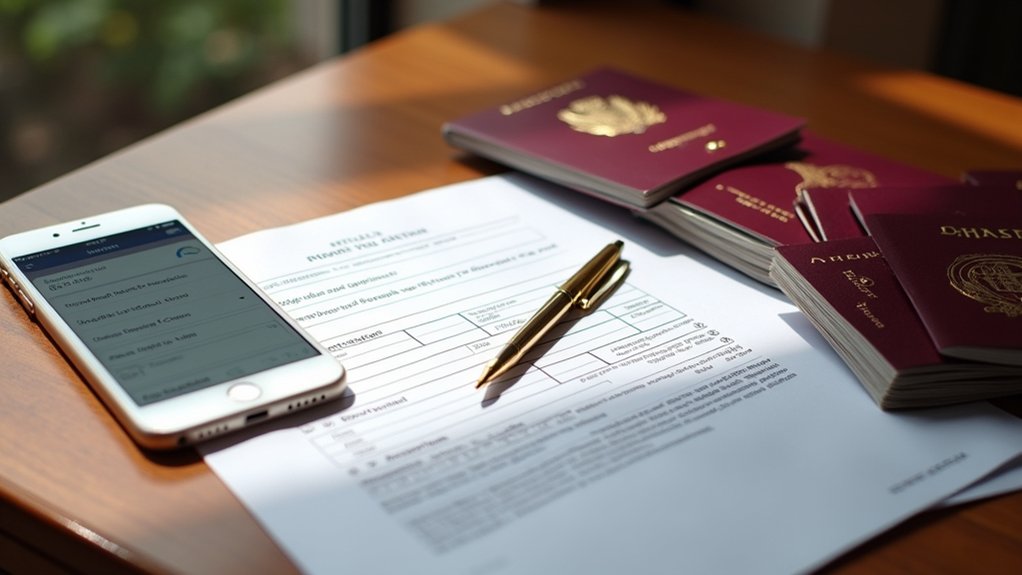
Before you click “purchase” on that family travel insurance policy, you’ll need specific information about every traveler, your trip details, and supporting documentation.
Start with basic policyholder details: names, birth dates, and home state for each family member. Document any pre-existing medical conditions and confirm household residency status for companions.
You’ll also need comprehensive trip specifics including exact destinations, travel dates, and total prepaid costs per person. Don’t forget your first payment date and planned activities.
Gather all travel supplier information—airlines, hotels, cruise lines, and tour operators with booking confirmations.
For children traveling, prepare birth certificates and written consent forms.
Keep receipts, invoices, and credit card statements organized. Once your policy is active, print the Confirmation of Coverage document to carry during your trip for emergency reference.
Having passport copies and identification documents ready streamlines the entire process.
Compare Multiple Providers and Plans
Once you’ve gathered all your documentation, it’s time to shop around—and you’ll quickly discover that family travel insurance isn’t a one-size-fits-all purchase.
Use comparison tools like Squaremouth and InsureMyTrip to evaluate multiple providers simultaneously and find plans that fit your family’s specific needs.
Pay special attention to kids-free coverage policies. Travel Insured International’s FlexiPAX covers up to nine children per adult at no extra cost, while most competitors limit free coverage to just one or two children.
Compare coverage limits carefully—medical coverage ranges from $25,000 to $100,000, while evacuation benefits typically reach $500,000. Keep in mind that search engines may not display every policy or provider, so additional research is necessary to ensure you’re seeing all available options.
Pricing varies markedly too. Trawick Safe Travels Protect costs just $43, while Berkshire Hathaway ExactCare averages $197, both below the $332 family plan average.
Review Pre-Existing Condition Exclusions for Children

While comparing providers gives you a solid foundation for choosing family coverage, you’ll need to pay close attention to how each plan handles your children’s pre-existing medical conditions.
Any condition that required medical care, medication, or treatment within 120 days before purchasing your policy counts as pre-existing – even without a formal diagnosis.
You must declare every condition during application to avoid claim denials abroad.
Some insurers like Good To Go specifically cover children with asthma, cancer, epilepsy, and autism.
Look for acute onset coverage that protects well-managed conditions experiencing sudden emergencies within 24 hours. Standard plans typically exclude congenital disorders along with other chronic conditions from comprehensive coverage.
Consider family policies over separate coverage – if your child has pre-existing conditions, everyone receives cancellation benefits when traveling together.
Keep Essential Documents Accessible During Travel
Document disasters abroad can derail your family vacation faster than flight delays or lost luggage. You’ll need your passport, round-trip tickets, and travel insurance policy within arm’s reach throughout your journey. Store original documents separately from photocopies—keep originals in your carry-on and leave copies with someone trusted back home.
Screenshot everything: boarding passes, hotel reservations, and itineraries. Email scanned passports to yourself and save emergency contacts both digitally and on paper. Download offline backup apps like Google Drive before departure.
For family travel, pack notarized consent letters from absent parents, birth certificates proving relationships, and immunization records. Store credit card company contacts in your phone. Always notify credit card companies about your travel plans before departure to prevent spending blocks on essential purchases abroad. Create separate storage locations so if one set disappears, you’re not stranded without essential documentation.
Last Words
You’ve got the tools to make a smart family travel insurance decision. Don’t rush through the process—take time to compare plans, read the fine print, and calculate what you’ll actually need. Remember, the cheapest option isn’t always the best when your family’s health and safety are on the line. Get your documents organized, ask questions, and choose coverage that’ll give you real peace of mind on your adventures.