Pompeii is one of those places where the ruins feel painfully real, because the city was frozen in time by Vesuvius. With this ticket, you get reserved entry plus an audio guide setup that lets you wander at your own pace through streets, shops, baths, temples, and theaters.
Two things I really like about this experience are the flexibility of choosing Pompei Express vs Pompei+ (it changes which villas you can reach), and the audio guide itself. It’s the kind of commentary that helps you connect what you’re standing next to—like the amphitheater seating or lunch spots in the market—with how Romans actually lived.
One drawback to plan for: the audio guide pickup and return are very specific, and the device has rules. You’ll need ID as a deposit, and Bluetooth headphones won’t work with the audio unit.
- Key Points Before You Go
- Pompeii Entry Ticket With Audio Guide: what you’re really booking
- Pompei Express vs Pompei+: choose the right ticket for your day
- Pompei Express
- Pompei+
- Timing note you should not ignore
- Price and value: why can be a smart deal
- Getting your voucher and entering: where the process can get confusing
- Audio guide setup details: ID, headphones, and what works
- What a “full” Pompeii day looks like in real life
- Your self-guided route: start where Pompeii feels most alive
- Markets and daily routines
- Public baths and mosaics
- Temples, theaters, and the feeling of being inside a city
- Temples of Venus, Apollo, and Jupiter
- Amphitheater: imagine the audience
- Villa Mysteries and the suburban villas on Pompei+
- Villa of the Mysteries
- Villa of Diomedes and Villa Regina with Antiquarium
- The practical drawback of villas
- Vesuvius in the background: photos and perspective that matter
- Parking problems, queues, and how to avoid wasted time
- Accessibility and comfort: what actually helps on the ground
- Food stops inside Pompeii: a break that won’t ruin your day
- If you want more than audio: when a human guide makes sense
- Should you book this Pompeii entry ticket with audio guide?
- FAQ
- How do I collect my Pompei ticket and audio materials?
- Is a digital audio guide included?
- Do I get headphones with the audio guide?
- Do I need ID to rent the audio guide device?
- Where do I return the audio guide after my visit?
- What is the difference between Pompei Express and Pompei+?
- What are the last entry times for Pompei+?
- Is the experience wheelchair accessible?
- Can I cancel for a full refund?
- The Best Of Pompeii Archaeological Site!
- More Guided Tours in Pompeii Archaeological Site
- More Tickets in Pompeii Archaeological Site
- More Tour Reviews in Pompeii Archaeological Site
Key Points Before You Go
 1 / 10
 2 / 10
 3 / 10
 4 / 10
 5 / 10
 6 / 10
 7 / 10
 8 / 10
 9 / 10
 10 / 10
- Pick your scope: Pompei Express or Pompei+
- Audio guide pickup is at Porta Marina Superiore and returns happen at the same desk
- The site is huge, so headphones and pacing matter more than you think
- Pompei+ adds suburban villas like the Villa of the Mysteries and other countryside sites
- Some spots may be under restoration, so not every viewpoint is guaranteed

👉 See our pick of the The 2 Most Popular Lunch Experiences In Pompeii Archaeological Site
Pompeii Entry Ticket With Audio Guide: what you’re really booking
This is a self-guided Pompeii day trip tool. You arrive, collect your materials, then walk the archaeological park on your schedule. The big value is that you’re not stuck on a fixed-group route. Instead, you can slow down where something grabs you: frescoes, mosaics, temple fronts, public buildings, or the amphitheater.
Your ticket includes reserved entry and an audio guide option. You can get a physical audio guide unit if you choose that add-on, and you also have access to a digital audio guide app. That means you can keep going even if your phone battery gets stressed.
And Pompeii is not a “quick wander” place. It’s a real city-sized site. A lot of visitors end up planning for more time than they first thought.
You can also read our reviews of more tours and experiences in Pompeii Archaeological Site



Pompei Express vs Pompei+: choose the right ticket for your day
The ticket splits your day into two different Pompeii experiences.
Pompei Express
This covers the ancient city of Pompeii only. The suburban villas are not included. If you’re tight on time and want the main-town essentials—streets, forum-area buildings, theaters, baths—this option can work well.
Pompei+
Pompei+ includes the ancient city plus suburban villas. The extra highlight is the Villa of the Mysteries, plus additional suburban villa stops (Villa of Diomedes and Villa Regina in Boscoreale, with Antiquarium).
Pompei+ matters if you want the full picture. Those suburban homes feel like a different world from the street grid, because you see wealth, daily routines, and the dramatic art that survived the ash fall.
Timing note you should not ignore
Pompei+ has a last entry time. In winter it’s 3:30 p.m., and in summer it’s 5:30 p.m. If you’re visiting in peak season, plan to start earlier so you’re not rushing the countryside villas at the end.
You can also read our reviews of more guided tours in Pompeii Archaeological Site



Price and value: why $40 can be a smart deal
At $40 per person, the value comes from two practical things you’re buying:
1) Reserved entry that lines up with your planned day.
2) An audio guide that makes Pompeii easier to enjoy without hiring a private guide.
Audio guides don’t just give facts. They help you interpret what you’re seeing so the walking feels purposeful. Instead of wandering through stone walls, you’re getting context for markets, bath mosaics, temples, and everyday life details that are easy to miss.
Also, you get help with logistics. Free luggage storage means you can travel lighter and not drag bags around the park.
The one “cost” is time. Pompeii rewards patience. If you only have a short visit window, you might end up seeing a fraction of the site.
Getting your voucher and entering: where the process can get confusing
Your flow is straightforward once you know the trick:
- You show your voucher (on your phone) at the door.
- You collect the audio guide materials at the park’s official audio guide desk in Porta Marina Superiore.
The meeting point instructions mention two places for ticket collection: Porta Marina Superiore or Piazza Esedra ticket office. Then, for the audio guide pickup, you specifically go to the official desk inside the Pompeii archaeological site, next to the ticket office.
A common travel problem here is simple signage confusion. Some people find themselves sent between counters before landing at the right one. My advice: head straight toward the audio guide desk area once inside the gates, and don’t overthink the arrows.
Audio guide setup details: ID, headphones, and what works
If you select the physical audio guide option, there are a few must-know rules.
- You’ll be asked for ID as a deposit to rent the audio device.
- You must pick up the audio guide unit at the audio guide desk near the ticket office.
- You must return it at the same desk after your visit.
Headphones are the other big gotcha:
- Headphones are not included.
- Bluetooth headphones don’t work with the audio device.
So bring wired headphones if you’re planning to use the physical unit. If you skip the physical device and rely on the digital app, your phone headphones should work normally, but battery life becomes your responsibility.
Languages are available in multiple options, including English, Italian, Chinese, Japanese, Portuguese, Russian, German, and French.
What a “full” Pompeii day looks like in real life
Pompeii covers a lot of ground. Most people underestimate the scale until they’re already walking.
A good rule of thumb: don’t plan your day like it’s a museum with a hallway route. Plan it like you’re exploring a neighborhood that happens to be ancient. You’ll want breaks, shade, and time to come back to things you want to re-read with audio.
One traveler mentioned they spent about 6 hours and clocked over 22,000 steps. Another noted you may need at least 3 hours to see only part of the site well. If you want villas too, give yourself more time than you think.
Your self-guided route: start where Pompeii feels most alive
Pompeii works best when you treat it like a series of “life scenes,” not random buildings.
Markets and daily routines
You’ll pass places tied to daily life—think markets where Romans would pick up lunch, plus street-level spaces that make the city feel active rather than dead.
If you’re using the audio guide, let it steer you. It’s easy to stand in front of a building and still miss what it was used for. The audio helps you connect purpose to architecture.
Public baths and mosaics
Pompeii’s mosaics are a highlight because they show taste and craftsmanship. Public baths are another anchor stop. When you’re there, don’t just glance. Slow down enough to notice patterns and how the space was designed for routine.
Even if you’re not an art person, bath floors and wall decoration give you a “this is how they spent time” feeling.
Temples, theaters, and the feeling of being inside a city
Pompeii wasn’t only houses and shops. It had public religion and public entertainment, and the ruins preserve that energy.
Temples of Venus, Apollo, and Jupiter
You’ll have a chance to visit temples tied to major deities—Venus, Apollo, and Jupiter are specifically mentioned. Those stops are worth it because they change your perspective. You’re no longer just imagining private rooms. You’re seeing civic space where people gathered, celebrated, and followed shared beliefs.
Amphitheater: imagine the audience
The amphitheater is one of those “wow” stops because it’s built for crowds. With an audio guide, you’re not just looking at seating. You’re hearing the context that makes the structure feel like an event space rather than broken stone.
If you’re traveling with kids or anyone who likes human stories, this is the place that usually clicks.
Villa Mysteries and the suburban villas on Pompei+
If you choose Pompei+, you add the countryside side of Pompeii. And this is where the experience often becomes more emotional for people.
Villa of the Mysteries
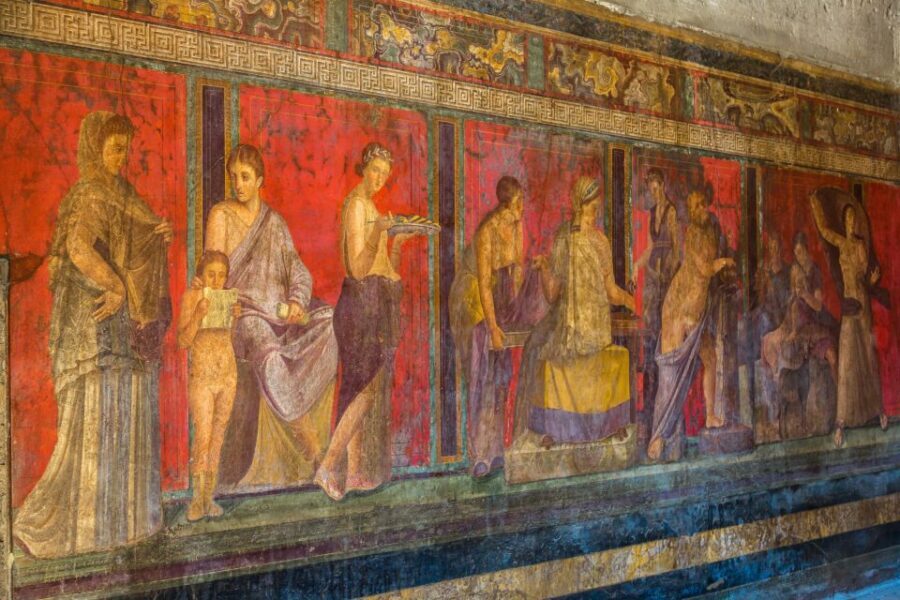
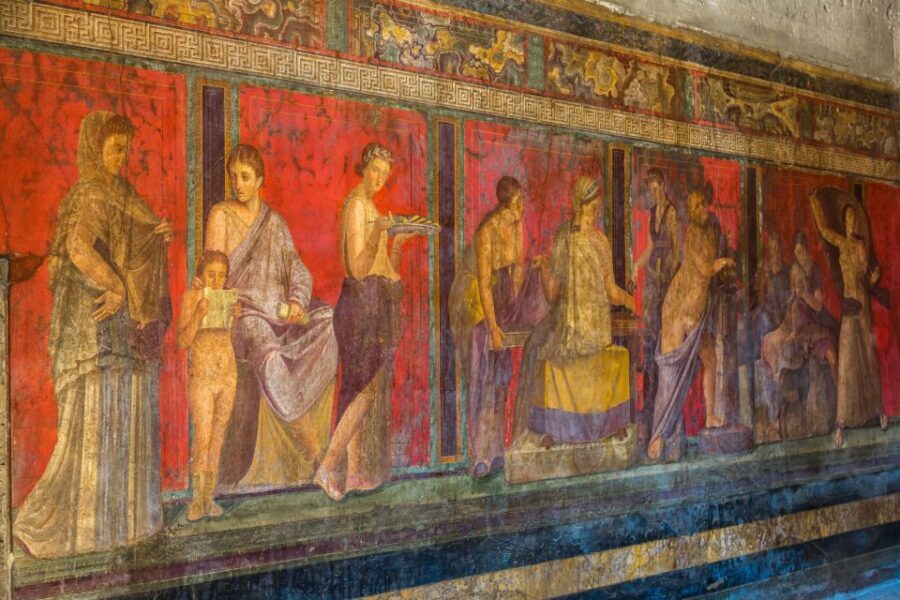
The Villa of the Mysteries is the headline. It’s known for frescoes that survived in ways that make you want to stand and stare for a while. You can feel the difference between main-city spaces and a villa setting—more privacy, more display, and more sense of how elite families lived.
Villa of Diomedes and Villa Regina with Antiquarium
Pompei+ also includes the Villa of Diomedes and Villa Regina in Boscoreale, plus the Antiquarium. These add depth because they show different villa styles and how wealth and taste were expressed in the suburbs.
The practical drawback of villas
Villas mean extra walking and extra time, plus you’re working against last entry times. If you’re the type who hates rushing, give yourself a big morning start for Pompei+.
Vesuvius in the background: photos and perspective that matter
You’ll be able to capture Pompeii with Vesuvius looming in the background. The view isn’t just for Instagram. It’s the mental bridge that makes the whole story click: this city was under volcanic threat, and then everything froze.
Photo-wise, you’ll want to think about where you place yourself. The ruins plus the mountain give you a rare chance to see scale—how close danger was, and how dense daily life became in one area.
Parking problems, queues, and how to avoid wasted time
Even with pre-booked vouchers, arrival can feel chaotic if you don’t follow the right path.
Some visitors report:
- Lines and counter confusion when collecting vouchers
- Needing a second trip between offices before reaching the audio guide desk
My best practical tip: after you’re inside the gates, aim for the audio guide desk rather than defaulting to the main ticket queue. Also, keep your ID ready because it’s required as a deposit for the device.
Also note: some buildings can be closed for preservation work, so a “perfect itinerary” isn’t guaranteed. That’s normal here.
Accessibility and comfort: what actually helps on the ground
Pompeii is wheelchair accessible, which is important to know. Terrain can still be uneven, but the access information is there.
For comfort, you’ll feel the basics fast:
- Wear comfortable shoes (paths can be uneven).
- Bring water and plan for long sun exposure.
- Use shade when you can, especially in hot months.
One traveler recommended simple shade gear like a small umbrella or large sunhat. That’s practical advice because Pompeii has limited “instant cooling” compared to a modern city.
Food stops inside Pompeii: a break that won’t ruin your day
Food is part of the experience, even if it’s a side quest between ruins.
Visitors mention a café inside Pompeii that serves fresh food and drinks that are not overly expensive. People also pointed out the speed and quality of the café meal, and one traveler noted cold beer as a welcome afternoon reset.
So don’t treat food like an emergency. Build a break into your route. If you’re doing Pompei+ and trying to fit villas in, a planned lunch break can keep you from burning out before the best parts.
If you want more than audio: when a human guide makes sense
This ticket is designed for self-guided walking. But some visitors do add a guide for extra explanation and pacing.
One traveler specifically mentioned a guide named Terese as being excellent. That’s a reminder that if you’re craving deeper interpretation, a human guide can connect dots faster than an audio track sometimes can.
That said, if you’re happy to go at your own pace and use audio, you can absolutely build a satisfying day without anyone leading you by the elbow.
Should you book this Pompeii entry ticket with audio guide?
Book it if you want:
- Flexible timing and the ability to pause, replay, and walk your own route
- Audio help for markets, baths, temples, and the amphitheater
- A ticket option that matches your ambition: Pompei Express for the core city or Pompei+ for the suburban villas too
Consider it carefully if:
- You know you move slowly or hate long walks. Pompeii is big, and “one day” can still feel like a sprint if you’re chasing everything.
- You want to use Bluetooth headphones. The physical device won’t work with Bluetooth, so plan wired headphones or rely on the digital app.
If you do decide to book, show up with the basics ready: ID, comfortable shoes, and a plan to prioritize the parts you care about most before the day gets away from you.
Pompeii: Entry Ticket with Audio Guide
FAQ
How do I collect my Pompei ticket and audio materials?
You collect your ticket by showing your voucher at Porta Marina Superiore or Piazza Esedra. Then you pick up your audio guide at the official desk inside Pompeii Archaeological Site near the ticket office.
Is a digital audio guide included?
Yes. The ticket includes a digital audio guide app, and the physical audio guide is included if you select that option.
Do I get headphones with the audio guide?
No. Headphones are not included, and Bluetooth headphones don’t work with the audio guide device.
Do I need ID to rent the audio guide device?
Yes. A valid ID is required as a deposit to pick up the audio guide unit.
Where do I return the audio guide after my visit?
You return the audio guide at the same official desk where you picked it up, located next to the ticket office at Porta Marina Superiore.
What is the difference between Pompei Express and Pompei+?
Pompei Express includes only the ancient city of Pompeii and not the suburban villas. Pompei+ includes the ancient city plus suburban villas such as the Villa of the Mysteries, Villa of Diomedes, and Villa Regina in Boscoreale with Antiquarium.
What are the last entry times for Pompei+?
The last entry time is 3:30 p.m. in winter (1 November–31 March) and 5:30 p.m. in summer (1 April–31 October).
Is the experience wheelchair accessible?
Yes, it is listed as wheelchair accessible.
Can I cancel for a full refund?
Yes. You can cancel up to 24 hours in advance for a full refund.
You can check availability for your dates here: