
I’m into smart shortcuts when a place is huge, and Pompeii qualifies. This 2-hour small-group tour helps you cover the famous stops with a guide who can explain what you’re seeing and why it mattered, without burning your whole day. It runs in English, uses a mobile ticket, and is family-friendly if your kids can handle crowds and standing.
What I like most is how much ground you can cover in a short time, including the headline sights you might miss if you wander on your own. I also really value the guide-led context for places like the theaters, the baths, and the richer homes, since it turns scattered ruins into an actual city with people, routines, and choices.
One thing to consider: two hours is still two hours in Pompeii. If you want a slower, deeper read of every street corner, or you’re extremely noise-sensitive in crowded spaces, you may feel a bit rushed even with a good pace.
- Key things to know before you go
- Quick reality check: Pompeii in 2 hours
- Meeting point and getting there without stress
- What you actually see: a highlight route that makes sense
- Archaeological Park of Pompeii: frescoes and the city’s big story
- Odeon and Teatro Piccolo: smaller stages with big clues
- Teatro Grande: the city’s most important theater
- House of Menander: elite home life and luxury signals
- Stabian Baths (Terme Stabiane): the oldest thermal complex
- Lupanar: the most famous brothel in Pompeii
- Via dell’Abbondanza: Pompeii’s main shopping street vibe
- House of the Faun: large private residences and status
- Foro de Pompeya: the main square as a social engine
- Basilica: merchants under a portico
- Pace and group size: small-group in a big place
- Guides: why people kept saying the same thing
- Value and price: what .67 gets you
- Family fit: yes, but read the fine print
- Heat, comfort, and what to bring
- Mobile ticket, confirmation, and logistics notes
- When this tour is the best choice (and when it isn’t)
- Should you book it?
- FAQ
- How long is the Pompeii tour?
- Is the tour in English?
- Where do we meet for the tour?
- What size is the group?
- Is the Pompeii entrance ticket included?
- What fitness level do I need?
- What is the cancellation policy?
Key things to know before you go
 1 / 3
1 / 3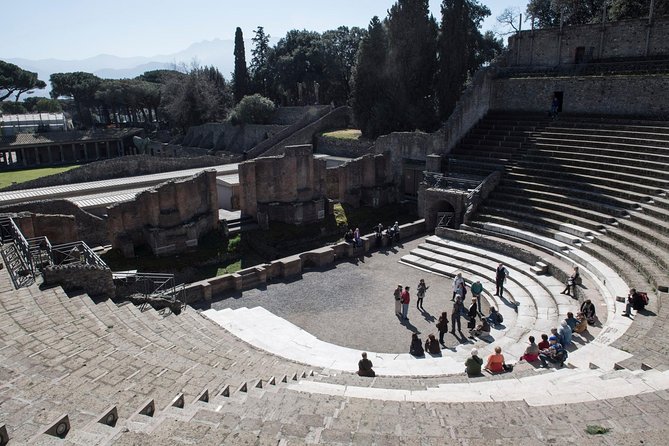 2 / 3
2 / 3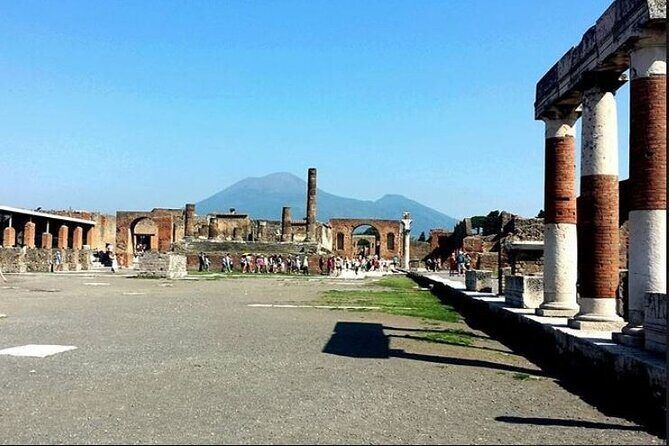 3 / 3
3 / 3- Expert-guided highlights in about two hours, so you’re not stuck doing guesswork in the largest open-air museum on Earth.
- A full route of major Pompeii areas, from theaters and baths to elite houses, plus the main square and civic buildings.
- Family-friendly approach varies by guide, and some people report extremely kid-capable storytelling, but engagement can depend on your group and your guide.
- Max 30 travelers, with a minimum of 6 for the tour to run, meaning small-group size can shift seasonally.
- Entrance ticket rules matter: first Sunday of each month is always free, and under 18 is always free with valid ID.
- Heat and walking shoes matter, since you’ll be moving between sites for those short stops.
Quick reality check: Pompeii in 2 hours
Pompeii is not a small stop you can casually “see.” It’s a whole ancient city, preserved after Vesuvius buried it in 79 AD, and the ruins sprawl in every direction. That’s why a timed guided route is such a practical move.
This tour is built for travelers who want the big moments: how Roman streets worked, what public buildings looked like, and what daily life might have felt like when the city was alive. You’ll move from one signature area to the next, with each stop focused enough to keep your day moving.
If you’re visiting Pompeii as part of a bigger Naples-area itinerary, two hours can be the sweet spot. If you’re also planning a second outing in the region, this route helps you “claim” Pompeii without losing your whole schedule.
Meeting point and getting there without stress
You’ll meet at Ristorante Suisse, Piazza Esedra, 10/13, 80045 Pompei NA. The good news is that the location is near public transportation, so you’re not locked into a car day.
You’ll also get a mobile ticket, which is one less thing to manage while you’re in transit and trying not to get swallowed by last-minute crowds.
Tip that applies to almost every Pompeii day: give yourself buffer time. Trains and local transfers can run differently than you expect, and you’ll want to arrive with a little calm.
What you actually see: a highlight route that makes sense
The itinerary moves stop-by-stop across Pompeii’s most recognizable spaces. Each stop is short by design, but the guide connects the dots so you don’t just pass through like a tourist stamp collector.
Here’s what the route is built to show you and what it means on the ground.
Archaeological Park of Pompeii: frescoes and the city’s big story
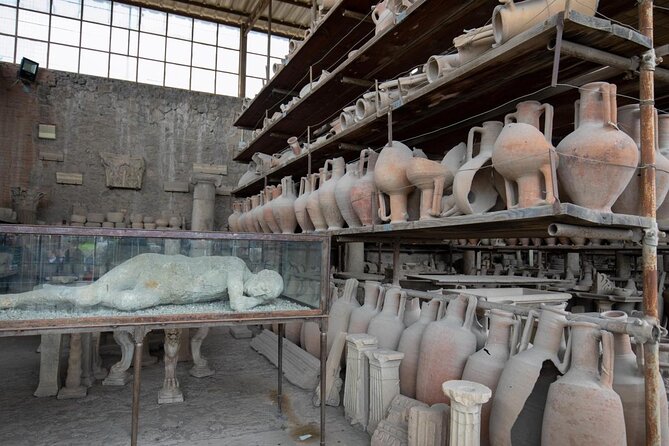
Your first stop is the Archaeological Park of Pompeii, the core of the visit. The focus here is on the most famous areas and frescoes, which are one of Pompeii’s biggest wow factors.
Frescoes can look like decoration if you don’t know what you’re seeing. With a guide, you start noticing the difference between art made to impress visitors and art that says something about a household’s style, aspirations, and identity.
This is also where you get your bearings fast. Even if you never return, you’ll understand what you’re looking at when you later spot streets, courtyards, and public structures.
Odeon and Teatro Piccolo: smaller stages with big clues
Next up is the Odeon – Teatro Piccolo. These quieter performance spaces help you understand Pompeii beyond the most famous venues. They remind you that entertainment wasn’t only a big event. It was part of everyday culture.
If you’ve only heard about Roman theaters in general, this stop makes the Pompeii version feel real. You can compare what “small” meant in Roman architecture and how built spaces shaped the audience experience.
Teatro Grande: the city’s most important theater
Then you move to Teatro Grande, the major theater in Pompeii. A guide matters here because theaters can be visually impressive but confusing. You’re looking at remains, and without context, it’s hard to reconstruct where people sat and how performances were experienced.
With explanation, you’re more likely to notice practical design choices: the scale, the layout, and how a theater fit into a city where public life mattered.
This stop is one of the strongest choices for first-timers because it anchors Pompeii in the language of Roman civic life.
House of Menander: elite home life and luxury signals
The House of Menander is a top pick for people who want to see Pompeii’s wealth, not just its tragedy. This is one of the richest and most magnificent homes, known for architecture, decoration, and what was found inside.
A guided stop helps you read the home like a lived space. Instead of thinking of rooms as museum labels, you’re more likely to understand how elite families displayed status through layout and decoration.
This is also a great stop for families, as long as your kids are curious about animals, art, or how people lived.
Stabian Baths (Terme Stabiane): the oldest thermal complex
Next come the Stabian Baths (Terme Stabiane). These occupy a vast area and are described as the oldest thermal complex in the city.
Bathrooms and baths are a powerful lens on Roman life because they weren’t just about cleanliness. They were social hubs and routine stops. You can understand why Pompeians left home for more than errands.
If it’s hot, this stop can still work because it gives you a different kind of structure to walk through, and you’re learning while you’re moving.
Lupanar: the most famous brothel in Pompeii
The Lupanar is the well-known brothel in Pompeii. This is a sensitive stop, but it’s also part of how historians read ancient cities: how commerce, gender roles, and street life intersected.
If you’re bringing kids, you’ll want to check your comfort level as you approach this part of the route. Some families say their children stayed engaged, while others prefer to skip this type of content.
The value here is historical context. A guide can help frame what you’re looking at without leaving you with pure shock.
Via dell’Abbondanza: Pompeii’s main shopping street vibe
You’ll also pass through Via dell’Abbondanza, Pompeii’s famous street corridor. This is the kind of place where the city starts to click: you can sense movement, trade, and the relationship between buildings and pedestrians.
Even if you only get a short window, it helps you understand how the ruins connect into one functioning place.
House of the Faun: large private residences and status
Then comes the House of the Faun, one of the largest and most impressive private residences in Pompeii.
This stop works well if you want to understand Pompeii as a mix of social classes. After public spaces and baths, you get a look at private power.
You’re also likely to appreciate how elite homes weren’t only about comfort. They were also about showing that you belonged at the top.
Foro de Pompeya: the main square as a social engine
Next is the Foro (main square). This is the civic heart in many ancient cities, and Pompeii is no different. It’s where you can imagine crowds, announcements, commerce, and public meetings.
A guide helps because the square can feel like a cluster of stones if you’re not told what kinds of activity likely happened there.
If you like understanding city planning, this is a meaningful stop. You’ll start noticing axes and the logic of how buildings face one another.
Basilica: merchants under a portico
Finally, you visit the Basilica, described as an open portico where merchants and other activities happened.
This stop turns the “square” into “life.” You’re not just seeing space; you’re learning how people interacted around it. That’s the difference between walking ruins and actually understanding them.
Pace and group size: small-group in a big place
This is sold as a small-group tour with a maximum of 30 travelers, and it requires a minimum of 6. In practice, this means you’ll probably feel like you’re with a real group, but the exact size can vary.
Many travelers report genuinely small groups and praise the guide’s pacing and ability to keep everyone moving at a manageable speed. Other travelers mention instances where the group size was larger than expected, so if you’re counting on a super-intimate experience, keep that possibility in mind.
What matters most is how the guide manages crowding and noise. Some guides are very good at keeping the group together while steering around busy points.
Guides: why people kept saying the same thing
Across the feedback, one theme shows up again and again: guides who can explain Pompeii in a way that feels alive. Names that come up include Gianluca, Luca, Roberta, Manuela, Patrizia, Enzo, Clare, and Mafilda.
I like this because it’s not just “fun facts.” In Pompeii, you need interpretation. A good guide helps you see why a bath complex feels different from a theater, why a house reads as elite, and why street spaces mattered.
You’ll also see comments about guides being kind, proactive, and adaptable. For example, some travelers mention shaded stops during heat, and others mention the guide managing late arrivals smoothly when travel delays happened.
If you want a trip where the ruins feel connected, a strong archaeologist-led guide is the whole point.
Value and price: what $32.67 gets you
At $32.67 per person, the value is strongest for travelers who want structure and expert explanation in a short visit.
Admission is included on the stops listed in the route, and that matters because Pompeii ticketing can add up. Also, the tour helps you avoid spending your precious time on logistics or figuring out where to go next.
This is not the cheapest way to see Pompeii. But for many people, it’s a smarter way to spend time. Two hours guided can save you hours of confusion and allow you to see more than you’d likely prioritize solo.
Also remember: Pompeii’s entrance ticket rules can change your math. The entrance ticket is free on the first Sunday of each month, and it’s free for under 18 with valid ID.
Family fit: yes, but read the fine print
The tour is described as family-friendly, and multiple families report success with kids around ages 7 to 13. Guides are praised for staying patient and making the tour engaging enough that children didn’t drift off.
But there’s one caution: a small number of travelers felt the tour wasn’t kid-engaging enough and reported uncomfortable behavior. That’s not what most people reported, but it’s a reminder that “family-friendly” can still depend on the specific guide and how your child handles crowds.
If you’re traveling with younger kids, consider bringing snacks, water, and a simple plan for breaks. Also, be realistic: Pompeii is mostly stone and walking. Engagement has to be story-driven, not just visually stimulating.
Heat, comfort, and what to bring
Pompeii can be brutally hot, and travelers specifically mention the heat as a challenge. Some guides respond by choosing shaded areas for explanation, which you’ll appreciate if you’re visiting in warmer months.
So come prepared:
- Comfortable walking shoes
- Water and sun protection
- A light layer for indoor or shaded stops
- Patience for crowds at popular points
The tour asks for moderate physical fitness, which basically means you should be comfortable walking across the park and standing for periods during short stops.
Mobile ticket, confirmation, and logistics notes
You should receive confirmation at booking. The tour uses a mobile ticket, and it ends back at the meeting point.
Also note the cancellation rules: free cancellation is available up to 24 hours before the experience’s start time for a full refund. If you cancel less than 24 hours before, you won’t be refunded.
If the minimum group number of 6 isn’t met, you may be offered an alternative date/experience or a full refund.
That flexibility is useful if your travel plans are still shaky when you book.
When this tour is the best choice (and when it isn’t)
Book this if:
- You want a guided Pompeii highlight in about two hours.
- You’d rather spend time learning than trying to assemble your own route.
- You enjoy theaters, baths, elite homes, and civic spaces.
- You’re visiting with teens or older kids who can stay engaged.
Consider skipping this tour if:
- You want a slow, quiet, deeply detailed visit without time limits.
- Your kids need constant interactive entertainment and you’re worried about short stops.
- You strongly prefer self-guided pacing and already know what you want to see.
For some travelers, a great strategy is to use the guided tour as your foundation, then roam afterward. Two hours can give you enough context to enjoy independent exploring.
Should you book it?
If you want the biggest Pompeii hits with a guide who can connect the dots, I’d lean yes. The biggest strength isn’t just the famous sights. It’s the consistency of skilled guiding that makes people feel like they understood Pompeii, not just that they walked through it.
My advice is simple: if you’re short on time and you like a clear route, this tour is a smart buy for value and interpretation. If you’re very heat-sensitive or need a totally flexible slow pace, you might prefer more time on your own. For most first-timers, two hours with the right archaeologist-led storyteller beats guessing in an enormous site.
Pompeii 2h Small-Group Tour with Expert Archaeologist
FAQ
How long is the Pompeii tour?
It lasts about 2 hours.
Is the tour in English?
Yes, it’s offered in English.
Where do we meet for the tour?
You meet at Ristorante Suisse, Piazza Esedra, 10/13, 80045 Pompei NA, Italy.
What size is the group?
There’s a maximum of 30 travelers, and the tour requires a minimum number of 6 people to run.
Is the Pompeii entrance ticket included?
The tour includes admission for the listed stops. Also, Pompeii’s entrance is free on the first Sunday of each month, and under 18 can enter for free with valid ID.
What fitness level do I need?
The tour is listed for travelers with a moderate physical fitness level.
What is the cancellation policy?
You can cancel for a full refund if you cancel at least 24 hours before the start time. If you cancel less than 24 hours before, it won’t be refunded.