
Rome moves fast, and on your own you can waste hours just figuring out streets, traffic, and the best places to pause. This Rome golf cart tour is built for an efficient, open-air “see a lot, learn enough” introduction to the Eternal City, with an English-speaking guide and smooth navigation through narrow lanes.
Two things consistently land well with travelers: the guides (names you may hear include Hadi, Francesco, Pietro, Marco, and Sahar) and the fact that you’re still moving at a photo-friendly pace. You’ll also get genuinely scenic moments—panoramic viewpoints and big-figure landmarks—without the sore-feet stress of a long walking day.
One drawback to consider: pickup can be painless in central Rome, but if you’re outside the core area you may need to meet the driver at a specific location, and that transition can get messy if your hotel pickup details are unclear. Also, a few travelers reported that in practice the stops felt rushed or harder to hear during the ride.
- Key Things to Know Before You Go
- Why This Rome Golf Cart Format Works for First-Time Sightseeing
- Price, Time, and Value: Is 0.91 Worth It?
- Pickup and Meeting Points: Central Comfort vs. Outside-the-Core Reality
- How Long 3 Hours Actually Feels
- The Guide Makes the Tour: What Travelers Keep Praising
- Villa Borghese Gardens: A Green Reset Before the Monuments
- Piazza del Popolo and the Pincio Views Energy
- Mausoleum of Augustus: A Quiet History Pause
- Via del Corso: Rome’s Central Shopping Spine
- Column of Marcus Aurelius: A Stop That Rewards Looking Up
- Piazza Venezia and the Vittoriano: Big, Italian, and Hard to Ignore
- Mercati di Traiano and the Imperial Fora Area: Rome’s Commercial Past
- Circus Maximus: Chariot-Race Scale Without the Crowds
- Giardino degli Aranci: Panoramas and the Keyhole Moment
- Mouth of Truth: The Funny Stop That Works
- Piazza del Campidoglio: Michelangelo’s Layout and the Marcus Aurelius Statue
- Piazza Navona and the Fountains That Set the Scene
- Pantheon: The One Stop Everyone Remembers
- Chiesa di Sant’Ignazio di Loyola: Baroque Trick Art
- Trevi Fountain and the Coin-Toss Tradition
- Piazza Di Spagna: Spanish Steps as a Rest-and-Reset Stop
- A Note on Food and Drinks: What You Might Get From Guides
- Accessibility and Who This Tour Fits Best
- Where Some Tours Go Wrong (So You Can Avoid It)
- Cancellation, Confirmation, and Booking Timing
- Should You Book This Rome Golf Cart Tour?
- FAQ
- How long is the Rome golf cart tour?
- What does the tour cost?
- Is pickup included?
- Where is the meeting point if I need to meet there?
- What language is the tour guide?
- Is this a private tour?
- Do I get a mobile ticket?
- Is admission included for the stops?
- What is the cancellation policy?
Key Things to Know Before You Go
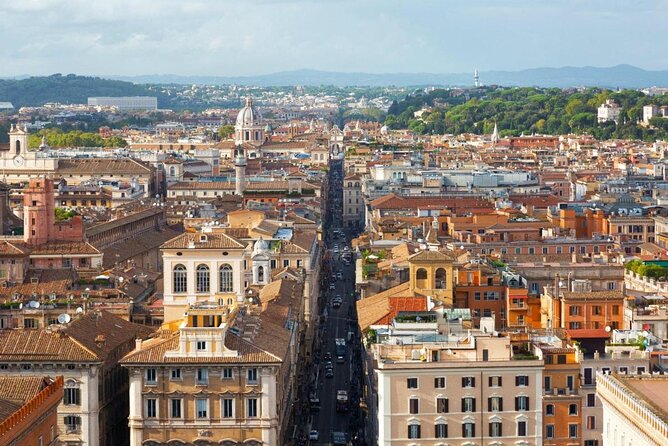
- Hotel pickup in central Rome helps you start without logistics headaches
- English-speaking guide with a strong history-and-neighborhood angle
- Private-group format so you’re not stuck with strangers at every pause
- Photo-friendly pace: quick hops between major sights, with time to look up close
- A mix of views and big landmarks rather than just one monument cluster
Why This Rome Golf Cart Format Works for First-Time Sightseeing
Rome is huge, but your vacation time is not. A golf cart tour is a smart compromise: you cover more ground than a walking route, yet you still stop often enough to see details and take photos.
The open-air setup also helps you feel Rome as you go. You’re not staring at a bus window while the day passes you by. Instead, you get brief stretches of movement, then short pauses where the guide can place what you’re seeing into context.
This is also one of the best formats for mixed groups: families, older travelers, and anyone who wants a big overview without turning the day into a stamina test.
Price, Time, and Value: Is $160.91 Worth It?
At $160.91 per person for about 3 hours, you’re paying for convenience plus guidance plus efficiency. The real question is whether you’d otherwise spend similar money on transit, taxis, guided “tickets only” tours, and the time cost of getting oriented.
The tour is designed to pack in major sights quickly, and it’s limited to your group. That tends to make the experience feel more personalized than large-group coach tours, which is why many travelers call it a must-do first day activity.
A balanced note: a few reviews mentioned feeling the tour was pricey for what they received when stops felt rushed, or when sound/guide communication was harder than expected. So, it’s good value when the guide and logistics line up; it’s less satisfying when communication is limited.
Pickup and Meeting Points: Central Comfort vs. Outside-the-Core Reality
Most travelers get pickup from a central Rome hotel, which is the big win. The driver guide is supposed to be waiting at your hotel’s main entrance, so you can begin without dragging your bags across the city.
But if your hotel is outside the central area, the plan changes: you’ll be asked to meet at a designated meeting point. The listed start point is Piazzale delle Canestre, SNC, 00197 Roma RM, Italy, and the tour ends back at that same meeting point.
My practical advice: confirm the pickup zone details before you rely on being collected at the door. In Rome, a few blocks can make the difference between smooth and chaotic.
How Long 3 Hours Actually Feels
Three hours is enough for an overview, not enough for lingering everywhere. That’s why the itinerary is built around short stops—often 5 to 15 minutes—at major landmarks and viewpoints.
You’re basically getting a fast route with guided interpretation. If you love “see it, then decide what you’ll revisit,” this timing works well. If you prefer deep, slow visits inside museums and churches, you’ll likely want a second day dedicated to the places that really grab you.
Travelers praise the pace as “jam-packed” and “easy,” especially because the cart helps you cover distances quickly. Still, if your group wants lots of unhurried time at every photo spot, you should know the day is structured to move.
The Guide Makes the Tour: What Travelers Keep Praising
This is not a scripted bus tour. The strongest reviews repeatedly mention guides who know the “why” behind what you see—history plus neighborhood context plus smart routes.
You’ll see names like Hadi and Francesco mentioned often, with praise for clarity and for tailoring the day. Some travelers also mention that guides handled questions well, adjusted pace for the group, and even helped with practical extras like recommendations for gelato or transport.
There’s also a useful real-world takeaway: if you struggle to hear on tours, ask ahead about audio support. A small number of travelers reported trouble hearing the guide when sound equipment wasn’t sufficient.
Villa Borghese Gardens: A Green Reset Before the Monuments
The day starts with Villa Borghese Gardens, a huge park area that covers more than 80 hectares. Even when you’re only there briefly, it works as a calm warm-up to Rome’s stone intensity.
Expect a mix of greenery, paths, and classic garden scenery. The Borghese area also connects to major art culture, including the Borghese Gallery (mentioned as part of the broader park context), so it’s a good moment to set the tone: Rome is not just ruins—it’s also landscape, art, and design.
Why it’s worth a stop on a golf cart tour: it gives you breathing room, plus a pleasant “Roman parks exist!” perspective that helps the rest of the day feel less frantic.
Piazza del Popolo and the Pincio Views Energy
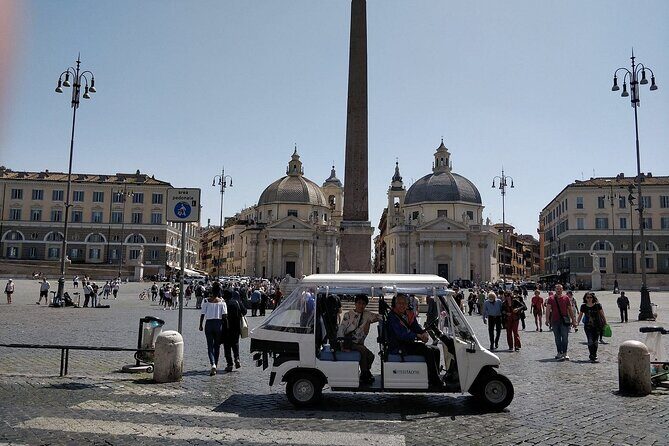
Next up is Piazza del Popolo, one of Rome’s busiest central squares. It’s dominated by an Egyptian obelisk and surrounded by historic facades, with Santa Maria del Popolo as a nearby anchor.
This stop is all about orientation and atmosphere. It’s a place where you can people-watch, scan the streets leading away, and visually reset your mental map of central Rome.
If you’re the type who likes a viewpoint, the nearby Pincio terrace is referenced as a place with city panoramas. Even if you don’t spend ages here, you’ll feel where Rome opens up.
Mausoleum of Augustus: A Quiet History Pause
The Mausoleum of Augustus is presented as a calmer counterpoint: a major ancient monument set in a park with greenery around it. It’s tied to the first Roman Emperor Augustus and dates back to 28 BC, with only part of the original structure remaining.
This stop is short, but it’s valuable because it shifts your attention from squares and fountains to imperial Rome’s “commemoration by architecture.” You’re looking at a monument that was built to last—and you can see how the setting still feels protective and quiet today.
Via del Corso: Rome’s Central Shopping Spine
Then you hit Via del Corso, a major shopping street running from Piazza del Popolo toward Piazza Venezia. It’s not a “ruins only” street; it’s a living Rome corridor lined with shops and cafes.
It also acts as a practical routing tool. Strolling its direction helps you understand how different neighborhoods connect through the center.
If you love browsing, it’s a good moment to mentally bookmark where you’d like to return later. If you prefer fewer crowds, treat it like a view-and-move stop.
Column of Marcus Aurelius: A Stop That Rewards Looking Up
The Column of Marcus Aurelius is one of those monuments you only fully appreciate when you take a second look. It’s about 38 meters tall and carved with a continuous spiral relief showing Marcus Aurelius’ military campaigns.
The tour frames it as a standout, including the fact you can climb the internal staircase for city views. That’s a big difference between “passing by” and actually using your time well.
Note: reviews don’t mention how long people spend here beyond quick stops, so if you’re the type who wants maximum time at a monument, be prepared for limited time unless the guide shifts the order.
Piazza Venezia and the Vittoriano: Big, Italian, and Hard to Ignore
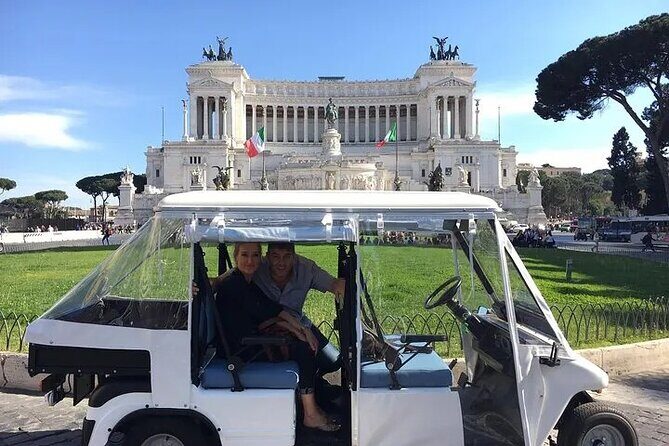
Piazza Venezia is dominated by the Vittoriano, the large white marble monument dedicated to Victor Emmanuel II. It’s one of Rome’s most recognizable landmarks because it’s huge, bright, and visually commanding.
This is a good stop for two reasons:
1) You instantly grasp where key sights cluster in central Rome.
2) You have an option to climb for panoramic views and explore museums/exhibitions inside, if timing allows.
Because the day is structured as short stops, treat this as a “place check” moment. You can decide later whether to return for longer time.
Mercati di Traiano and the Imperial Fora Area: Rome’s Commercial Past
The Trajan Market (Mercati di Traiano) is tied to the Roman emperor Trajan and served as a hub for commerce. Even in a brief visit, it helps you see that ancient Rome wasn’t only temples and forums—it was business, crowds, and infrastructure.
What makes this stop interesting in a tour format is the architecture. The description emphasizes restored ruins, interconnected spaces, and underground areas, plus a curved façade and intricate design.
If you like imagining daily life in ancient cities, this stop can be surprisingly satisfying even without a long deep dive.
Circus Maximus: Chariot-Race Scale Without the Crowds
Circus Maximus is presented as an ancient chariot racing stadium that once held up to 250,000 spectators. Today, much is gone, but it still reads as a huge open space with a park-like feel.
On a golf cart tour, the stop works because you can walk along the ancient track line and quickly orient yourself to scale. Even without massive remaining structure, the location gives you that “this was a stadium city” feeling.
It’s also a great contrast after all the tight streets—more breathing space, more sky, more sense of Rome’s size.
Giardino degli Aranci: Panoramas and the Keyhole Moment
The Orange Gardens (Giardini degli Aranci) on Aventine Hill are a highlight for views. You get greenery, citrus trees, and a calmer pace, plus panoramic sights over Rome and toward the Tiber River.
This stop is also famous for the small keyhole that frames a view of St. Peter’s Basilica in the Vatican from the right angle. It’s the kind of quirky Rome detail that feels small until you’re there and you want to line up the view yourself.
Even if you only spend about 15 minutes, the gardens give you a breather and an easy win for photos.
Mouth of Truth: The Funny Stop That Works
Bocca della Verità is the famous circular stone face at the portico of Santa Maria in Cosmedin. The big draw is the legend: if you put your hand inside and tell a lie, you lose your hand.
Even if you don’t care about the myth, it’s still a memorable pop-culture Rome moment, featured in films like Roman Holiday. Many travelers treat it like a quick photo payoff.
In a tour setting, it’s a light break in the middle of the big monuments, and that helps the day stay enjoyable.
Piazza del Campidoglio: Michelangelo’s Layout and the Marcus Aurelius Statue
On Capitoline Hill, Piazza del Campidoglio is designed by Michelangelo, and it’s framed by major museum buildings like Palazzo dei Conservatori and Palazzo Nuovo (not always visited inside on a short tour).
There’s also mention of a Marcus Aurelius equestrian statue in the area, one of the few surviving equestrian statues from ancient Rome. That detail matters because it connects your tour route back to the earlier Marcus Aurelius column, giving the day a subtle thematic thread.
This stop is quick, but the location helps you understand that Rome’s “hills” aren’t just geography—they’re also layers of power and symbolism.
Piazza Navona and the Fountains That Set the Scene
Piazza Navona is lively and central, known for three fountains, including Fontana dei Quattro Fiumi by Bernini. If you’ve only seen fountains in photos, this is where the scale and setting click.
The square is also a natural people-watch zone with cafés and artists. Even in a short time, it gives you a sense of Rome as a city built for gathering.
Tour value here is simple: you see a top-tier square without needing a long detour from your main route.
Pantheon: The One Stop Everyone Remembers
The Pantheon is one of the most famous buildings in Rome for a reason. The description highlights the enormous unsupported dome and the circular oculus that brings light into the interior.
What you get on this kind of tour is usually that first emotional hit: the building design and engineering read instantly when you’re inside. Then you move on—no long waiting for a ticket strategy or a complicated itinerary.
Because Pantheon time can feel intense (crowds, lines, and attention), the short guided pause is likely perfect if you’re using the tour as an orientation step.
Chiesa di Sant’Ignazio di Loyola: Baroque Trick Art
Sant’Ignazio di Loyola brings you into baroque church design, including frescoes, gilded details, and the famous False Dome painted trompe-l’oeil ceiling effect by Andrea Pozzo.
Even if you only see it briefly, it’s one of those “how did they do that?” stops that makes Rome feel like a place where art and architecture were built to play with your perception.
This is a nice shift from outdoors monuments to indoor storytelling.
Trevi Fountain and the Coin-Toss Tradition
Trevi Fountain is famous for a reason: it’s baroque, sculptural, and instantly recognizable. The central Neptune figure and the tradition of tossing coins are part of the big “Rome must-see” package.
The tour keeps this stop short, but it’s still worth it. You’ll see the scale and the classic composition in person, and then you can decide if you want to return later at a different time of day for fewer crowds or better light.
Piazza Di Spagna: Spanish Steps as a Rest-and-Reset Stop
Piazza di Spagna and the Spanish Steps give you a scenic pause in the middle of the day’s intensity. The steps connect the Piazza di Spagna to Trinità dei Monti and are lined with famous views and the Barcaccia fountain at the base.
This is a great “sit and regroup” moment where you can also people-watch. If you’re traveling with kids or older family members, this stop is often the one where energy comes back.
A Note on Food and Drinks: What You Might Get From Guides
The core tour itself is about sightseeing and stops, not a fixed meal plan in the provided details. Still, some travelers mention guides suggesting local gelato and even stopping for snacks.
One review specifically notes Francesco helping arrange suppli from a local favorite shop and recommending gelato near the Spanish Steps. Treat that as an example of the kind of local touch that can happen when you’ve got a guide who enjoys the city.
My take: don’t assume lunch is included, but do expect helpful food direction, especially near major squares.
Accessibility and Who This Tour Fits Best
The tour is described as accessible for most travelers, and the golf cart format is naturally easier than walking long distances. Reviews also mention it’s especially comfortable for older family members and for people who don’t want to spend the day on foot.
This is a good fit if you:
- want a first-time Rome overview
- care about history but don’t want museum-heavy logistics
- have limited time and want a route across many neighborhoods
- are traveling with mixed mobility needs
Where Some Tours Go Wrong (So You Can Avoid It)
A few travelers reported problems that are worth planning around.
1) Audio and hearing: some groups said they struggled to hear the guide during the ride if sound equipment wasn’t clear.
2) Pickup confusion: if the driver couldn’t reach a hotel location, meeting at the listed start point became the fix, but it caused stress for some people.
3) Pace vs. expectations: some guests felt the tour was rushed, or that not every listed stop got the attention they expected.
None of that means the tour is bad. It just means you should go in with the right expectations: this is an overview tour with short pauses, and your biggest success factor is smooth pickup and a good audio situation.
Cancellation, Confirmation, and Booking Timing
You get free cancellation up to 24 hours before the start time for a full refund. Confirmation is received at booking, and the tour is also described as near public transportation.
Average booking timing is about 62 days in advance, which suggests it’s popular enough that planning early can help lock in your slot.
Should You Book This Rome Golf Cart Tour?
If you’re trying to make the most of a short visit, this tour has a clear appeal: it’s an organized way to hit major Rome landmarks with a guide who explains more than just dates and names. The repeated praise for guides like Hadi, Francesco, Pietro, and Marco points to a real strength: people feel cared for, not herded.
I’d especially recommend it if you want:
- an easy first-day perspective
- a photo-friendly route
- less walking strain
- quick, local context for what to revisit later
Skip or at least adjust expectations if you need long museum time, perfect deep stops at every site, or you’re worried about hearing the guide. And if your hotel is outside central pickup coverage, double-check your meeting-point instructions early.
Rome: Golf Cart Tour of the Eternal City
FAQ
How long is the Rome golf cart tour?
It’s listed as about 3 hours.
What does the tour cost?
The price is $160.91 per person.
Is pickup included?
Yes, pickup is offered from a central Rome hotel. If your hotel is outside the central area, you may need to meet at a designated central location.
Where is the meeting point if I need to meet there?
The listed start point is Piazzale delle Canestre, SNC, 00197 Roma RM, Italy.
What language is the tour guide?
The tour is offered in English.
Is this a private tour?
Yes. It’s described as private, meaning only your group will participate.
Do I get a mobile ticket?
Yes, the tour includes a mobile ticket.
Is admission included for the stops?
The itinerary items are listed with Admission Ticket Free.
What is the cancellation policy?
You can cancel for free up to 24 hours in advance for a full refund. If you cancel less than 24 hours before, the amount paid is not refunded.