
- Where to Stay in Tokyo With Kids
- Why Your Tokyo Neighbourhood Matters
- Ueno — Our Top Pick for Families
- Near Tokyo Station — For Day-Trip Families
- Shinjuku — Brilliant but Chaotic
- Shibuya — For Teens, Not Toddlers
- The Disney Area (Urayasu/Maihama)
- MIMARU Apartment Hotels — The Best Family Option in Tokyo
- Practical Tips for Booking Tokyo Hotels With Kids
- Our Recommended Strategy
Where to Stay in Tokyo With Kids
Tokyo’s a city that rewards you for picking the right base. Get it wrong and you’ll spend half your holiday dragging tired children through underground corridors, changing train lines for the third time, wondering why you didn’t just book somewhere sensible. Get it right and everything clicks — the station’s two minutes away, there’s a konbini on the corner for morning rice balls, and the kids are happy.
We’ve stayed in four different neighbourhoods across multiple Tokyo trips. Some were brilliant. One was a mistake we won’t repeat. Here’s what we’ve learned about choosing where to stay in Tokyo with kids, and why it matters more than you’d think.
Why Your Tokyo Neighbourhood Matters
Most visitors underestimate how spread out Tokyo is. It’s not like London where you can walk between major sights. Each neighbourhood has its own station, its own character, its own rhythm. The train system connects everything beautifully, but when you’re travelling with small children, fewer train changes means fewer meltdowns. Simple as that.
You also need to know that standard Japanese hotel rooms are small. We’re talking 15 to 18 square metres for a typical double. That’s fine for a couple. For a family of four? Absolutely not. You’ll want to specifically book rooms designed for three or four guests, and even then, manage your expectations. This isn’t a Premier Inn family room. Space is precious in Tokyo and the hotels reflect that.
Ueno — Our Top Pick for Families
If you’re visiting Tokyo with kids for the first time, stay in Ueno. Full stop.
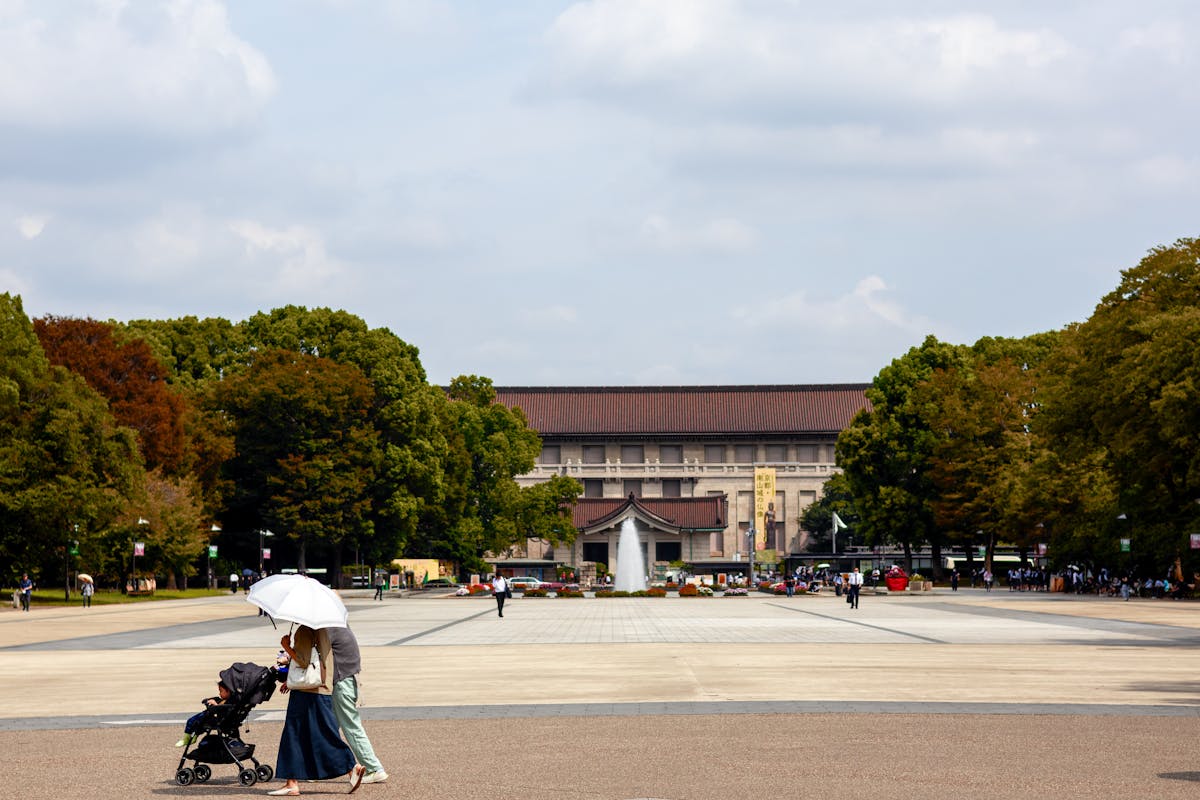
It’s quieter than Shinjuku, less chaotic than Shibuya, and genuinely family-friendly in a way that most Tokyo neighbourhoods aren’t. Ueno Park is right there — an enormous green space with playgrounds, temples, museums, and Ueno Zoo. On our first morning, the kids spent two hours in the park before we’d even attempted a train journey. That slow start set the tone for the whole trip.
The practical side is strong too. Ueno Station sits on the Yamanote Line (the circular line that connects all of Tokyo’s major areas) and it’s the terminus for the Keisei Skyliner to Narita Airport. That Skyliner connection is gold — 36 minutes from Ueno to the airport terminal, no changes, comfortable seats. When you’re leaving Japan with exhausted children and overstuffed suitcases, you’ll be grateful for it.
The streets around Ueno feel calmer. There are family restaurants, small parks tucked between buildings, and Ameyoko market for cheap snacks and fruit. It doesn’t have the glamour of Shibuya or the skyscrapers of Shinjuku, but that’s precisely why it works for families.
The Mitsui Garden Hotel Ueno is a solid choice if you want a proper hotel with good service. Rooms are still compact by British standards, but the location is hard to beat — a short walk from the station and the park.
Near Tokyo Station — For Day-Trip Families
If your Japan itinerary includes shinkansen day trips to places like Hakone, Kamakura, or Nikko, then basing yourselves near Tokyo Station makes a lot of sense. You can roll out of your hotel, walk to the platform, and be on a bullet train within minutes. No navigating rush-hour connections with a pushchair.
Tokyo Station itself is worth exploring. Character Street in the underground shopping area sells merchandise from every Japanese character you can imagine — Pokémon, Studio Ghibli, Sanrio, Shinkansen-themed everything. Our kids thought it was a theme park. Budget warning: you will spend money here. Probably quite a lot of money.
The Imperial Palace East Gardens are a ten-minute walk from the station. Free entry, beautifully maintained, and spacious enough that children can actually run around. It’s one of the few central Tokyo spots where you don’t feel hemmed in by buildings.
Hotels near Tokyo Station tend to be business-oriented, which means efficient but not especially child-friendly. You won’t find many family rooms. The area’s also quieter in the evenings — not much nightlife, which is either a positive or a negative depending on your perspective. For us, with kids in bed by eight, it was ideal.
Shinjuku — Brilliant but Chaotic
Shinjuku is Tokyo’s main transport hub. More train lines converge here than anywhere else in the city, which makes it incredibly convenient for getting around. The catch? Shinjuku Station is the busiest railway station on earth, and navigating it feels like being inside a labyrinth designed by someone who actively dislikes travelers.
I’m not exaggerating. The station has over 200 exits. Two hundred. Even with Google Maps open, we got lost three times in one day. With a toddler in a carrier and a six-year-old asking for the toilet, it was properly stressful. If your children are older — say, eight and up — and reasonably patient with crowds, Shinjuku works brilliantly. For families with little ones, I’d think twice.
There’s also the Kabukicho entertainment district to consider. It’s Tokyo’s red-light area, and while it’s not dangerous, it’s not somewhere you’d choose to walk through with young children. Bright lights, loud touts, host club advertising. Fine if your hotel isn’t in that pocket, but worth checking the exact location before you book.
On the positive side, Shinjuku Gyoen National Garden is genuinely lovely — wide lawns, a greenhouse the kids enjoyed, and cherry blossoms in spring that’ll stop you in your tracks. Entry is just ¥500 for adults, free for children under six.
The Keio Plaza Hotel Tokyo is one of the few Shinjuku hotels that properly caters to families. It’s a large, established hotel on the west side of the station — away from Kabukicho — with rooms that can accommodate three or four guests. The west exit area is noticeably calmer than the east side.
Shibuya — For Teens, Not Toddlers
Shibuya is cool. There’s no denying it. The famous crossing, the trendy shops, the energy of the place — teenagers absolutely love it. Our eldest thought it was the best part of Tokyo.
But for younger kids? It’s overwhelming. The crowds around the crossing are dense, the pavements are narrow, and everything’s designed for twenty-somethings spending money on fashion and food. There aren’t playgrounds. There aren’t quiet green spaces (Yoyogi Park is technically closer to Harajuku). The restaurants tend to be small, up narrow staircases, and not pushchair-friendly.
If you’ve got teens and no little ones, Shibuya’s a fantastic base. The Shibuya Excel Hotel Tokyu sits directly above the station with views of the crossing — your teenagers will think you’re the coolest parent alive. It’s well-connected on the Yamanote Line and walking distance to Harajuku and Omotesando.
For families with under-tens, though, I’d visit Shibuya for an afternoon rather than staying there. You get the experience without the hassle of navigating it with tired children every evening.
The Disney Area (Urayasu/Maihama)
Let’s be honest about this one. The hotels around Tokyo Disney Resort in Urayasu and Maihama are there for one reason: the parks. If you’re spending two or three days at Tokyo Disneyland and DisneySea, staying nearby saves you the hour-long commute from central Tokyo each way.
But that’s all it’s good for. There’s nothing else in the area. No local restaurants worth mentioning, no sightseeing, no sense of being in Japan. Once you’ve finished your Disney days, you’ll want to move to a central hotel.
The Hilton Tokyo Bay is the family favourite here. Larger rooms than most Tokyo hotels, a pool, and the Disney Resort shuttle stops right outside. For two or three nights of theme-park madness, it does the job well. Expect to pay around ¥35,000–50,000 per night for a family room.
Our advice: book Maihama for your Disney nights only, then shift to Ueno or Tokyo Station for the rest of your trip. Don’t try to do central Tokyo sightseeing from a Disney-area hotel. The commute will eat your day alive.
MIMARU Apartment Hotels — The Best Family Option in Tokyo
Right. This is the recommendation that genuinely changed how we do Tokyo.
MIMARU runs a chain of apartment-style hotels across Tokyo (and Kyoto and Osaka) that are specifically designed for families and groups. They’re not serviced apartments in the traditional sense — there’s a front desk, daily options for cleaning, and hotel-level service. But your room has a proper kitchen, a washing machine, a dining table, and enough space for everyone to breathe.
After a week of eating out three times a day in Tokyo, the ability to make the kids pasta or rice in your own kitchen is transformative. Not every meal needs to be an adventure. Sometimes children just want something familiar, made quickly, eaten in their pyjamas. MIMARU lets you do that.
The washing machine is the other game-changer. Pack half the clothes you’d normally bring and do laundry every few days. Your suitcase will thank you.
Room sizes are significantly larger than standard hotels — typically 40 to 50 square metres, with separate sleeping and living areas. Some rooms have bunk beds, which our kids treated as a holiday highlight all on their own. There’s also a tatami area in many rooms, which little ones love for playing and rolling around on.
MIMARU Tokyo Ueno North combines our favourite neighbourhood with our favourite hotel type. It’s a ten-minute walk from Ueno Station, in a quiet residential street. Rates start around ¥25,000 per night for a family room, which is genuinely good value when you factor in the space and the kitchen savings.
They’ve got branches in Shinjuku, Nihonbashi, Akasaka, and several other locations. Whichever neighbourhood you choose, check if there’s a MIMARU there first.
Practical Tips for Booking Tokyo Hotels With Kids
Book rooms for your actual number of guests. Japanese hotels take occupancy seriously. A room listed for two guests means two guests. Adding a third or fourth person isn’t just a matter of requesting an extra bed — many hotels charge ¥5,000–8,000 per extra person per night, and some simply won’t allow it. Search specifically for three-person or four-person rooms from the start.
Consider tatami rooms. Traditional Japanese-style rooms with futon bedding on tatami mats are brilliant for families. The whole floor becomes one big bed. No risk of little ones rolling off, plenty of space to spread out, and kids find the whole thing exciting. Many hotels and ryokan offer tatami rooms or combination Western-Japanese rooms. They’re usually the same price or even cheaper than twin rooms.
Don’t underestimate room size. I’ll say it again because it catches people out every single trip. Standard rooms in Tokyo are 15 to 18 square metres. Some budget hotels go as low as 12. That’s the size of a garden shed. With suitcases open on the floor, you can barely move. For families, you want 25 square metres minimum, ideally 35 or more. Filter your hotel search by room size — most booking sites allow this.
Location beats luxury every time. A three-star hotel next to a major station will serve your family better than a five-star hotel that requires two train changes to reach anything. Tokyo’s train system is magnificent, but every connection adds ten minutes and another set of stairs or escalators to navigate. Proximity to a Yamanote Line station should be near the top of your priority list.
Book early for peak seasons. Cherry blossom season (late March to mid-April) and autumn colours (mid-November to early December) are when family-friendly rooms vanish fastest. If you’re travelling during school holidays that overlap with these periods, book your hotels three to four months ahead. Six months isn’t too early for Golden Week (late April to early May).
Our Recommended Strategy
For a week-long Tokyo trip with kids, here’s what we’d do. Spend your first three or four nights in Ueno, using it as a base for central Tokyo sightseeing. If you’re doing Disney, shift to Maihama for two nights. Then either return to Ueno or, if you’re catching a shinkansen onward to Kyoto or elsewhere, spend your final night near Tokyo Station.
Moving hotels mid-trip sounds like a hassle, but in Tokyo it’s genuinely easy. Coin lockers at major stations are large enough for suitcases (¥700–1,000 for the biggest size, and most hotels will store your luggage before check-in or after checkout. The city is built for people in transit.
Tokyo with kids is one of the best family trips we’ve ever done. The right hotel in the right neighbourhood makes the difference between a good holiday and an extraordinary one. Take the time to get it right and everything else falls into place.
For more on planning your trip, see our complete guide to family travel in Japan.