
Okinawa With Kids
We nearly didn’t go. Okinawa felt like a detour — extra flights, more luggage wrangling, more “but WHY can’t I bring my bucket on the plane.” Adding a beach destination to a Japan trip seemed off-brand. Japan is temples and bullet trains and ramen. Not turquoise water and white sand. Right?
Wrong. Completely wrong.
Okinawa is Japan’s subtropical south. A chain of islands stretching way below the mainland, closer to Taiwan than to Tokyo, with a climate and culture all its own. The Ryukyu Kingdom ruled here for centuries before Japan absorbed it, and that history colours everything — the food, the architecture, the pace of life. Think Japan meets the Caribbean. Warm shallow seas, coral reefs, and an attitude so laid-back it makes mainland Japan look frantic. It’s where Japanese families go on holiday. That should tell you something.
For us, it turned out to be the best four days of our entire trip. The kids went feral on beaches, we swam with tropical fish, and everybody slowed down. If you’re planning a family trip to Japan and you’ve got room in your itinerary, Okinawa deserves serious consideration.
Getting to Okinawa
No train. That’s the first thing to know. Okinawa is about 1,600 kilometres south of Tokyo, and the only way there is by air. Shinkansen connection? Doesn’t exist.
Flights from Tokyo Haneda or Narita take two and a half to three hours. From Osaka Kansai, closer to two. ANA and JAL fly the route, plus budget airlines Peach and Jetstar. Expect ¥10,000–25,000 (~£53–130) per person one way, depending on season and how far ahead you book.
We flew Peach from Osaka. Fine. No frills, no legroom, but two hours passes quickly with a tablet and rice crackers. If you’re flying to Japan with kids on an international ticket, check whether your airline offers a domestic add-on — ANA and JAL both sell discounted internal flights to foreign passport holders.
Best Time to Visit Okinawa
This matters more than you’d think.
The sweet spots are April to June (before the rainy season properly kicks in) and October to November (typhoon risk dropping, crowds thinning, water still warm). We went in late October and it was gorgeous — 26°C days, warm enough for swimming, not so hot that the kids melted on every pavement.
July and August are scorching, humid, and typhoon season. If a typhoon parks itself overhead, your trip becomes four days watching rain from a hotel room. Not ideal.
The sea is warm enough for swimming from roughly March through November. Cherry blossoms arrive in Okinawa in January — weeks before the mainland. Winter rarely drops below 15°C.
For families, I’d push for that late October sweet spot. Manageable heat, fewer crowds, reasonable prices. May is lovely too if school holidays allow it.
You Need a Rental Car
Public transport in Okinawa is thin. Naha has a monorail — useful for the city. Beyond that? Buses exist. They’re slow, infrequent, and reaching the aquarium by bus with children is an exercise in frustration. Rent a car. Every family we met had done the same.
Driving is easy. Left-hand side, same as the UK, so no mirror-image panic. Roads are well-maintained, signposted in English, and traffic outside Naha is light. A standard car costs ¥5,000–8,000 (~£26–42) per day. Most agencies accept international driving permits. Book ahead in peak season.
The Beaches
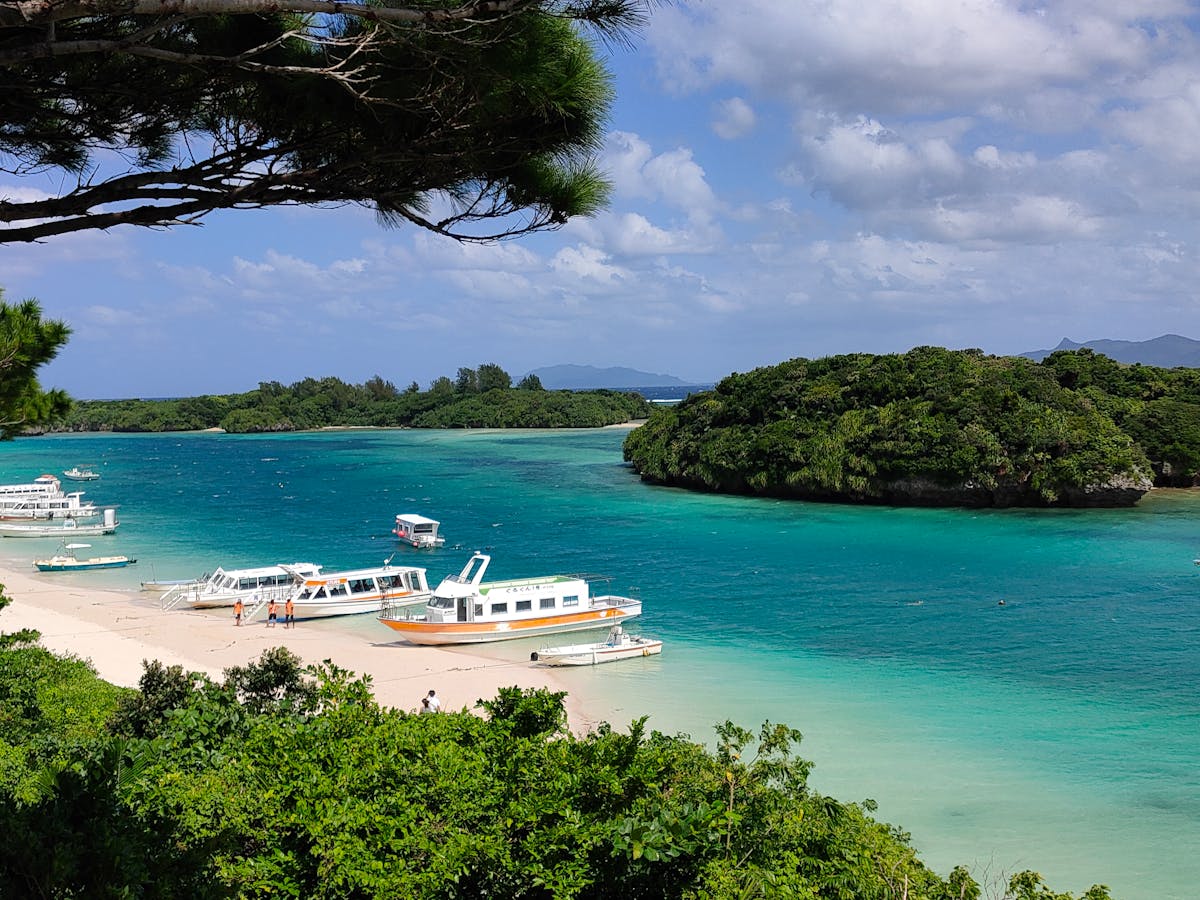
Okinawa has Japan’s best beaches and it’s not even close. Mainland Japan has some decent coastal spots, but nothing that looks like this — white sand, water so clear you can see fish from the shore, and that particular shade of blue-green that makes your phone camera give up trying to capture it.
A few favourites.
Araha Beach in Chatan was our go-to. Long stretch of calm, shallow water. Lifeguards on duty in summer. A playground right behind the sand. Clean facilities. Free parking. It ticked every family box without feeling remotely like a tourist trap. We went three times in four days.
Naminoue Beach in central Naha is the city beach — walkable from Kokusai Street, backed by a clifftop shrine, surprisingly pretty for an urban spot. Small but convenient if you’re based in Naha and want a quick swim without driving anywhere.
Manza Beach on the west coast is resort territory. Stunning setting on a headland with cliffs either side. Crystal water. Hotel facilities available for a fee if you’re not staying there. Worth a visit even if you’re based elsewhere.
Emerald Beach sits right next to Churaumi Aquarium, which makes it perfect for combining an aquarium morning with an afternoon on the sand. Shallow, calm, and the kids can burn off their post-aquarium energy without you driving anywhere else. Clever planning, that.
Most beaches have lifeguards during the official swimming season (roughly April to October). Outside those months you can still swim — the water’s warm enough — but supervision is your own responsibility.
Churaumi Aquarium
This is the headline attraction. One of the biggest and best aquariums on the planet, and genuinely worth the trip to Okinawa on its own.
The centrepiece is the Kuroshio Sea tank — an enormous wall of glass holding 7,500 cubic metres of water, whale sharks, manta rays, and hundreds of other species drifting past in slow motion. Our children stood in front of it with their mouths open for a solid twenty minutes. I’m not sure any of us have been that quiet in a public place before or since.
Beyond the big tank: touch pools (shrieks of delight mixed with shrieks of horror), a turtle pool, dolphin shows, and coral reef sections. The building moves you from shallow reef at the top to deep ocean at the bottom. Clever design.
Admission is ¥2,180 for adults, ¥610 for children aged 6–17, free for under-sixes. Allow three hours minimum. There’s a cafe overlooking the main tank where you can eat lunch while whale sharks glide past. Surreal.
The aquarium is in Motobu, about 90 minutes north of Naha. Go early — arriving by 9am beats the tour buses.
Shuri Castle
A bit of culture between beach days. Shuri Castle sits on a hill overlooking Naha — the seat of the Ryukyu Kingdom for centuries, now a UNESCO World Heritage Site. The red-lacquered buildings with Chinese-influenced design look nothing like mainland castles. Different kingdom, different aesthetic.
The main hall was destroyed by fire in 2019 and reconstruction is underway. Still worth visiting — the outer walls, gates, and grounds are intact, and the rebuilding itself is part of the experience now, with viewing platforms showing traditional techniques. Admission ¥400 adults, ¥160 children. Reachable by monorail (Shuri station). Budget an hour.
American Village
Chatan’s American Village is a sprawling waterfront shopping area that exists because of the US military presence on Okinawa. Brash, colourful, completely unlike anywhere else in Japan. Giant Ferris wheel, neon signs, American-style diners, beachside boardwalk.
Culturally enriching? Not particularly. Did our kids adore it? Absolutely. The Ferris wheel got three rides. The sunset from Sunset Beach was spectacular. Free to wander — you only pay for what you buy. We used it as an evening destination after beach days. Low effort, high reward.
Snorkelling and Glass-Bottom Boats
Glass-bottom boat tours run from various spots along the coast, typically ¥3,000–5,000 (~£16–26) per person. You sit in the hull watching clownfish and sea turtles through the transparent bottom. Dry, safe, and our youngest’s absolute highlight.
For older children who swim confidently, guided snorkelling trips are brilliant. Warm water, ten-metre visibility, tropical reef life. Blue Cave near Cape Maeda is the popular spot — a sea cave where sunlight turns the water an impossible shade of blue. Family sessions include guides, equipment, and life jackets. Easy to book locally.
Kokusai Street
Naha’s main drag. About 1.6 kilometres of shops, restaurants, and market stalls. Touristy, yes, but fun — especially evenings when the food stalls fire up.
The kids loved the purple sweet potato tarts. Okinawa is obsessed with beni-imo and you’ll find it in tarts, ice cream, crisps, Kit Kats, and forms you didn’t know existed. The tarts from Okashigoten are the classic souvenir. We bought too many boxes.
Salt ice cream is the other must-try. Okinawan sea salt mixed into vanilla soft serve. Sounds odd. Tastes fantastic. A couple of hundred yen from stalls along the street. The Makishi Public Market nearby is a maze of fish sellers where you buy seafood downstairs and have it cooked upstairs. Not cheap but a great experience.
Okinawan Food
Okinawan cooking is its own thing. Shaped by the Ryukyu Kingdom’s trade links with China and Southeast Asia, plus decades of American influence. Heartier, saltier, more relaxed than mainland cuisine.
Goya champuru — bitter melon stir-fried with tofu, egg, and pork. Acquired taste. Most children want nothing to do with it. Taco rice is the one they’ll actually eat — seasoned mince, cheese, lettuce, and salsa over rice. Cheap, filling, universally popular with small people. Okinawa soba (soki soba) is thick wheat noodles in pork broth, topped with stewed ribs. ¥600–900 a bowl. Rich and comforting.
The dining culture is noticeably more relaxed than Tokyo or Kyoto. Restaurants are louder, nobody bats an eyelid at children being children. A genuine relief after weeks of teaching ours to whisper in ramen shops.
Where to Stay
Three main options depending on what kind of trip you’re after.
Naha is the obvious base if you want city convenience. Walking distance to Kokusai Street, the monorail, Shuri Castle. Good restaurant options. Easy access to the airport. The downside: you’ll be driving to every beach and the aquarium.
Chatan is our pick for families. Halfway up the west coast, right next to Araha Beach and American Village. Close enough to Naha for evening trips but positioned for easier drives north to the aquarium. Beach on your doorstep. It’s the sweet spot.
West coast resort hotels — Onna, Motobu, that stretch — are for families who want a full beach holiday. Big pools, ocean views, resort breakfasts. Closer to Churaumi Aquarium. More isolated, higher price point, but if lazing by a pool while the kids swim themselves unconscious is the goal, these deliver.
Prices vary wildly by season. Budget hotels in Naha start around ¥8,000 (~£42) per night. Mid-range family rooms in Chatan run ¥12,000–20,000 (~£63–105). Resort hotels on the west coast can hit ¥30,000–50,000 (~£158–263) or more in peak season. Book early for summer and Golden Week — availability disappears fast.
How Long Do You Need?
Three days is the absolute minimum to justify the flights. Five is better. A full week is genuinely easy to fill without repeating yourself — between the aquarium, two or three different beaches, Shuri Castle, American Village, snorkelling, Kokusai Street, and some lazy pool time, you won’t run out of things to do.
We had four days and wished we’d had six. The Kerama Islands — Zamami and Tokashiki — are reachable by ferry and supposedly even more spectacular. Next time.
If you’re combining Okinawa with a wider Japan trip, fly down at the end rather than the beginning. Use it as decompression after Tokyo and Kyoto. Your children will be temple’d out by then. Four days of beaches and ice cream before the flight home is a kindness to everyone.
Is Okinawa Worth Adding to Your Japan Trip?
If you’ve got the time and the budget for extra flights — yes. Unequivocally.
Okinawa showed us a side of Japan we’d never have found on the mainland. The kids swam in water that belongs on a postcard, fed starfish at one of the world’s great aquariums, and declared taco rice the best meal of the entire holiday. Over actual sushi in Tokyo. Thanks very much.
It’s not the Japan you see in the guidebooks. It’s the Japan where Japanese families go to breathe out. After two weeks of train schedules and shrines with overtired children, breathing out was exactly what we needed.