
Greece wasn’t even on our radar for years. We kept gravitating towards Spain and France, the way most British families do, because they felt safe and familiar. Then a friend came back from Crete raving about it — the beaches, the food, the prices — and we thought, fine. Let’s try it. Best decision we’ve made.
There’s something about Greece that clicks with families in a way that’s hard to explain until you’ve been. The culture is genuinely child-friendly. Not in a “here’s a kids’ club, off you go” kind of way, but in a deeper sense. Greek people adore children. Your kids will get fussed over in restaurants, handed free biscuits by shopkeepers, welcomed into places that in other countries would feel stuffy or adult-only. It’s a Mediterranean thing, but Greece does it better than most.
And the practical stuff stacks up too. Three to four hours from most UK airports. Budget flights with easyJet and Ryanair to dozens of Greek islands and Athens. The euro means no awkward currency conversions. Food is affordable — properly affordable, not “affordable for a holiday” affordable. A full taverna meal for a family of four can come in under forty euros, easily. Good luck doing that in the south of France.
Why Greece Works for Families
The short version: warm sea, cheap food, friendly locals, ancient history your kids will actually find interesting, and beaches that go on forever. The slightly longer version involves the fact that Greek islands offer a pace of life that suits families perfectly. Nobody’s in a rush. Lunch stretches for two hours. Dinner doesn’t start until nine. There’s a looseness to the whole thing that takes the pressure off in a way that theme parks and all-inclusive resorts never quite manage.
The beach-plus-history combination is a genuine selling point. You can spend the morning at a 3,000-year-old archaeological site and the afternoon floating in crystal-clear water. Try doing that in Blackpool.
Athens With Kids
Let’s start with the capital. Athens gets a bad reputation as being too hot, too chaotic, too urban. And it can be all of those things. But it’s also magnificent, and one to two days here at the start or end of your trip is absolutely worth it.
The Acropolis is the main event. Obviously. It’s one of the most famous structures on the planet and it does not disappoint. Tickets are around twenty euros for adults, and here’s the brilliant bit — under 18s from EU countries get in free. Free. To the Acropolis. That’s an absurd deal.
The critical advice: go at opening time. Eight in the morning. We cannot stress this enough. By ten o’clock it’s heaving with tour groups, the sun is hammering down, and there’s virtually no shade up there. At eight, it’s quiet, the light is gorgeous, and your kids might actually enjoy it rather than whining about being hot. Because they will be hot. There’s no way around that. Bring water, wear hats, and don’t dawdle.
The Acropolis Museum sits at the base of the hill and it’s a perfect follow-up. Ten euros for adults, free for under 5s. It’s air-conditioned, which after the hilltop feels like walking into paradise. The glass floor showing the excavations underneath is brilliant — kids love looking down at it. An hour is plenty unless yours are particularly into ancient pottery.
After that, wander down into Plaka for lunch. It’s the old neighbourhood below the Acropolis, full of narrow streets and tavernas with outdoor seating. Touristy? Yes. But the food is still good and the atmosphere is lovely. Grab a souvlaki and sit in the shade for a while.
If your children need to burn off energy — and they will — the National Garden is a ten-minute walk from Plaka. There’s a free playground, a small zoo, a duck pond, and loads of shaded paths. It’s not spectacular but it does the job, and after a morning of ancient ruins, sometimes “does the job” is exactly what you need.
One to two days in Athens is enough with kids. Don’t try to stretch it further unless you’re staying somewhere with a pool. The city is intense in summer and everyone’s tolerance has a limit.
Greek Islands for Families
This is where it gets good. Greece has over two hundred inhabited islands and choosing between them can feel overwhelming. Here’s our honest take on the best ones for families.
Crete is the biggest island and probably the best all-rounder for a family holiday. There’s genuinely loads to do. Knossos — the ancient Minoan palace — is fascinating for kids who are into mythology (hello, Minotaur). The beaches are stunning, particularly along the west coast around Chania. Elafonissi with its pink-tinged sand is one of the most beautiful we’ve seen anywhere. The Samaria Gorge is spectacular if your kids are old enough for a proper hike. And because Crete is large, it doesn’t feel overcrowded even in peak summer. There’s always another beach to discover.
Rhodes has something Crete doesn’t — a medieval old town that looks like it belongs in a film set. The kids will think they’ve walked into a castle. Knights’ armour, narrow stone alleys, cats sleeping on ramparts. It’s brilliant. The beaches on the east coast are calm and family-friendly, and there are decent waterparks if you need a day of pure kid entertainment.
Corfu is the green one. Lush, almost tropical in places, with olive groves running down to the sea. It’s popular with package holiday companies, which means there are plenty of family-oriented resorts with pools and kids’ clubs if that’s your thing. The northeast coast around Kassiopi has gorgeous pebble coves with clear water. Not as wild or adventurous as Crete, but sometimes relaxing is the whole point.
Naxos is our quiet favourite. Less developed than the bigger islands, with long sandy beaches that stretch out empty even in July. Agios Prokopios and Plaka beach are genuinely some of the best family beaches in Greece — shallow water, soft sand, gentle waves. The town is charming without being overrun. If you want a proper unwind-and-do-very-little holiday, Naxos is hard to beat.
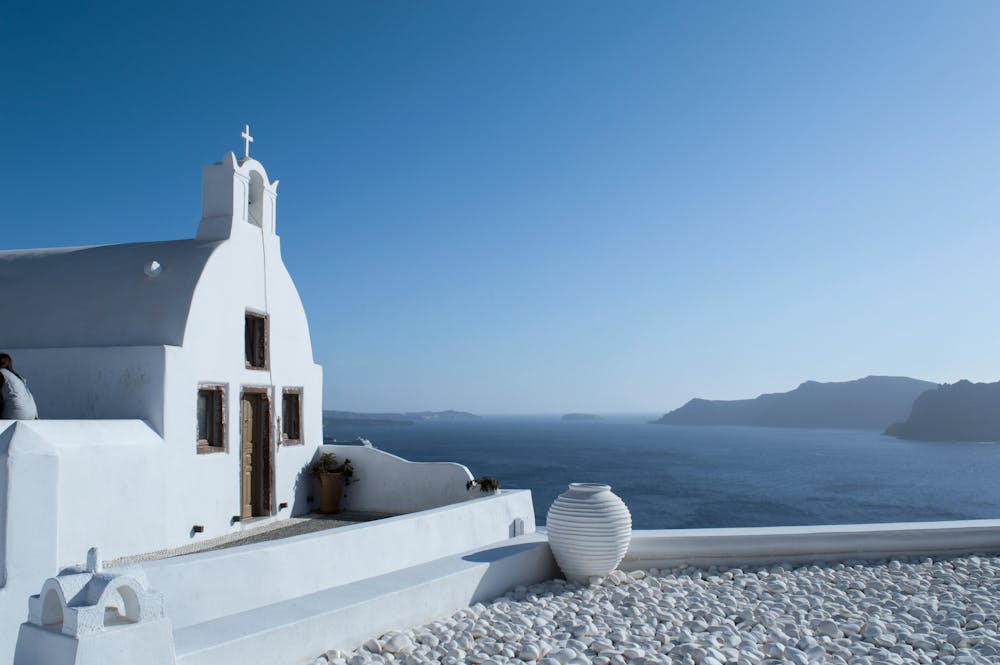
Santorini — and here’s where we upset people — is not great for families with small children. It’s gorgeous. Truly. Those white buildings tumbling down the caldera are as dramatic as every photo suggests. But. The paths are steep and narrow. Steps everywhere. Pushchairs are basically useless. The beaches are volcanic — black or red pebble, not sandy — and the water drops off quickly. Restaurants are expensive by Greek standards. And the crowds in summer are relentless. Go for your anniversary. Don’t take the toddler.
Greek Beaches
We’ve already mentioned a few, but it’s worth saying: Greek beaches are phenomenal for children. The water in the Aegean and Ionian is warm from June through September — properly warm, not “I’ll get in if I don’t think about it” warm. Many beaches have a long shallow entry, so small kids can paddle and splash without you having a cardiac event every thirty seconds.
Sand quality varies by island. Naxos and parts of Crete have soft golden sand. Rhodes is mostly pebble on the west coast, sand on the east. Corfu is a mix. It’s worth researching the specific beaches near your accommodation before you book, because the difference between a sandy bay with shallow water and a pebbly cove with a steep drop-off is the difference between a relaxed day and a stressful one.
Popular beaches in summer have lifeguards, which helps. Sunbeds and umbrellas are available at most organised beaches for around eight to fifteen euros per set. Or bring your own towel and find a quieter stretch. Both approaches work.
Eating Out With Kids
Greek food might be the most naturally kid-friendly cuisine in the Mediterranean. Souvlaki. Chips. Grilled chicken. Bread with olive oil. Pasta. Plain grilled fish. Meatballs. There is something on every taverna menu that even the fussiest child will eat.
The sharing style of Greek dining makes family meals easy. You order a bunch of dishes for the table — a Greek salad, some tzatziki, a plate of chips, grilled lamb chops, maybe some fried calamari — and everyone picks at everything. No stress about ordering a separate “kids’ meal” that arrives as a sad plate of nuggets. Most tavernas don’t even have a children’s menu, because they don’t need one.
Prices are a genuine pleasure. A full taverna dinner with drinks — we’re talking multiple plates, bread, a carafe of house wine for the adults, soft drinks for the kids — comes to around eight to fifteen euros per person. On the islands, some of the best food comes from tiny family-run places with plastic tablecloths and cats weaving between the chairs. Don’t chase fancy restaurants. The simple ones are usually better.
And the attitude towards children in Greek restaurants is wonderful. Nobody bats an eyelid if your toddler is wandering between tables. The owner’s grandmother is probably sitting in the corner doing exactly the same thing. We’ve had waiters bring out free fruit and honey for the kids without being asked. It’s that kind of place.
Island Hopping With Kids
The romantic idea of island hopping — catching ferries between sun-bleached islands — is absolutely doable with children, but it needs some thought.
The main ferry companies are BlueStar and Hellenic Seaways. Ferries range from huge car-carrying vessels with cafes and outdoor decks to smaller high-speed catamarans. The big slow ferries are more comfortable for families — more space to move around, less motion. The fast ones are quicker but can be rough in wind, and the Aegean winds in July and August can be ferocious. A meltemi blowing at full force turns a calm crossing into a washing machine.
Keep crossings short if you’ve got small children. Mykonos to Naxos is about thirty-five minutes. Manageable. Athens (Piraeus) to Santorini is five hours on the fast ferry. Less manageable with a three-year-old who’s had enough.
Book in advance for July and August sailings. Ferries do sell out, particularly the popular routes. We’d suggest two or three islands maximum over a two-week trip. Any more than that and you’ll spend your holiday packing and unpacking.
Where to Stay
Apartments and villas with a private pool are the sweet spot for families in Greece. Hotel rooms on the islands tend to be small — fine for a couple, cramped for a family. A two-bedroom apartment with a kitchen and a pool gives you space to spread out, the option to make breakfast and snacks without eating out for every meal, and somewhere for the kids to swim during the hottest part of the day when the beach is unbearable.
Villas with pools are surprisingly affordable on islands like Crete and Naxos. You can find a good three-bedroom place with a pool for one hundred to one hundred and fifty euros a night, which split between two families is a bargain.
Book early for July and August. Really early. February or March early. The best family properties get snapped up fast, and by May you’ll be choosing between leftovers and places that cost twice what they should.
When to Go
June or September. That’s our answer and we’re not budging.
July and August are peak season. Temperatures hit thirty-five degrees and higher. The islands are packed. Flights and accommodation cost a fortune. Beaches that are peaceful in June are wall-to-wall sunbeds in August. If you’re tied to school holidays you don’t have much choice, and Greece is still wonderful in high summer — just hotter, busier, and pricier.
June is gorgeous. Warm enough for swimming — mid to high twenties — but not oppressive. The islands are alive with wildflowers. Restaurants and beaches aren’t rammed. Prices are significantly lower.
September is similar. The sea is actually warmer than June because it’s had all summer to heat up. The crowds thin out after the first week. Late September can be a gamble weather-wise, but early September is close to perfect.
May and October are true shoulder season. You might get lucky with weather or you might get a few cloudy days. The sea in May is still a bit fresh for proper swimming. October is warm enough, usually. Both months are dramatically cheaper.
Getting Around
On the islands, renting a car gives you freedom that buses can’t match. Greek island bus services exist but they’re infrequent — sometimes two or three a day to the popular beaches, nothing at all to the quiet ones. A small hire car costs around thirty to forty euros a day in summer. The roads are generally fine, though some beach access tracks are more pothole than road. Drive carefully. Greek driving standards are, shall we say, relaxed.
In Athens, the metro and trams are clean, reliable, and cheap. A single journey is about one euro fifty. The metro goes to the airport and covers most of the central sights. You don’t need a car in Athens. You actively don’t want one. Parking is a nightmare and Athenian drivers make the island ones look cautious.
Practical Bits
Sun protection is not optional. The Greek sun in summer is fierce — stronger than most British families are used to. High-factor suncream, reapplied constantly. Hats. Rash vests for the kids in the water. Shade during the middle of the day. We’ve seen families who’ve clearly underestimated it, and lobster-red children are not having a good holiday.
Dehydration sneaks up on you. Carry water everywhere. Buy the big one-and-a-half-litre bottles from supermarkets for about fifty cents rather than paying tourist prices at beach bars. Make sure the kids are drinking regularly even when they say they’re not thirsty. Particularly not thirsty.
Pharmacies are everywhere in Greece and the pharmacists are knowledgeable and helpful. Most stock the common brands of children’s paracetamol, antihistamines, and suncream. If you forget something, you’ll find it.
English is widely spoken in tourist areas. You’ll have no trouble communicating in Athens, on the major islands, in hotels, restaurants, and shops. Learning a few words of Greek goes down well though. “Efharisto” (thank you) gets you a long way.
One last thing. Take the trip. Greece is one of those places that delivers more than you expect. The combination of stunning scenery, ancient history, extraordinary food, and genuine warmth towards families is hard to find anywhere else at this price point. We went once on a whim and we’ve been back three times since. The kids ask for it by name now. That tells you everything.