
Hokkaido With Kids
Japan’s northernmost island doesn’t feel like Japan. Or at least, not the Japan most people picture. Forget the narrow alleyways and neon towers and crowds pressing through Shibuya crossing. Hokkaido is wide open. Dairy farms rolling towards mountains. Lavender fields that stretch further than your kids can run (and they will try). Snow so deep in winter that fences disappear. Seafood so fresh it borders on ridiculous.
We went expecting a slightly different version of our Tokyo-Kyoto trip. What we got was a completely different country.
Hokkaido makes up about a fifth of Japan’s land area but holds only four per cent of its population. The result? Space. Actual space. Roads with nobody on them. Ski resorts where you get fresh tracks at 10am. Beaches in summer where your children are the only ones building sandcastles. After the gorgeous intensity of travelling through Honshu with kids, Hokkaido felt like someone turned the volume down. In the best possible way.
The climate alone is reason enough. While mainland Japan sweats through 35°C summers with humidity that makes you question your life choices, Hokkaido sits comfortably at 20–25°C. You can actually walk around outside in August without needing to wring out your shirt every twenty minutes. For families, that changes everything.
Getting to Hokkaido
Two options, and one of them is clearly better.
Flying from Tokyo Haneda to New Chitose Airport (Sapporo’s main airport) takes about an hour and a half. ANA, JAL, and budget carriers like Peach and Skymark all fly the route multiple times daily. Expect to pay ¥8,000–20,000 (~£42–105) per person one way, depending on the airline and how far ahead you book. Budget airlines at the cheap end, full service at the top. We flew Peach. Perfectly fine. Pack snacks.
The other option is the Hokkaido Shinkansen from Tokyo to Hakodate, which takes about four hours and drops you at the southern tip of the island. Scenic? Yes. Practical with small children who’ve already done six hours on trains that day? Less so. From Hakodate you’d still need another three-plus hours by train to reach Sapporo. Fine if Hakodate is your main destination. Otherwise, fly.
If you’re flying into Japan from the UK, check whether your international carrier offers discounted domestic add-on flights. ANA’s Experience Japan fare is often a bargain.
Sapporo With Kids
Sapporo is Hokkaido’s capital. Nearly two million people, proper city infrastructure, and the most logical base for your first few days. It feels different from Tokyo or Osaka straight away — wider streets, more breathing room, mountains visible from the city centre. Think a smaller, calmer city that still has everything you need.
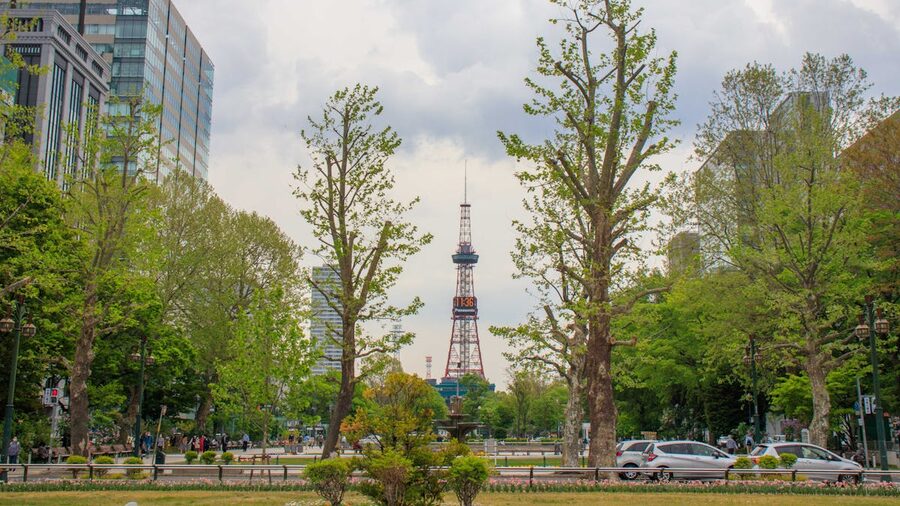
Odori Park runs through the middle of town like a green spine. In summer it’s full of food stalls and families. In winter it hosts the Sapporo Snow Festival, which is exactly as brilliant as it sounds — enormous snow sculptures, ice slides, illuminated displays. Even without a festival, the park is a good place to let children loose while you sit on a bench and drink canned coffee from a vending machine. Parenting in Japan at its finest.
The Sapporo Beer Museum is free to enter and oddly interesting even if your kids couldn’t care less about brewing history. The red brick building looks impressive, there’s a tasting hall for the adults (paid), and the garden area outside is pleasant for a wander. Tanukikoji, the covered shopping arcade nearby, stretches for seven blocks and has enough shops, game centres, and sweet stalls to keep everyone occupied for an hour or two.
Now. Sapporo’s famous Clock Tower. You’ll see it on every tourism poster. I’m going to save you the trip: skip it. It’s a small wooden building sandwiched between modern office blocks. Underwhelming doesn’t begin to cover it. The kids took one look, said “is that it?” and asked if we could get ramen instead. Fair enough.
And about that ramen. Sapporo’s miso ramen is the reason to eat here. Rich, buttery, topped with sweetcorn and butter (a Hokkaido thing), and absolutely perfect after a cold day outside. A bowl costs ¥800–1,000 (~£4.20–5.30) at most places. Ramen Yokocho — a narrow alley lined with tiny ramen shops — is the traditional spot, though honestly any well-reviewed place in central Sapporo will be excellent. Our children, who at home refuse soup of any description, ate every drop.
Otaru — The Canal Town
Thirty minutes from Sapporo by train. That’s it. And it’s a completely different atmosphere.
Otaru is a former trading port with a pretty canal lined with old stone warehouses, now converted into shops, cafes, and museums. Charming in summer. Magical in winter when the canal path is lit with snow lanterns. Our lot were more interested in the glassblowing workshops, where kids can watch artisans shape molten glass and — at some studios — have a go at making their own pieces. Surprisingly gripping for children who normally can’t sit still for three minutes.
The Otaru Music Box Museum is another good stop. A gorgeous old building crammed with music boxes of every size and type, and a workshop area where children can decorate their own. Ours still has hers on her bedside table. The seafood market near the canal is worth a browse even if you’re not buying — but you should be buying. Sushi lunch in Otaru runs ¥1,500–3,000 (~£8–16) per person and the quality is outstanding. Some of the freshest fish in a country obsessed with fresh fish.
Furano and Biei
If you’re visiting Hokkaido between late June and early August, Furano and Biei are non-negotiable. This is where those lavender field photos come from. The real thing is better than any photo.
Farm Tomita in Nakafurano is the most famous lavender farm and it’s completely free. Rows upon rows of purple stretching across gentle hills, backed by mountains, with the scent hitting you before you even get out of the car. There’s lavender ice cream (surprisingly good), lavender essential oil, lavender everything. The kids ran through the flower rows pretending to be bees. We let them.
Nearby Biei has the “patchwork hills” — agricultural fields in different colours creating a natural quilt effect across the landscape. Gorgeous. The Blue Pond, about twenty minutes from Biei town, is an artificial pond with dead birch trees standing in unnervingly blue water. It looks Photoshopped. It isn’t. Apple used it as a default wallpaper a few years back. Free to visit, small car park, worth the detour.
In summer, melon is the thing. Yubari melon, specifically. Hokkaido grows Japan’s most prized melons and in Furano you’ll find melon soft-serve, melon smoothies, melon slices, melon with everything. Try it all. The kids will not object.
Getting to Furano from Sapporo takes about two and a half hours by car or bus. A rental car gives you far more flexibility for this area — the farms and viewpoints are spread out and bus services between them are limited.
Niseko — Skiing and Beyond
Niseko’s reputation precedes it. Japan’s most famous ski resort, known worldwide for powder snow so light and dry it feels like skiing through flour. December through March, this is one of the best places on the planet for family skiing.
The resort area has four interconnected ski zones. Grand Hirafu is the biggest and most popular with international visitors. Annupuri is quieter and better suited to families with younger children — gentler slopes, smaller crowds, and a less intense atmosphere. All four areas are covered by the Niseko United all-mountain pass: ¥6,000–8,000 (~£32–42) per day for adults, with children’s rates roughly half that.
Ski schools with English-speaking instructors are widely available. Equipment hire is straightforward. The town has plenty of restaurants, and the apres-ski scene — while not exactly your priority with a six-year-old — means good food options in the evening. Accommodation ranges from self-catering apartments to luxury hotels, though prices in peak season reflect Niseko’s international popularity. Book early.
What surprised us: Niseko in summer. Mountain biking trails, river rafting, horse riding, zip lines. Far fewer travelers than winter, and a completely different landscape of green mountains and wildflowers. If winter skiing isn’t your thing but you want Hokkaido’s outdoors, summer Niseko delivers.
Asahiyama Zoo
We’re not always zoo people. But Asahiyama Zoo in Asahikawa is genuinely special. One of Japan’s most popular zoos and — more importantly — one of its best designed. The enclosures are built around the animals’ natural behaviours rather than just sticking them behind glass and hoping for the best.
The seal tunnel is the standout. A clear tube running through the middle of the seal tank, so the animals swim directly over and around you. Our youngest stood in the tunnel shrieking with delight as a spotted seal glided past her face. The polar bear enclosure has underwater viewing. The penguin section, in winter, features the famous “penguin walk” — keepers lead the penguins on a daily waddle through the snow outside their enclosure, and visitors line up to watch. It’s as joyful as it sounds.
Admission is ¥1,000 (~£5.30) for adults. Under-fifteens go free. Free. For a zoo this good. Asahikawa is about an hour and a half from Sapporo by car or two hours by train. We combined it with a day trip and it was easily worth the journey.
Hakodate
Southern Hokkaido. The first city you’d reach if you came by shinkansen, and worth at least a night even if you flew into Sapporo.
Goryokaku is the big draw for families — a star-shaped Western-style fort from the 1860s, now a park surrounded by a moat. In spring, the cherry blossoms here are extraordinary. Year-round, climb Goryokaku Tower for a bird’s-eye view of the star shape. Kids find the geometry satisfying in a way they can’t quite articulate. “It looks like a massive star, Mum.” Yes. That’s the idea.
The night view from Mount Hakodate is ranked among the top three night views in Japan. The ropeway carries you up to the summit — ¥1,800 (~£9.50) return for adults — and the view of the city lit up between two bays is stunning. Go on a clear evening. Wrap up warm. Even summer nights get cool up there.
Hakodate Morning Market opens early (5am in summer) and is packed with seafood stalls. The signature dish is ikura don — rice topped with glistening salmon roe. Rich, salty, and a firm no from the children, who opted for grilled corn on the cob instead. Fair.
Best Time to Visit Hokkaido With Kids
Two peak seasons, both excellent but totally different trips.
Winter (December to February) means snow. Loads of it. Skiing in Niseko, the Snow Festival in Sapporo, penguin walks at Asahiyama Zoo, snow lanterns in Otaru. Temperatures hover around -5 to -10°C, so you’ll need proper winter gear for the kids — thermals, waterproof layers, decent boots. But the snow is soft, the heating indoors is fierce, and there’s something magical about Hokkaido in full white-out mode.
Summer (June to August) is flowers, farms, outdoor adventures, and that blissful 20–25°C climate while the rest of Japan melts. Lavender season peaks in July. Beaches are swimmable. Hiking is accessible. It’s comfortable in a way that Honshu simply isn’t during those months.
Spring (April to May) and autumn (September to November) are quieter, cheaper, and still beautiful. Cherry blossoms reach Hokkaido in early May — weeks after the mainland. Autumn colours in October are spectacular. Fewer crowds, lower prices, and shoulder-season availability at popular family-friendly ryokans.
If forced to choose one: summer. The weather advantage over mainland Japan is enormous when you’re travelling with children who wilt in heat.
Getting Around — Rent a Car
Sapporo itself has a metro and bus system that works well. You don’t need a car for the city. Beyond Sapporo? You really do.
Hokkaido is big and public transport between smaller towns is patchy. Trains connect the main cities but reaching lavender farms, the Blue Pond, smaller ski resorts, or coastal viewpoints without a car means relying on infrequent buses and complicated connections. With children and car seats and all the gear, a rental car simplifies everything dramatically.
Driving in Hokkaido is pleasant. Wide roads, light traffic outside cities, clear signposting in English, and — crucially for British families — they drive on the left. No mental gymnastics required. Rental costs run ¥5,000–8,000 (~£26–42) per day. Book child seats in advance as they’re required by law for under-sixes. Most major rental companies operate from New Chitose Airport.
One thing: distances are deceptive. Hokkaido looks compact on a map of Japan. It’s roughly the size of Austria. Sapporo to Hakodate is over three hours by car. Plan your driving days realistically, especially with kids who need toilet stops, snack stops, and the occasional “I feel sick” stop.
How Long Do You Need?
Four days minimum if you’re sticking to Sapporo, Otaru, and one other area. A week lets you see Sapporo, Otaru, Furano/Biei, and either Niseko or Hakodate without rushing. Trying to cram everything into three days will leave you frustrated and exhausted.
We did six days and it felt right. Two in Sapporo (including the Otaru day trip), two in the Furano area, one at Asahiyama Zoo, and a final night back in Sapporo before flying out. Could easily have added Hakodate with another two days. Next time.
Hokkaido rewards slower travel. The landscapes are the attraction as much as any specific destination, and the best moments — stopping at a roadside farm stand for melon, watching the kids play in snow that comes up to their waists, eating ramen in a tiny shop while steam fogs the windows — happen when you’re not racing between sights. Give it time. It gives back.