
I’m reviewing this Best of Belfast Walking Tour as a practical way to get your bearings fast in Belfast. It’s a 3-hour city-center walk that strings together big landmarks and smaller stories, with headsets so you can hear your guide outdoors.
I like that you start at the civic heart (Belfast City Hall) and end at the Titanic Memorial Garden, so the route feels like a full arc rather than random photo stops. I also like the consistently praised licensed local guides (you might get Mark, Colin, Jim, Paul, Steve, Chris, or James), who balance history with helpful tips for what to do next.
One thing to plan for: it’s still a walking tour. Even with a moderate pace and time for questions, it covers a lot of ground and may not suit everyone with mobility needs.
- Key things to know before you go
- Price and logistics: what .05 buys you
- Getting started at Belfast City Hall: the tour’s main anchor
- Stop 1: Belfast City Hall (15 minutes)
- Stop 2: St Mary’s Roman Catholic Church and the grotto area
- Stop 3: Belfast Cathedral in the Cathedral Quarter (15 minutes)
- Stop 4: Hill Street, street art, and why punk mattered
- Stop 5: Customs House and Speaker’s Corner (10 minutes)
- Stop 6: Big Fish, the Lagan river, and Titanic-era connections
- Stop 7: Albert Memorial Clock Tower and the “leaning tower” detail
- Stop 8: The Belfast Entries—an outdoor art gallery
- Stop 9: Spirit of Belfast and quirky public art
- Stop 10: Titanic Memorial Garden and the end back at City Hall
- Pace, comfort, and what travelers repeatedly mention
- Weather and accessibility: plan smarter
- Who this tour is best for (and who should consider alternatives)
- Cancellation policy: your risk is low
- Final verdict: should you book Best of Belfast?
- FAQ
- Where does the tour start?
- What time does it start?
- How long is the tour?
- What is included in the tour?
- Is admission required for the stops?
- Is the tour offered in English?
- Is it wheelchair or mobility accessible?
- What is the group size?
- What is the cancellation policy?
Key things to know before you go
Headsets included so you can follow the guide on outdoor streets.
Max group size 25 keeps it social but not chaotic.
10 stop route from City Hall to Titanic Memorial Garden, all within the core center.
Free sights at every stop (listed as free admission for each stop).
Local history with city-center landmarks ties together Belfast past and present.
Halfway break is built in based on what many travelers mention after the first stretch.
Price and logistics: what $36.05 buys you
At $36.05 per person for about 3 hours, the value comes from the guide time plus the structure. This isn’t just a walk-by tour where you read plaques on your own. You get a local guide who connects the dots across Belfast’s major sites, and you get headsets that improve the experience immediately in windy or busy areas.
Also, it tends to book well in advance (on average around 33 days), which usually means schedules are popular for first-time visitors. If you’re traveling in peak season, picking an early slot can help you lock in your preferred date.
Getting started at Belfast City Hall: the tour’s main anchor
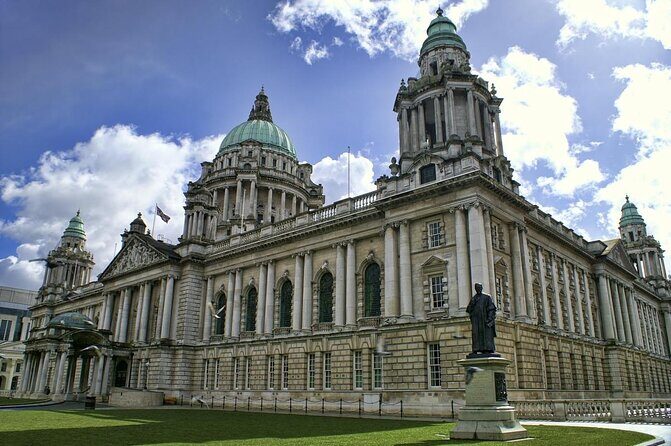
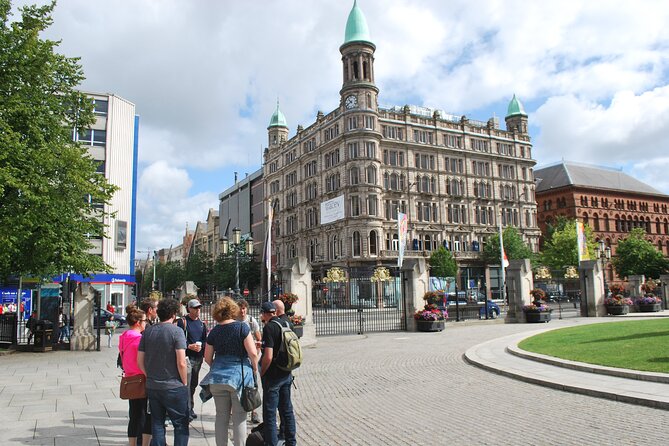
The tour meets at the front gates of Belfast City Hall at 10:00 am and begins with a quick orientation. City Hall is a great starting point because it signals the tour’s tone: civic Belfast, not just pub-and-pictures Belfast.
You’ll also hear a foundation story right away. That matters because the rest of the route is packed with references to places and movements across centuries. Starting with context makes the later stops easier to understand instead of feeling like you’re collecting facts with no thread.
Stop 1: Belfast City Hall (15 minutes)
You’ll spend about 15 minutes here. Expect your guide to explain what City Hall represents and how it connects to Belfast’s development. Since the admission is listed as free, you’re not paying for entry. The real value is your guide’s framing.
This is also a good moment to ask a question or two before the walking starts. If you’re curious whether the tour leans political, cultural, or purely architectural, this first stop is where you can gauge it.
Stop 2: St Mary’s Roman Catholic Church and the grotto area
Next you head to St Mary’s Roman Catholic Church in Bank Square. This stop is short (around 10 minutes), but it’s designed to give you something specific: the church’s history, a unique grotto, and what stood nearby, including the original Belfast Castle.
This is one of those “small time, big takeaway” stops. In a city tour, the danger is spending too long at every location and ending the day with sore feet and loose understanding. Here, the stop format helps you build a mental map of Belfast’s layers.
Stop 3: Belfast Cathedral in the Cathedral Quarter (15 minutes)
Then you step into the Cathedral Quarter and visit Belfast Cathedral, the Cathedral Church of St Anne. Your guide introduces you to stories tied to the United Irishmen and their contributions to the city’s development.
Why this matters: the Cathedral Quarter isn’t only scenic. It’s a hub where Belfast’s identity formed in public spaces—churchyards, meeting places, and the streets between. Even if you’re not into early-modern Irish history, the tour tends to translate names and dates into why they mattered locally.
This stop is about 15 minutes with free admission listed for the cathedral. Expect a blend of place-based storytelling and wider historical context.
Stop 4: Hill Street, street art, and why punk mattered
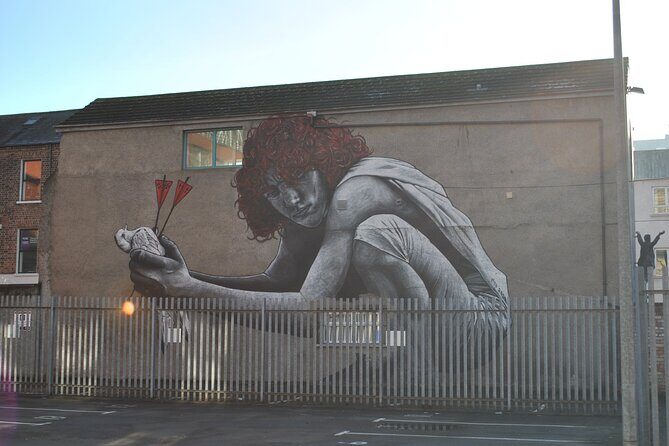
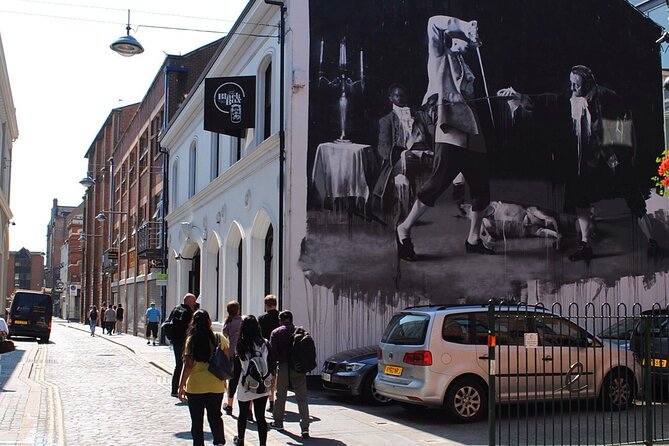
One of the most fun parts comes on Hill Street, described as one of the last cobbled streets in Belfast. This is where the tour shifts from “what happened here” to “what Belfast feels like now.”
You’ll hear about standout street art and get recommendations for bars, restaurants, and nightspots. There’s also a story angle about punk in Belfast and why it was important during the Troubles.
That combination is a smart move. If you only hear difficult history, the city can feel heavy. If you only see murals and drink spots, you miss the why. This stop aims for both, so you leave with places to go tonight and context to make sense of them.
Stop 5: Customs House and Speaker’s Corner (10 minutes)
At the Customs House, the tour zeroes in on conversation as a form of power. This building is described as having been home to Speaker’s Corner, where orators delivered their arguments.
You’ll also hear stories about the best and worst speakers who stood there, plus nearby references to one of Belfast’s oldest pubs still standing.
It’s a short 10-minute stop, so don’t expect a long museum moment. Think of it as a quick mental switch: Belfast’s history isn’t only about events. It’s about people trying to persuade, protest, and shape the public mood.
Stop 6: Big Fish, the Lagan river, and Titanic-era connections
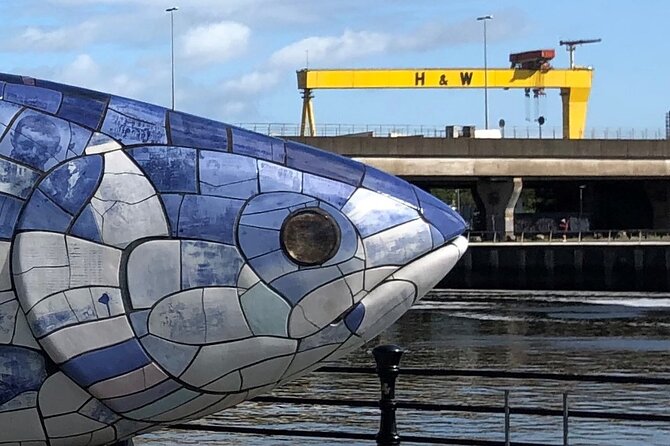
Next you walk along the banks of the river Lagan. The tour then ties together views across to Harland & Wolff shipyard, where the Titanic was built more than a century ago.
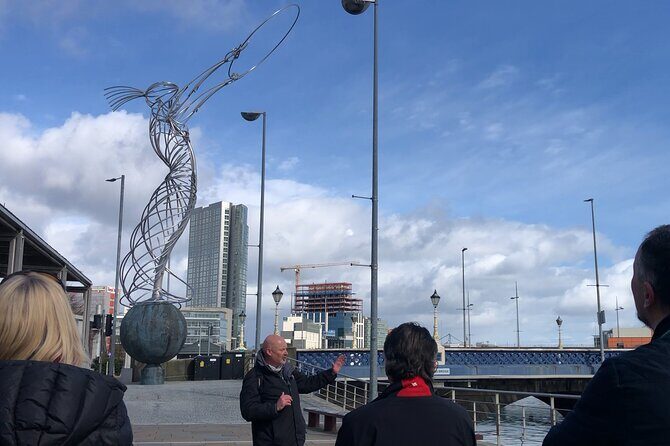
You’ll also hear a legend connected to the Salmon of Knowledge sculpture. Then comes a local favorite: the Beacon of Hope, described as a symbol of resilience and regeneration in recent years.
This stop works well for photos, but it’s more than that. The guide’s job here is to connect Belfast’s industrial past to its modern identity. Many travelers find this part a turning point because it feels like the city moved forward, not just through conflict.
Stop 7: Albert Memorial Clock Tower and the “leaning tower” detail
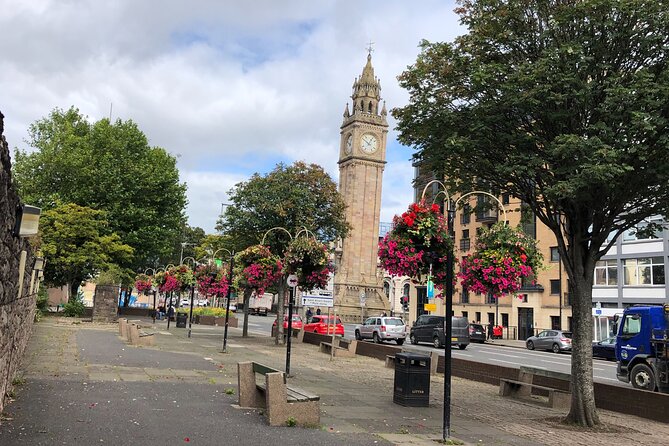
Then you reach the Albert Memorial Clock Tower, where Belfast’s own “leaning tower” comparison comes into play. Your guide explains why the tower is angled and also shares how Belfast got its name.
This is a very “local knowledge” stop. A lot of guides can point at a landmark. Fewer will tell you the reason behind the famous detail and connect it to the larger identity of the city. Travelers often mention how guides make these facts feel like a story instead of a lecture.
Also, you’ll get a hint at the local side of Belfast: your guide will show you a famous footballer’s favorite pub.
Stop 8: The Belfast Entries—an outdoor art gallery
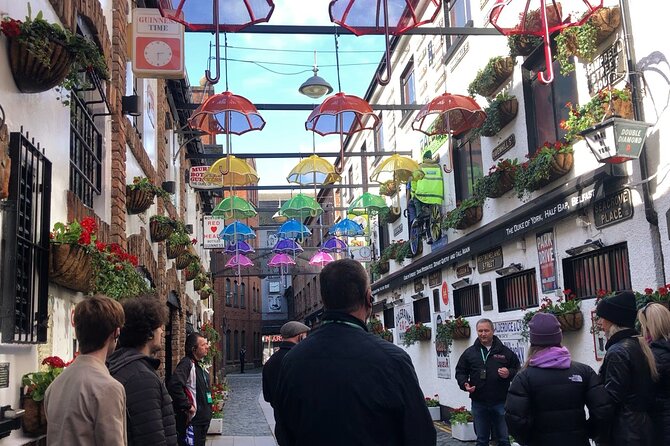
One of the most distinctive parts of the route is the Belfast Entries, described as being at the heart of the oldest part of the city. Today it’s turned into an outdoor art gallery with dozens of pieces, each with its own story.
This stop is about 15 minutes, and it’s where a walking tour becomes a wandering tour—just with a guide doing the interpretation. You get to explore pieces of art and understand why this area mattered and who lived here over the centuries.
Tip: if you love street-level history, this is the stop to slow down and actually look at the details. The point isn’t speed; it’s turning the city into a readable place.
Stop 9: Spirit of Belfast and quirky public art
In the pedestrian precinct at the center of the city, you’ll meet the Spirit of Belfast public art. Your guide explains its meaning and also shares the alternative name and stories attached to the historic buildings around it.
This is another stop that signals the tour’s balance. It doesn’t only cover heavy topics. It also shows how Belfast expresses itself in small, quirky, public ways.
If you’re worried the tour will feel all doom-and-gloom, this is one of the signs that it won’t.
Stop 10: Titanic Memorial Garden and the end back at City Hall
The tour ends at the Titanic Memorial Garden, back at City Hall. You’ll hear the story of the most famous ship built here and about some of the people who sailed on her. The guide then wraps up with tales of some notable citizens whose statues are found in the grounds.
Ending here is satisfying. You started with the city’s civic face and finish with a global Belfast icon tied to shipbuilding. It’s a good “before you continue your trip” finale because it gives you something bigger than Belfast while still feeling local.
Also, the tour finishes back at the meeting point, so you’re not stuck with the logistical headache of getting back to where you started.
Pace, comfort, and what travelers repeatedly mention
Most travelers describe the pacing as easy to maintain, not strenuous. That said, it is still a walking tour with outdoor time between stops, and comfortable shoes are a must. A few people also mention the value of the ear-piece units since they help you hear the guide without constantly leaning in.
You’ll also appreciate that the guide can answer questions. Several travelers mention being able to ask things during the walk, which helps if you want advice on neighborhoods or practical next steps.
And yes—there’s often a coffee/restroom opportunity around the halfway mark. That matters more than you’d think on a 3-hour stroll, especially if you arrive with a tight schedule.
Weather and accessibility: plan smarter
This tour operates in all weather conditions, but it also notes that it may be canceled due to poor weather, with an option for a different date or a full refund. So you should expect the guide to keep going unless conditions make it unsafe.
On accessibility: the tour states that most travelers can participate, but one person noted it wasn’t suitable for someone with mobility issues. If mobility is a concern, ask before booking. Even with a moderate pace, stop-to-stop walking adds up.
Who this tour is best for (and who should consider alternatives)
This tour is a strong fit if you:
- are visiting Belfast for the first time and want a clean orientation fast
- want local history explained clearly by a licensed guide
- like a mix of landmarks, stories, and practical recommendations for where to eat or go later
- value value and hate wasting time on tours that only skim the surface
It may be less ideal if you:
- need frequent seated access or step-free routes
- prefer long museum-style stops instead of short, guided highlights
Cancellation policy: your risk is low
Good news for planning: there’s free cancellation. You can cancel up to 24 hours in advance for a full refund, and changes inside that window aren’t accepted.
If the tour is canceled due to poor weather, you’ll either get an alternate date or a full refund. That’s a practical safety net for a place where the sky can change quickly.
Final verdict: should you book Best of Belfast?
I think you should book this tour if you want a high-value Belfast orientation with a guide and an itinerary that actually connects the city. The big selling points are consistent: guides who know the story, headsets that make it easy to follow, and a route that includes both big landmarks and the smaller Belfast details people remember.
Skip it or weigh it carefully if mobility is an issue, because it’s still a walking circuit through the city center. But for most visitors, this is one of the simplest ways to leave Belfast understanding more than you did when you arrived.
If your goal is to learn Belfast without getting lost in a guidebook, this tour delivers that in a compact, easy-to-plan package.
Best of Belfast Walking Tour
FAQ
Where does the tour start?
The tour meets at the front gates of Belfast City Hall, Donegall Square N, Belfast BT1 5GS, UK.
What time does it start?
The start time is listed as 10:00 am.
How long is the tour?
The duration is approximately 3 hours.
What is included in the tour?
Included are local guide services and headsets to help you hear the guide outdoors.
Is admission required for the stops?
Admission is listed as free for the stops included in the itinerary.
Is the tour offered in English?
Yes, it is offered in English.
Is it wheelchair or mobility accessible?
The tour states most travelers can participate, but it is still a walking tour. If mobility is a concern, it’s a good idea to check details with the provider.
What is the group size?
The tour has a maximum of 25 travelers.
What is the cancellation policy?
Free cancellation is available up to 24 hours before the experience for a full refund. If canceled less than 24 hours before, the amount paid is not refunded. If canceled due to poor weather, you’ll be offered a different date or a full refund.