
If you’re trying to squeeze Pompeii into a busy Italy trip, this complete skip-the-line guided walk is one of the smartest ways to do it. You’ll get pre-booked entry, a trained archaeologist guide (not just a narrator), and headsets when you need them for clear explanations.
I especially like how the tour is built around how people actually lived. You’ll see everyday places like a Roman bakery and other “ordinary” sites, not only the big postcard angles. I also like the small-group setup (max 15 travelers), which makes questions easy and keeps the pace more human.
One thing to consider: it’s a walking tour with a moderate walking pace, and there can be long stretches with little to do between listening pauses. A few travelers also flagged meeting-point confusion at first, so give yourself a few extra minutes to find the right group.
- Key highlights at a glance
- Pompeii, but with a guide who actually knows the site
- Skip-the-line entry: why it matters in real time
- The small-group size that changes the feel
- Tour length and the Express option (~2 hours)
- Meeting point at Via Villa dei Misteri: simple plan, fewer headaches
- Stop-by-stop: what you’ll actually see and why it clicks
- Stop 1: Archaeological Park of Pompeii, plus the life-story overview
- The Roman bakery: food, routines, and preserved details
- Temple of Apollo: religion in the public square
- The Roman Forum area: politics and public business
- An ancient supermarket: where goods met daily life
- Cemetery stop: when the city remembers its dead
- Brothel stop (only if age appropriate)
- Plaster casts: the moment Pompeii froze in time
- Pompeii’s Main Street: built for movement, commerce, and noise
- Roman baths: public body care and social life
- “Guided tour & Photo stop” moments: how to use them well
- What’s included (and what isn’t)
- Accessibility and who this tour fits best
- Weather, comfort, and small traveler tips that matter
- How the guides show up in reviews (and why it’s worth it)
- Value for money: is .38 worth it?
- Possible downsides to keep in mind
- If you’re pairing this with self-guided Pompeii
- Cancellation policy: flexible enough to plan with confidence
- Should you book this Pompeii archaeologist tour?
- FAQ
- What language is the tour offered in?
- How long is the Pompeii complete skip-the-line tour?
- Is there an express option?
- What’s included in the price?
- Do I need hotel pickup?
- Where does the tour meet and where does it end?
- Is it a walking tour?
- What should I do about my name on the booking?
- What is the cancellation policy?
Key highlights at a glance

- Skip-the-line entry with pre-reserved tickets, so you start seeing Pompeii faster
- Archaeologist-led commentary focused on daily life, not just dates and stones
- Small group (15 or fewer) for better questions and less crowd pressure at each stop
- Curated stops like the bakery, Main Street, Forum areas, Roman baths, and more
- Express option (~2 hours) for “just the essentials” if you’re short on time
- Headsets included when needed to keep the guide’s explanations easy to hear
Pompeii, but with a guide who actually knows the site
Pompeii can feel like a blur when you go solo. You’re surrounded by streets, buildings, and rooms, but it’s hard to connect the dots fast enough to understand what you’re looking at. This tour solves that by putting a guide with real archaeological knowledge in front of you.
And you feel the difference right away: you’re not just “seeing ruins.” You’re learning how people in the Roman world organized their days, what they ate, where they shopped, and how public and private life overlapped. Guides mentioned in traveler feedback include archaeologist-style experts such as Enzo and Ilaria, plus other knowledgeable hosts who explained details with humor and patience.
Skip-the-line entry: why it matters in real time
The official tickets are pre-reserved, and you meet up with your guide at Via Villa dei Misteri, 1 in Pompei. From there, you head into the Archaeological Park of Pompeii with the advantage of skipping long lines.
That may sound like a small perk until you picture Pompeii on a busy day. When you’re walking through an open-air site that’s physically demanding, losing time waiting at entry can turn your “planned visit” into a scramble.
The small-group size that changes the feel
Maximum 15 travelers is the sweet spot here. Reviews consistently describe the experience as easier to follow than crowd-heavy tours, and you’re less likely to get separated from your group at the turns.
This matters most at the tricky parts: places that are visually similar, where context helps you tell one space from another. With fewer people, your guide can slow down if someone has a question, instead of rushing everyone onward.
Tour length and the Express option (~2 hours)
Most versions run about 2 to 3 hours. If you’re short on time, you can choose the Pompeii Express option at booking. That express route focuses on a curated set of highlights and is still led by an archaeologist.
If you want to do both guided and self-guided Pompeii later, the express version can be a good first pass. If this is your only Pompeii outing, the longer version is usually the better bet.
Meeting point at Via Villa dei Misteri: simple plan, fewer headaches
You start at Via Villa dei Misteri, 1, 80045 Pompei NA, Italy. The tour ends inside the Pompeii Archaeological Site.
A few travelers mentioned they initially struggled to find the group leader and advise double-checking you’re at the correct entrance area. My practical suggestion: arrive a bit early, and don’t rely on directions that drop you at a building near the train station area. Give yourself time to walk to the right entrance point before your start.
Stop-by-stop: what you’ll actually see and why it clicks
Here’s how the experience is structured once you enter. The exact flow can adapt as discoveries and preservation efforts change, but the tour style stays consistent: each stop connects a location to how people lived in Pompeii around 79 AD.
Stop 1: Archaeological Park of Pompeii, plus the life-story overview
Right at the start, your guide sets the scene: Pompeii in the Roman Republic and the way ordinary people navigated daily life. This is where you get the “map in your head,” which makes later buildings and streets make sense.
You’ll also learn why Pompeii feels incomplete. About a third of the site remains uncovered, and excavation and preservation continue. That context helps you interpret what you’re seeing, especially where you might expect more than what’s visible today.
The Roman bakery: food, routines, and preserved details
One of the most memorable early stops is a Roman bakery, with evidence that the food is still almost intact. Even if you don’t care about archaeology as a hobby, this type of stop grabs your brain because it ties buildings to real habits: making bread, feeding households, and serving customers.
Drawback to note: because it’s an open-air site with crowded moments, you may not always get a perfect angle for photos. Plan for quick snapshot moments, not long picture sessions.
Temple of Apollo: religion in the public square
Seeing the Temple of Apollo adds a different layer. This is where you understand that Pompeii wasn’t only built around commerce and streets. It also centered on public ritual, civic identity, and the kinds of beliefs that shaped everyday choices.
If your guide is strong (and reviews suggest they often are), the temple won’t feel like “another big ruin.” It’ll feel like a piece of a social system.
The Roman Forum area: politics and public business
The route includes the Roman Forum area. This is another “context stop,” because the Forum concept is tricky if you don’t have guidance.
You’ll likely walk away understanding it as a place where public life happened: meetings, public announcements, and the constant flow of people and activities. For me, that’s the point of a guide: you stop looking at stones as decoration and start seeing them as infrastructure.
An ancient supermarket: where goods met daily life
The tour also references an ancient supermarket concept. This is a great example of how the guide reframes what you see in plain terms.
You’ll come out thinking about trade and supply, not only elite villas and grand monuments. That’s a big reason travelers say they feel they learned more than they would have wandering on their own.
Cemetery stop: when the city remembers its dead
The inclusion of a cemetery is a reminder that Pompeii wasn’t only about the dramatic final day. It was a living town with routines that included honoring the dead.
This stop can be emotionally heavy, especially near the eruption-related material later. If you’re sensitive to tragedy, it’s helpful to know this tour doesn’t shy away from it.
Brothel stop (only if age appropriate)
The tour mentions a brothel (if age appropriate). That’s an important “value” detail: it suggests the guide covers a wide range of the city’s social reality, not a sanitized highlights reel.
If you’re traveling with kids or you have questions about what will be covered, clarify that during booking. The tour data explicitly notes it’s handled based on age appropriateness.
Plaster casts: the moment Pompeii froze in time
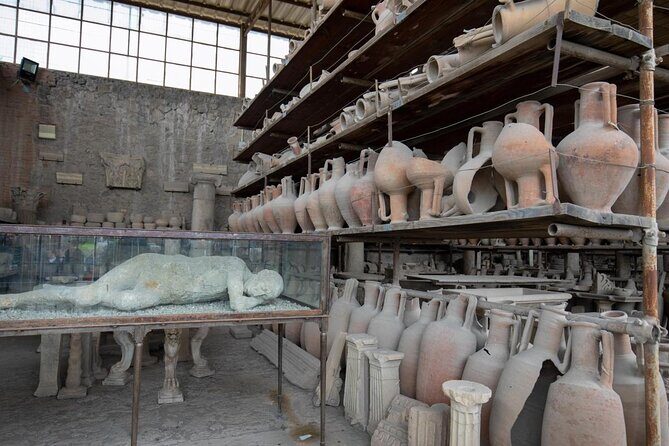
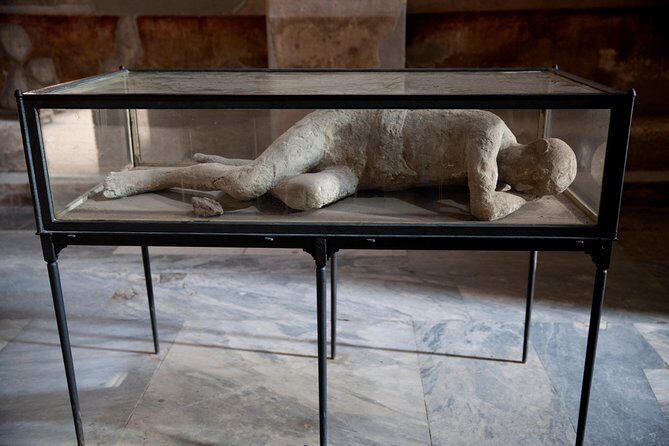
One of the most heart-wrenching parts of Pompeii is the plaster casts of people caught in the eruption at the exact moment of their death.
Guides matter here. If you have an archaeologist who can explain without turning it into spectacle, the stop becomes meaningful rather than just shocking. Reviews mention guides described the last minutes of habitants back in 79 AD, which is exactly the sort of careful framing you want.
A practical note: the casts can be difficult to see clearly depending on crowds and viewing angles. If you care about photos, don’t count on unobstructed pictures.
Pompeii’s Main Street: built for movement, commerce, and noise
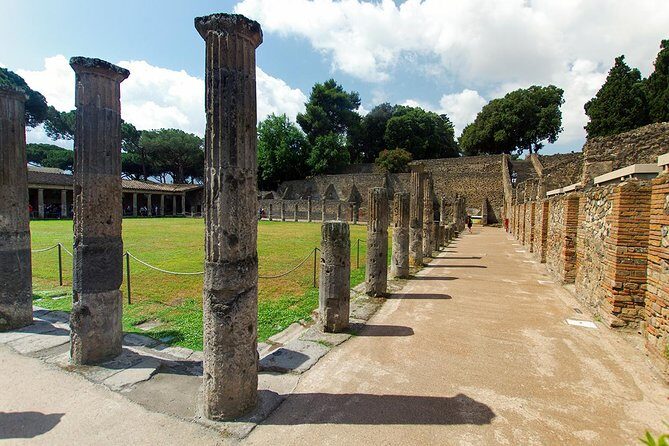
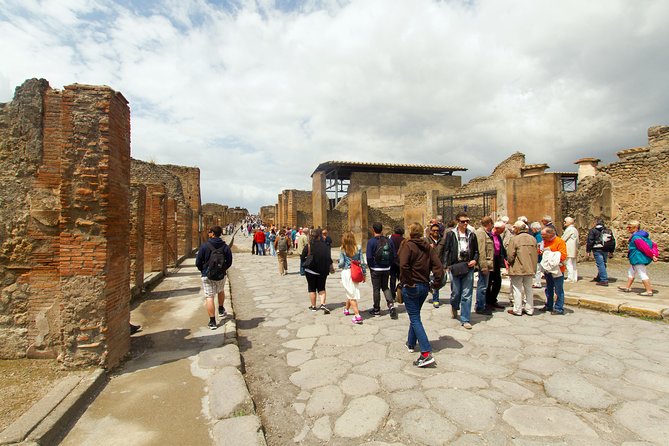
You’ll visit Pompeii’s Main Street with guided tour and photo stop moments. This is where Pompeii starts to feel like a place you could walk through in real life.
Streets are the city’s “bones.” When a guide explains what likely happened here—shops, movement, and the rhythm of daily life—you’ll notice details you’d miss solo.
Roman baths: public body care and social life
The route includes the Roman Baths with guided explanation and photo pauses.
Even if you’ve seen bathhouses in other Roman cities, Pompeii’s preserved elements make the experience feel closer to the real layout. You’re learning how people used public spaces for more than one purpose: cleanliness, conversation, and routine.
“Guided tour & Photo stop” moments: how to use them well
Several segments are listed as guided tour & photo stop. That’s useful because Pompeii is huge and easy to wander past without context.
Use photo stops to capture one wide shot and one detail shot, then move on. The ruins reward attention to small things, but you don’t want to get stuck in one spot while the group keeps moving.
What’s included (and what isn’t)
This tour includes several practical items that make it smoother:
- Official Pompeii tour guide
- Small groups of 15 people or fewer
- Pre-reserved entrance tickets to Pompeii
- Headsets when needed
- Walking tour setup with guide-led stops
Not included: hotel pickup/drop-off.
Also remember: confirmation comes at booking, and for entry logistics, full participant names must match your ID/passport. Name changes aren’t permitted.
Accessibility and who this tour fits best
This is a walking tour with a moderate pace. Most travelers can participate, but you should be ready for uneven terrain, long outdoor stretches, and the kind of walking that adds up fast in summer heat.
If you have mobility concerns, double-check your comfort level with Pompeii’s terrain before booking.
Weather, comfort, and small traveler tips that matter
Pompeii is outdoors. A few traveler tips that line up with reality:
- Bring water (reviews call this out)
- Use sun protection and wear comfortable walking shoes
- Many travelers recommend not wearing sandals
- If rain threatens, you may want an umbrella
Also consider that some stops are pause/listen moments rather than true “breaks,” so plan your day around walking first and breaks second.
How the guides show up in reviews (and why it’s worth it)
Traveler feedback repeatedly highlights strong guidance. Names mentioned include Enzo, Ilaria, Francesco, Francesca, Sonja/Sonia, and others like Vincenzo/Vito/Vincento.
Common threads:
- Guides described as fun, personable, and patient
- Commentary that answers questions instead of brushing them off
- Some guides described as former archaeologists at Pompeii or with deep credentials
- The best guides help you envision everyday life, not just the final eruption story
If you’re the type who likes to understand what you’re seeing, this kind of tour is often money well spent.
Value for money: is $71.38 worth it?
At $71.38 per person, you’re paying for three things that add up fast:
1. Pre-reserved entry so you lose less time
2. A real guide trained to explain daily life and key sites
3. Headsets, which can make a long walk easier to enjoy
Given how big Pompeii is and how easy it is to miss context, that mix tends to be a strong value. Many travelers explicitly say the tour is worth the investment, especially because they gained understanding they wouldn’t get on their own.
Possible downsides to keep in mind
A few issues come up in feedback:
- Break pacing: some travelers felt there were pauses that felt slow, with little to do during those gaps
- Meeting point clarity: a handful had trouble locating the group at first
- Crowds: Pompeii can be busy, and even a small group can feel crowded at popular photo stops
- Facilities: at least one traveler noted no bathroom access for about 3 hours
These aren’t dealbreakers, but they’re worth weighing before you book.
If you’re pairing this with self-guided Pompeii
This tour ends inside the site. That’s a nice setup if you want to continue on your own afterward.
Here’s the trick: use the guided tour to learn how Pompeii “works,” then self-explore with better instincts. You’ll recognize streets and building functions faster, which helps you avoid the common problem of wandering without understanding.
Cancellation policy: flexible enough to plan with confidence
You can cancel for a full refund as long as you do it at least 24 hours before the experience start time (local time). Cancellation within 24 hours isn’t refundable, and changes inside 24 hours aren’t accepted.
Free cancellation is a real advantage when your schedule is fluid.
Should you book this Pompeii archaeologist tour?
Book it if you want:
- A guided, archaeologist-led explanation of Pompeii’s everyday life
- Skip-the-line entry to protect your time
- A small group (15 or fewer) so you can ask questions
- A clear route through major sites like Main Street, baths, and key landmark areas
Skip or reconsider if:
- You dislike walking tours or struggle with uneven terrain
- You’re hoping for a slow, mostly sit-down experience
- You need lots of planned breaks or full restroom stops (some travelers report limited facilities during the longer stretch)
My take: for first-timers, or for anyone who wants Pompeii to feel understandable instead of overwhelming, this is one of the stronger ways to go. The biggest payoff is the guide’s ability to turn ruins into lived-in places you can picture.
Complete Pompeii Skip the Line Tour with Archaeologist Guide
FAQ
What language is the tour offered in?
The tour is offered in English.
How long is the Pompeii complete skip-the-line tour?
It runs about 2 to 3 hours.
Is there an express option?
Yes. You can choose the Pompeii Express option for about 2 hours, focusing on a curated route of highlights.
What’s included in the price?
Included are the official Pompeii tour guide, pre-reserved entrance tickets, and headsets when needed, plus a small group of 15 or fewer.
Do I need hotel pickup?
No. Hotel pickup/drop-off is not included.
Where does the tour meet and where does it end?
It starts at Via Villa dei Misteri, 1, 80045 Pompei NA, Italy and ends inside the Archaeological Park of Pompeii.
Is it a walking tour?
Yes. It’s a walking tour with a moderate pace, and most travelers can participate.
What should I do about my name on the booking?
You must provide the full names of all participants at booking, and they must match your ID/passport. Name changes are not permitted.
What is the cancellation policy?
You can cancel for a full refund up to 24 hours before the experience’s start time (local time). Less than 24 hours before start time is not refundable.