
Japan With Toddlers
We nearly talked ourselves out of it. Japan felt ambitious with a toddler in tow. Eleven hours on a plane, a completely different language, and the nagging worry that we’d spend thousands of pounds only to see the inside of our hotel room during enforced nap times.
Glad we ignored our own doubts.
Japan turned out to be cleaner, safer, and more toddler-friendly than anywhere we’ve been in Europe. The pavements are spotless. Strangers beam at your child on the train. Nobody tuts when your eighteen-month-old drops rice on the restaurant floor. The whole country has collectively decided that small children are welcome, not tolerated.
If you’re wondering whether Japan is realistic with a one, two, or three-year-old — yes, absolutely. Here’s everything we wish someone had told us before we went.
- Pushchairs, Carriers, and Getting Around
- The Nap Question
- What Toddlers Actually Eat in Japan
- Nappies: Leave Yours at Home
- Baby Rooms and Changing Facilities
- Best Activities for Toddlers
- Parks
- Trains
- Aquariums and Zoos
- Department Store Play Areas
- What to Skip
- Where to Stay
- MIMARU Apartment Hotels
- Ryokans
- What to Avoid
- Practical Bits
- Is It Worth It?
Pushchairs, Carriers, and Getting Around
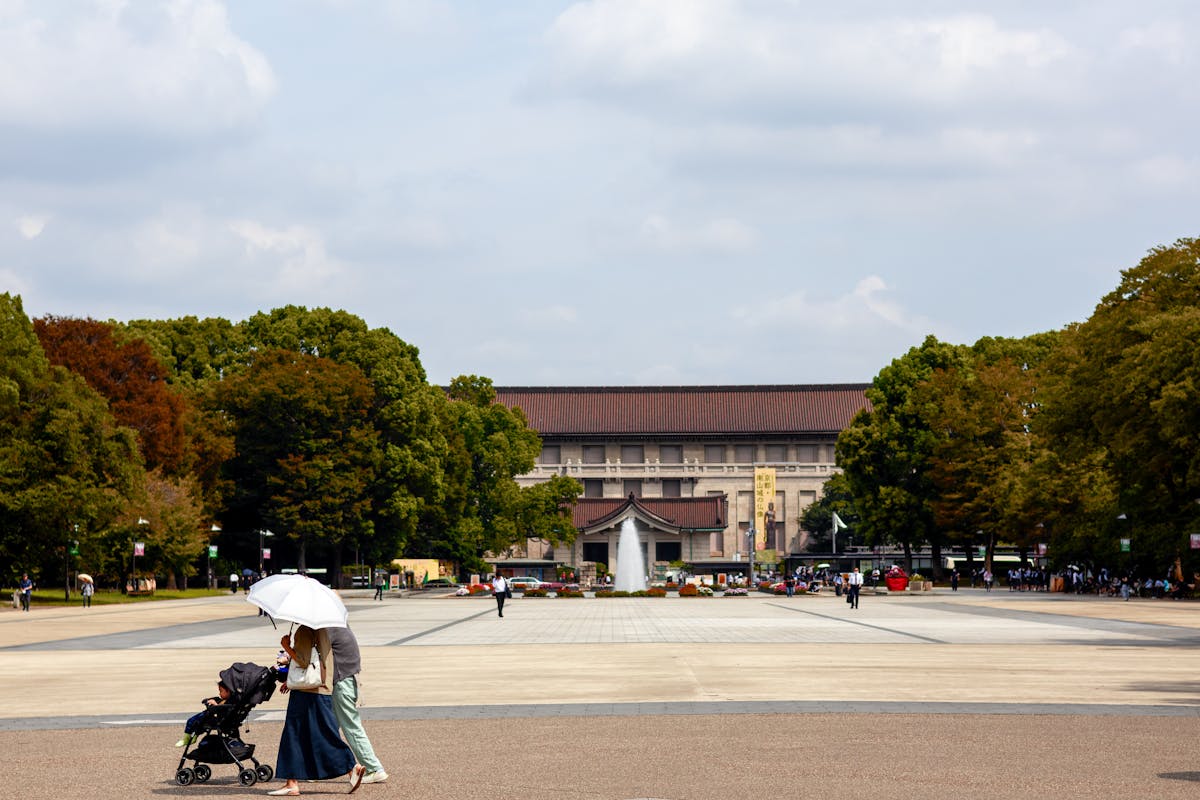
Bring both. That’s genuinely the best advice we can give.
A lightweight, compact pushchair works brilliantly on flat ground. Japanese pavements are smooth and well-maintained. The trains have designated priority spaces near the doors where pushchairs are not only allowed but expected. Nobody bats an eyelid. We used ours for long walks around Osaka, flat stretches in Tokyo, and the entire time we were in shopping districts.
But the moment you approach a shrine, a temple, or any older part of town, you’ll hit stairs. Lots of them. Gravel paths too, which are murder on small wheels. Most stations have lifts, though tracking them down sometimes feels like a quest in itself. Shinjuku Station has about forty-seven exits and the lift is inevitably behind the one you didn’t choose. A structured carrier saved us every single time.
Our routine: pushchair folded, carrier on, toddler up. For shrine visits and temple grounds, the carrier was non-negotiable. For everything else, the pushchair made life far easier than carrying a 12kg child all day.
Children under six travel free on Japanese trains, by the way. No ticket needed. Walk through the wide gate at the barrier together and you’re sorted.
The Nap Question
Here’s where we have a strong opinion. Protect the nap. At all costs.
We know it’s tempting to cram in as much as possible. You’ve flown halfway around the world, you’re paying for hotels, there’s so much to see. But an overtired toddler in Tokyo is the same as an overtired toddler at home, except you’re also jet-lagged and standing in a train station at rush hour.
Our rule: one activity in the morning, back to the hotel by midday for a nap, then one outing in the late afternoon. Two things per day maximum. Some days we only managed one, and those were often the best days because nobody melted down.
The first few days are hardest because jet lag throws everything sideways. Our toddler woke at 4am for three mornings straight, crashed by 10am, completely out of sync. We wrote off those early days. Wandered to a local park. Found a konbini for breakfast. Let the rhythm sort itself out. By day four, things clicked into place.
Accommodation matters here — you need somewhere your toddler can nap while you still function as a human being. More on that further down.
What Toddlers Actually Eat in Japan
Japanese food might be the most naturally toddler-friendly cuisine we’ve come across. Plain white rice appears at every meal. Udon noodles are soft, mild, and perfect for small mouths. Tamagoyaki — that sweet rolled omelette — became our daughter’s favourite food on earth. Karaage, which is essentially Japanese fried chicken in bite-sized pieces, is basically posh chicken nuggets. Edamame turns up as a side dish everywhere.
We were genuinely surprised by how easily our fussy eater took to it all. She rejected pasta in Rome but inhaled bowls of udon in Kyoto. Children are contradictions.
Family restaurants like Gusto, Saizeriya, and Jonathan’s have kids’ menus, highchairs, and nobody minds if your toddler makes a mess. A full meal for under ~1,000 (about £5). They won’t win foodie awards, but with a hungry toddler at 5pm, you won’t care.
The real secret weapon is the konbini — convenience stores like 7-Eleven, Lawson, and FamilyMart, found on every corner. Onigiri rice balls for ~150 (£0.80) each. Steamed buns. Banana bread. Yoghurt drinks. We grabbed konbini breakfasts most mornings. Fast, cheap, toddler happy before we’d even thought about coffee.
Do bring familiar snacks from home, though. Breadsticks, rice cakes, squeeze pouches — whatever your child reliably eats. Not because Japan lacks options. Because at 3pm on a crowded train when everything is going wrong, you want a guaranteed win in your bag. For much more on this, see our guide to eating in Japan with kids.
Nappies: Leave Yours at Home
Pack enough for the flight and the first night. That’s all you need.
Japanese nappies are brilliant. Merries and Moony are the two brands you’ll see everywhere, and they’re genuinely better than what we get in the UK. Softer, thinner, and they hold an astonishing amount. We ended up buying extra packs to bring home because our daughter had clearly developed expensive taste.
You’ll find them in any drugstore — Matsumoto Kiyoshi and Sundrug are the big chains — plus supermarkets and even some konbinis. A pack of Merries costs roughly ~1,200–1,500 (£6–8) depending on size. Japanese sizing runs slightly small compared to British brands, so go up a size if your child is between.
Seriously, don’t fill half your suitcase with Pampers. Use that space for the souvenirs you’re inevitably bringing back.
Baby Rooms and Changing Facilities
This is where Japan makes everywhere else look embarrassing.
We’re used to hunting for a grotty fold-down changing table in a pub toilet. Japan is a different planet. Department stores, train stations, shopping centres, and tourist spots have dedicated baby rooms with proper changing stations, hot water dispensers for formula, private nursing areas with comfortable chairs, and sometimes even microwaves for warming food.
The baby room in Takashimaya in Shinjuku was nicer than some hotels we’ve stayed in. Soft lighting, padded chairs, individual feeding cubicles. We sat there in complete comfort while travelers marched past outside with no idea it existed.
Look for signs showing a baby icon or the words “baby room” in English. Department stores typically have them near the children’s clothing floor. Stations keep them close to the accessible toilets. We never struggled to find one, which felt revolutionary after years of changing nappies on park benches across Europe.
Best Activities for Toddlers
Bin the guidebook itinerary. Your toddler does not care about the golden pavilion. Here’s what actually works.
Parks
Japanese parks are spectacular. Even small neighbourhood ones have imaginative play equipment, clean surfaces, and springy rubber flooring. Bigger parks like Yoyogi in Tokyo or the castle grounds in Osaka are perfect for letting your toddler run themselves ragged while you sit with a vending machine coffee. Free, beautiful, no tantrums.
Trains
Your toddler will become obsessed with Japanese trains. The Shinkansen is like a spaceship to a two-year-old. Local trains, monorails, the Yurikamome line in Tokyo that runs driverless with a front window — all peak entertainment. Some days we just rode trains for the sake of it, and our daughter was happier than she’d been at any attraction. The viewing platforms at Tokyo Station are free. Stand there for twenty minutes watching bullet trains glide in and out. Better than any soft play.
Aquariums and Zoos
Osaka Aquarium Kaiyukan is world-class. Our toddler stood transfixed by the whale shark tank for ten solid minutes, which in toddler time is roughly three hours. Adults pay ~2,700 (£14), under-threes free. Ueno Zoo in Tokyo has pandas, a petting area, and charges ~600 (£3) for adults — under-twelves free. Both pushchair-friendly.
Department Store Play Areas
Most visitors miss these entirely. Loads of Japanese department stores have rooftop play areas with small rides, coin-operated trains, and climbing structures. Each ride costs ~100–200 (£0.50–1). A lifesaver when you need thirty minutes of contained toddler entertainment.
What to Skip
Long temple visits. Anything that requires quiet contemplation with a child who has just discovered screaming. Crowded peak-hour shrines — Fushimi Inari at midday is narrow paths, steep steps, and zero toddler appeal. Tea ceremonies. Kaiseki dinners. You know your child. If it involves sitting still for more than eight minutes, it’s not happening.
A quick word on Disney. If you’re choosing between the two Tokyo Disney parks, pick Disneyland over DisneySea for this age group. DisneySea is gorgeous and we loved it as adults, but it skews older. Fewer rides for little ones, more walking, and the theming is impressive rather than fun-for-a-toddler. Disneyland has Fantasyland and Toontown, which are basically designed for the under-five set. We’ve covered both parks in detail in our Disneyland vs DisneySea with kids guide.
Where to Stay
Your accommodation choice matters more with a toddler than at any other stage of family travel. Get this wrong and you’ll be miserable. Get it right and the whole trip flows.
MIMARU Apartment Hotels
Our top recommendation. MIMARU properties are scattered across Tokyo, Kyoto, and Osaka. You get a proper kitchen, a washing machine, a separate living space, and room to breathe. Rates sit around ~15,000–25,000 (£79–132) per night. The kitchen alone is worth it — warming milk, prepping simple meals, storing snacks. During nap time, you sit in the living area with a cup of tea instead of perching on a bed in the dark, scrolling your phone in silence.
Ryokans
Tatami rooms and toddlers are a surprisingly perfect match. The entire floor is padded. Futons sit directly on it. No bed to roll off. No crib to wrestle into a tiny space. Your toddler can crawl, roll, and spread out however they like. Many ryokans serve dinner in-room, which removes the restaurant stress entirely. Check before booking that the ryokan welcomes small children — some have age restrictions.
What to Avoid
Standard business hotels. Japanese business hotel rooms average about 13 square metres. A double bed, a sliver of floor, and a bathroom you can barely turn around in. Nowhere for a travel cot. Nowhere for a toddler to play. Nap time means sitting in pitch darkness together, questioning your life choices. Spend the extra. Your sanity is not optional.
For neighbourhood-by-neighbourhood breakdowns in Tokyo, have a look at our where to stay in Tokyo with kids guide.
Practical Bits
Jet lag hits hard. Budget three or four rough nights. Don’t plan anything for day one beyond finding food and a park.
Shoes come off everywhere — restaurants, temples, ryokans, some shops. Get your toddler into slip-on shoes or velcro trainers. Laces will break you.
The toilets will fascinate your child. Heated seats, buttons that play music, bidet functions that spray without warning. Guard the controls or accept the consequences.
Bring a portable white noise machine. Hotel walls tend to be thin, and a toddler who wakes at 3am because of a motorbike outside is everyone’s problem.
If you’re still sorting flights, our guide to flying to Japan with kids covers seat choices and surviving the long haul.
Is It Worth It?
Completely. Without hesitation.
Japan with a toddler is slower than Japan without one. Fewer sights. More afternoons in parks than in temples. But you’ll watch your child point at a bullet train with pure, uncomplicated joy. You’ll share bowls of udon. You’ll realise that a country you thought was too far and too complicated is actually one of the easiest, warmest places you’ve ever taken your family.
Don’t wait until they’re older. The toddler years are short and Japan handles them brilliantly. Go.