
This is a 2–3 hour VR walking tour of Ancient Olympia in Greece, starting and ending at the office called Olympia back in time. You pick up VR glasses (with an audio guide and a GPS-enabled virtual map), walk the archaeological site, and return the equipment when you’re done.
The biggest win is how the VR fills in what ruins can’t. Instead of squinting at broken stone, you see key spaces restored and animated, including the scale of the Temple of Zeus, plus a recreated look at how athletes and spectators felt at the stadium.
One thing to plan around: the VR rental is not the same as park admission. You’ll need to buy the Olympia entry ticket separately, and the walking plus return timing (including a daily closed window) can be a squeeze if your schedule is tight.
- Key points to know before you go
- A VR headset walk-through of Ancient Olympia
- Where you meet Olympia back in time (and why it’s convenient)
- How the VR glasses, audio guide, and GPS map work
- Your route: from VR context to Zeus, the stadium, and Hera
- Stop 1: Olympia back in time for the demo and setup
- Temple of Zeus: the scale and color problem solved
- Stadium at Olympia: watching the ancient Olympic race in place
- Temple of Hera: the Olympic Flame and the women’s games
- The main archaeological site: 12 more monuments and the big-picture payoff
- Stop 6: return the glasses, but mind the 13:30–15:00 window
- Price and value: what you pay for, what you still need
- Who this is best for (and who might want a different plan)
- Walking, heat, and timing: the part nobody can VR away
- Technical support and ease of use
- Group size and the feel of the visit
- What about food, drinks, and wine?
- Tips to make this VR tour go smoothly
- Should you book Olympia VR glasses?
- FAQ
- Is the Olympia entry ticket included in the VR tour?
- How long does the Olympia VR glasses tour take?
- Where do I meet and return the VR glasses?
- What’s included with the price?
- What language is the tour offered in?
- Do I need to pick up physical tickets?
- Is there a time when returns are not available?
- Is the tour self-guided or led as a group?
- Is it suitable for most travelers?
- Is there a group size limit?
- Can I cancel for free?
Key points to know before you go
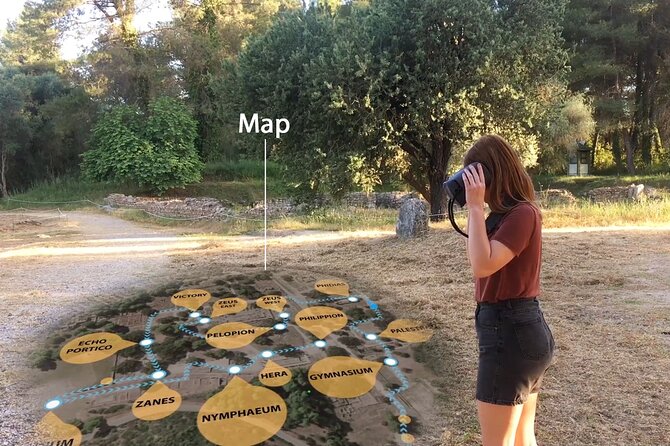
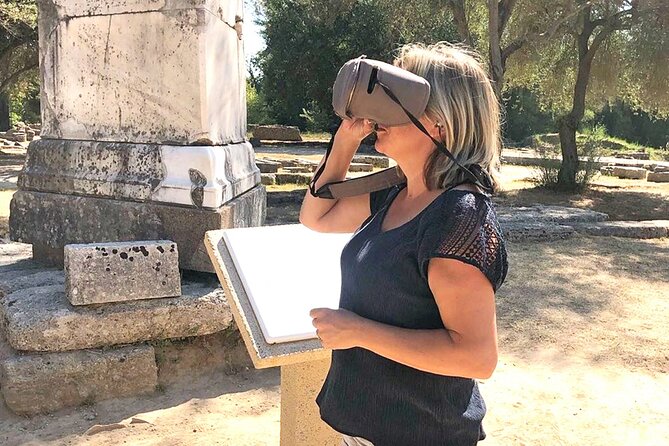
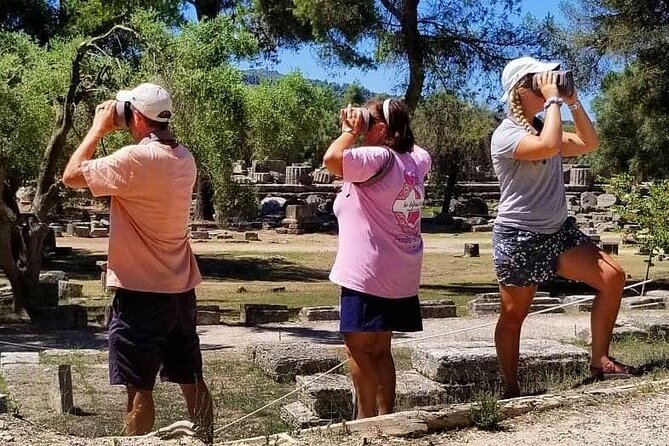
- VR glasses + GPS audio guide: the narration guides you as you walk, not in a fixed bus-loop pattern.
- You control the pace: no group herding, which is a big comfort at a large site.
- Temple of Zeus and the stadium are standout moments: VR helps you grasp scale and action when the real structures are mostly ruins.
- Park entry is not included: budget for the separate admission ticket.
- Return logistics matter: returns are not available during 13:30–15:00 due to working schedule.
- Best for travelers who like context: if you want to understand what you’re looking at, this format is made for you.
A VR headset walk-through of Ancient Olympia
Ancient Olympia is famous, but in real life it’s also… broken, spread out, and easy to misread. What makes this tour work is that it treats VR as a translator. The glasses aim to show you what important structures looked like when they weren’t collapsed into a field of stone.
Instead of relying only on signs (often limited in what they explain), the tour gives you a guided story tied to where you’re standing. That’s especially helpful at a place where you can walk past a ruin and only later realize what it was. Travelers consistently say the VR makes the site make sense fast.
Where you meet Olympia back in time (and why it’s convenient)
You meet at Olympia back in time at Tsouřeka Θ., Archea Olimpia 270 65, Greece, and you return there at the end. The meeting point is close enough to matter because you’re not just doing the ruins—you’re also handling pickup and drop-off.
A practical detail: the tour is designed around you picking up the VR equipment first, then walking the site, then returning it. So you’re planning a mini “equipment flow,” not just arriving at the gate and strolling.
How the VR glasses, audio guide, and GPS map work
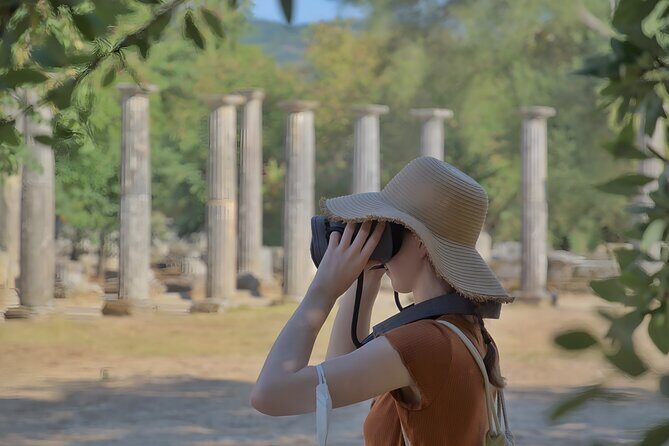
This experience includes virtual reality glasses and an audio guide, plus technical support and a live demonstration. Before you start, you’ll get a short demo so you aren’t fumbling with controls mid-ruin (which is the kind of frustration you don’t want at midday heat).
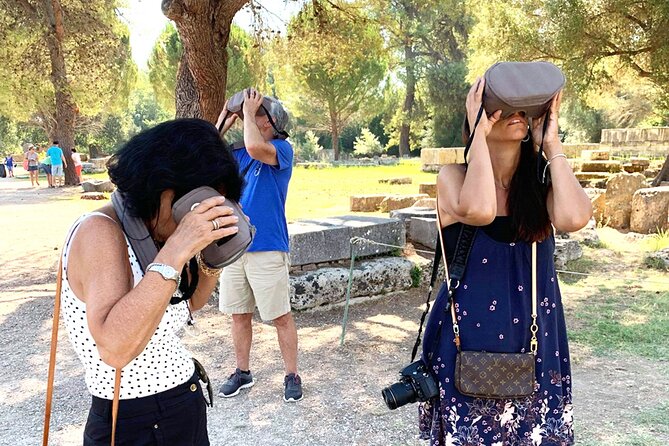
The glasses use GPS to help guide you with a virtual map. In other words, you’re walking the real site while the audio and VR content correspond to what you should be looking at. One review note that directional clarity could be improved for some people—so if you’re easily turned around, build in extra time and don’t assume every turn is instantly obvious.
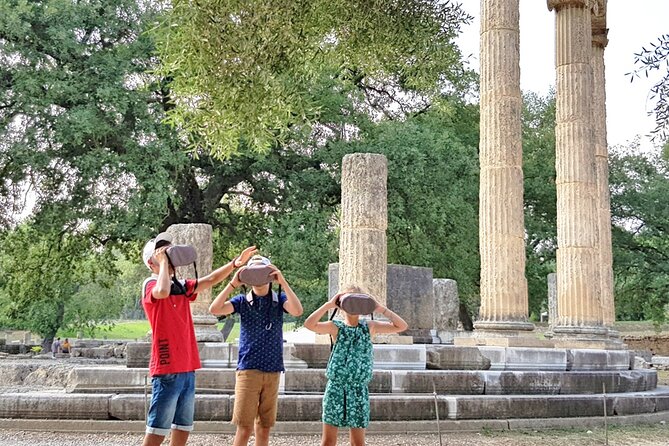
Also, yes, you’ll look a little silly wearing VR gear outdoors. But travelers say the payoff is the context you get while everyone else is left mostly reading signs.
Your route: from VR context to Zeus, the stadium, and Hera
The tour is structured as a sequence of stops with a clear story arc. You start with a welcome and demo, then you move through the highlights: Temple of Zeus, the stadium (with the “ancient Olympic race” recreation), and Temple of Hera (including the Olympic Flame and games for Hera). After that, you loop through the larger archaeological site area.
It’s a great format because the stops aren’t random. They build your mental picture: religion and power first (Zeus and Hera), then competition and spectacle (the stadium), then the wider complex.
Stop 1: Olympia back in time for the demo and setup
You begin at the Olympia back in time office. After a short demonstration, you head to the archaeological site, where the “magic” happens in VR.
This step matters more than it sounds. If you’ve never used GPS-guided VR content, the demo is your insurance policy. You’ll learn how to operate the glasses and get oriented before you start walking between monuments that can look similar from a distance.
Temple of Zeus: the scale and color problem solved
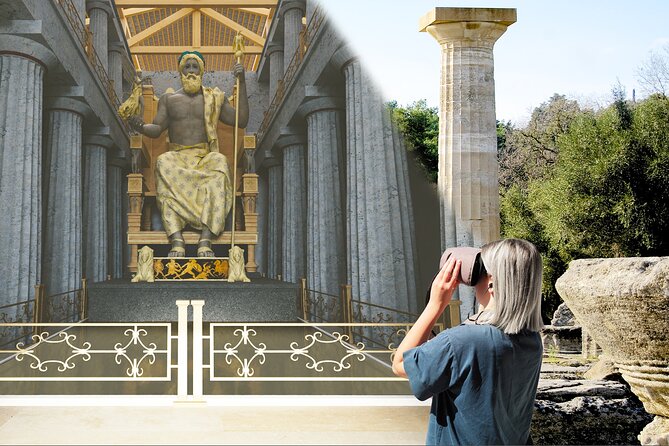
The Temple of Zeus is where the VR experience gets especially memorable. Travelers call out the sense of scale: you stand in front of the massive Statue of Zeus that’s described as so tall it nearly reaches the ceiling.
The VR also restores statues and faded details with color, aiming to recreate how the space looked about 2,000 years ago. Even if you’ve read about Olympia before, VR helps you translate written descriptions into a real sense of size and presence.
In plain terms: if you struggle to picture ancient art and architecture from ruins alone, Zeus is the payoff stop.
Stadium at Olympia: watching the ancient Olympic race in place
Next is the stadium at Olympia. The VR experience recreates the feel of competition—athletes running with all their strength and a finish-line celebration, surrounded by cheering spectators.
The stadium is a good choice for VR because it’s a place built for attention and motion, not for static looking. When you’re standing in a real ruin, it’s easy to underestimate how loud and packed it would have been. VR tries to fill that gap with action and crowd energy.
This is also a stop that’s frequently praised for families. If kids (or adults) are losing interest in ruins, VR “moves” the story again.
Temple of Hera: the Olympic Flame and the women’s games
At Temple of Hera, the VR experience focuses on two linked ideas: a sacred lighting ritual connected to the Olympic Flame, and the ancient games held for women in honor of Goddess Hera.
This is one of the more distinctive angles in the itinerary because it nudges you toward a lesser-known side of Olympia. You’re not only seeing what powered the big male competitions; you’re also seeing how the games and religious life connected to Hera.
It’s short in time, but it’s conceptually satisfying. You leave with a more complete sense of what Olympia represented.
The main archaeological site: 12 more monuments and the big-picture payoff
After the headline stops, you enter the Archaeological Site of Olympia experience that covers 12 more monuments. The idea here is to connect the dots.
At a place full of fragments, “big picture” context is what turns wandering into understanding. Travelers repeatedly mention that the information provided by the VR is more helpful than what’s available through standard signage alone. That doesn’t mean signs are useless; it means the VR gives you the missing interpretation layer.
One practical note: the site is walk-heavy. So this segment is where pace planning matters most. If you’re prone to rushing, you may miss how VR content changes with each area.
Stop 6: return the glasses, but mind the 13:30–15:00 window
You finish back at Olympia back in time to drop off the VR glasses and share your experience. There’s an important scheduling constraint: returns between 13:30 and 15:00 are not available due to the working schedule.
Also, at least some travelers report office closure around that midday window can create stress—especially for people connecting to cruise schedules or bus timetables. Even if you’ve planned a self-paced visit, build a buffer for pickup/drop-off time so you don’t get stuck rushing the site.
Price and value: what you pay for, what you still need
The tour price listed is $31.13 per person for the VR experience, with virtual reality glasses, the audio guide, a live demonstration, and technical support included.
What is not included is the entry ticket to Olympia. That’s a separate payment at €20.00 per person in the provided info, with free admission mentioned for certain travelers (EU under 25, and non-EU under 18). So your total cost depends on eligibility and whether you qualify for free entry.
Is it good value? For many visitors, yes—because the VR does something a standard guidebook can’t do easily: it reconstructs scale and scenes in situ. Multiple travelers mention it’s cheaper than hiring a live guide and helps you understand what you’re looking at, especially since Olympia has limited structure remaining.
One reality check: you may not save money versus a basic entry ticket alone. But if you’re already paying for admission, the VR portion can feel like the “upgrade” that turns ruins into a story you can actually follow.
Who this is best for (and who might want a different plan)
This tour works best if you want context and you don’t want to guess what every ruin used to be. It’s also a strong family option, with travelers specifically mentioning kids enjoying it because the VR adds action and clarity.
You might want to consider a more traditional guided approach (or at least add extra time) if you know you dislike tech gear or you’re easily stressed by wayfinding. Some travelers noted directional issues inside the experience, which matters if you’re already prone to getting turned around.
Walking, heat, and timing: the part nobody can VR away
Ancient Olympia involves real walking. Several travelers mention a lot of walking, and that the VR office-to-entrance distance can feel longer than expected on a hot day. So plan for hydration, comfortable shoes, and a realistic pace.
If you’re coming from a cruise or any itinerary that’s time-locked, be extra careful. Reviews mention transportation challenges after 12pm and the office’s midday closure window can force you to hurry through the site. In that case, the VR experience is still worth it, but only if you build the schedule correctly.
Technical support and ease of use
The included technical support and setup demo are a big deal because VR is only fun if it works smoothly. Travelers report the glasses are easy to use and pickup is straightforward, with staff providing simple instructions.
You’ll also hear the audio through an earpiece, so you’re not stuck trying to read while you stand under a burning sun. For many, that’s the real convenience: you get a guided experience while remaining physically flexible.
Group size and the feel of the visit
The tour has a maximum of 60 travelers, and it’s not described as a long bus-queue style group tour. The core feel is self-guided walking with guided audio and content triggers.
That “not too crowded” feeling matters at Olympia. A tightly packed group can turn ruins into a photo-jog. Here, you’re walking at your own tempo, which many visitors find more enjoyable.
What about food, drinks, and wine?
Nothing in the included details suggests a wine tasting or a structured meal stop. So don’t plan this as a food-and-drink experience.
You can, however, pair it with a meal in Olympia afterward. Some travelers mention enjoying dinner during their day, but the tour itself doesn’t advertise a specific wine selection.
Tips to make this VR tour go smoothly
- Budget time for the walk between pickup and the entry area, not just time in the park.
- Plan around the 13:30–15:00 return gap, especially if you have a tight transport connection.
- Wear comfortable shoes. This is a walking-heavy site, even with VR doing the storytelling.
- If directions are tough for you, add buffer time. A few travelers wanted clearer on-screen direction cues.
- Use the GPS audio as intended and don’t treat it like a “set-and-forget” device. Staying aware of where you are makes the VR experience click.
Should you book Olympia VR glasses?
If you’re the type of traveler who wants to understand ruins—especially when structures are mostly broken—this is an excellent way to make Olympia readable. The VR highlights (Zeus, the stadium, and Hera) are the strongest reason to book, and the audio-guided, GPS-linked pacing gives you more independence than a classic group tour.
Book it if:
- you want context at each stop, not just photos
- you’re visiting with kids or family and want them engaged
- you’re okay paying entry separately and planning for walking time
Skip it or adjust your plan if:
- you have a very strict schedule that risks the return window or transportation timing
- you know you get uncomfortable with tech gear or you dislike wearing headsets for extended periods
Bottom line: for most visitors, paying for the VR glasses turns Olympia from confusing ruins into a place that makes sense on your feet. Just plan your timing well, and you’ll get the best of both worlds.
Olympia: The Famous VR Glasses Tour (+Audio Guide)
FAQ
Is the Olympia entry ticket included in the VR tour?
No. Entry ticket to Olympia is not included. The provided info lists €20.00 per person, with free entry mentioned for some travelers (EU under 25 and non-EU under 18).
How long does the Olympia VR glasses tour take?
It’s listed as about 2 to 3 hours.
Where do I meet and return the VR glasses?
You meet and return at Olympia back in time at Tsouřeka Θ., Archea Olimpia 270 65, Greece.
What’s included with the price?
Included are virtual reality glasses, an audio guide, a live demonstration, and technical support & information.
What language is the tour offered in?
The tour is offered in English.
Do I need to pick up physical tickets?
You get a mobile ticket.
Is there a time when returns are not available?
Yes. Returns between 13:30 and 15:00 are not available due to the working schedule.
Is the tour self-guided or led as a group?
It’s designed as a self-guided walking experience with the VR glasses and audio guide that work with GPS.
Is it suitable for most travelers?
The information says most travelers can participate.
Is there a group size limit?
Yes, it has a maximum of 60 travelers.
Can I cancel for free?
Free cancellation is available. You can cancel up to 24 hours in advance for a full refund.