Based on nearly 900 reviews and extensive traveler feedback, this historical walking tour stands as one of Dublin’s most reliable introductions to the city’s complex and fascinating past. We love how the tour distills thousands of years of Irish history into a digestible two-hour experience, and we’re equally impressed by the consistently high caliber of the guides, all of whom hold history degrees. That said, this tour leans heavily into political and historical depth—if you’re looking for a casual stroll focused primarily on Instagram-worthy buildings, you’ll want to manage your expectations accordingly.
This experience works best for history enthusiasts, curious travelers arriving in Dublin for the first time, and anyone who wants to understand the cultural context behind the city’s major landmarks before exploring them independently later in the day.
- What Makes This Tour Special: Real Value in a Tourist-Heavy City
- The Itinerary: Eight Essential Stops Through Dublin’s Soul
- Trinity College Dublin: Where It All Begins
- Bank of Ireland: A Building That Changed History
- Temple Bar: From Demolition to Cultural Hub
- Wood Quay Amphitheatre: Where Vikings Founded Dublin
- Four Courts: Where Civil War Began
- Christ Church Cathedral: Medieval Dublin’s Spiritual Heart
- City Hall: Symbol of Irish Catholic Emancipation
- Dublin Castle: Power and Identity
- What Travelers Are Actually Saying: Beyond the Star Ratings
- The One Honest Criticism Worth Considering
- Practical Details That Matter
- Is This Tour Worth Your Time and Money?
- FAQ: Questions Travelers Ask About This Tour
- Final Verdict: A Smart Investment in Understanding Dublin
- The Best Of Dublin!
- More Walking Tours in Dublin
- More Tours in Dublin
- More Tour Reviews in Dublin
What Makes This Tour Special: Real Value in a Tourist-Heavy City
 1 / 2
1 / 2 2 / 2
2 / 2At $22.98 per person, this tour delivers exceptional value in a city where tourist activities can quickly drain your budget. You’re paying for two hours of expert historical knowledge from someone with genuine academic credentials, not just a charismatic storyteller regurgitating facts from a guidebook. The guides are history postgraduates—these are people who’ve studied Irish and Dublin history at university level, and that background shows throughout the tour.
What strikes us most about the reviews is how consistently travelers mention feeling genuinely educated rather than merely entertained. One traveler who’d completed over 20 historical walking tours across Europe noted this tour went deeper than others, which for history buffs is precisely the appeal. Another reviewer, a graduate student of history herself, praised how the guide “wove otherwise disparate information into a fascinating story of the Irish political landscape.” That’s the difference between a good tour and an exceptional one.
The logistics also deserve mention. With a maximum of 25 people per group, you’re not herded through the city like cattle. You’ll actually hear your guide without straining, ask questions when something interests you, and maintain a sense of intimacy that larger group tours simply can’t match. The tour runs on a fixed two-hour schedule, which means you have the rest of your day completely free—perfect for revisiting sites that captured your imagination or grabbing lunch at a Temple Bar café.
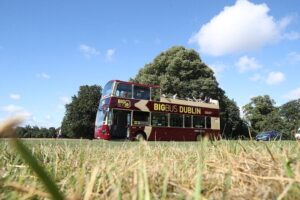
👉 See our pick of the Discover 6 Great Shore Excursions In Dublin
The Itinerary: Eight Essential Stops Through Dublin’s Soul
The tour’s route takes you through the geographic and historical heart of Dublin, visiting eight major landmarks that together tell the story of how this city transformed from a Viking settlement into a modern capital. Let’s walk through what you’ll experience at each stop.
You can also read our reviews of more walking tours in Dublin



Trinity College Dublin: Where It All Begins
Your tour kicks off at the Grattan statue on College Green, directly opposite Trinity’s iconic front gate. This is arguably Dublin’s most famous institution, founded in 1592, making it older than Harvard University. Your guide will walk you through the campus and explain Trinity’s significance as Ireland’s oldest university—a symbol of Protestant Ascendancy and colonial-era learning.
The most valuable artifact housed here is the Book of Kells, an 8th-century manuscript containing the four Gospels written in Latin. While the tour itself doesn’t include admission to see the Book of Kells (that’s a separate paid experience), your guide will provide context about this extraordinary medieval work and help you decide whether it’s worth the additional cost and time. Many travelers find this helpful—understanding what you’re about to see before you see it deepens the experience considerably.
You’ll spend about 20 minutes here, enough time to get oriented to the college’s layout and appreciate the Georgian architecture while absorbing the historical significance of the place.
Bank of Ireland: A Building That Changed History
Next, you’ll visit the Bank of Ireland building, originally constructed in 1729 as Ireland’s colonial parliament. This architectural gem represents the “Protestant Ascendancy” of the 18th century—a period when Protestant landowners and merchants held virtually all political and economic power in Ireland. The building’s neoclassical style exemplifies the refined architectural tastes of that era.
What makes this stop particularly meaningful is understanding its role in Irish independence. The Act of Union in 1800 abolished this Irish parliament, effectively ending any pretense of Irish self-governance and subordinating Ireland directly to Westminster. Standing outside this building, your guide will help you grasp why this moment mattered so deeply to Irish nationalists. It’s a brief 10-minute stop, but the historical weight it carries is substantial.
Temple Bar: From Demolition to Cultural Hub
Temple Bar represents Dublin’s more recent history—a neighborhood that nearly disappeared entirely. In the 1990s, this area of narrow medieval streets was slated for demolition to make way for a bus station. Instead, local developers repurposed it as “Dublin’s Cultural Quarter,” and today it’s a vibrant hub of pubs, galleries, and live music venues.
For many travelers, this stop provides valuable context for one of Dublin’s most visited areas. If you’re planning to spend an evening in Temple Bar later in your trip, understanding its transformation from near-destruction to cultural centerpiece adds layers of appreciation. You’ll spend about 10 minutes here, observing the narrow lanes and perhaps catching the energy of the neighborhood even during daytime hours.
Wood Quay Amphitheatre: Where Vikings Founded Dublin
This stop takes you to the site of major archaeological excavations from the 1980s that uncovered extensive remains of the Viking city. Vikings founded Dublin in AD 840, and for centuries this area was the commercial and political heart of the settlement. The excavations revealed timber houses, workshops, and artifacts that fundamentally changed our understanding of early Dublin.
The modern amphitheatre constructed at this site now serves as a public gathering space and archaeological monument. Standing here, you’re literally standing on top of 1,200 years of history. Your guide will help you visualize what this area looked like when Viking traders dominated the Liffey and Dublin was a crucial trading post connecting Scandinavia to the Irish interior. Ten minutes might seem brief, but it’s enough to grasp Dublin’s ancient origins.
You can also read our reviews of more historical tours in Dublin



Four Courts: Where Civil War Began
The Four Courts, Ireland’s legal headquarters, is the site of a pivotal moment in Irish history. In June 1922, Irish Civil War fighting erupted here between those who supported the Anglo-Irish Treaty of 1921 (which granted independence but partitioned the island) and those who opposed it, demanding a fully unified Irish republic.
This building and this conflict represent one of the most painful chapters of Irish history—a war fought between former allies who’d fought together against British rule just years earlier. The Treaty itself was the culmination of the War of Independence (1919-1921), a brutal struggle that left the nation exhausted and divided over whether the peace agreement was sufficient. Your guide will spend about 20 minutes here, helping you understand the political complexities that led to civil war and how this conflict shaped modern Irish politics.
Christ Church Cathedral: Medieval Dublin’s Spiritual Heart
Dublin’s oldest cathedral, originally founded in 1030, was rebuilt in stone during the 1170s by Strongbow, the Norman knight central to the original English invasion of Ireland. This building represents the Norman conquest and the introduction of medieval European Christianity to Ireland on a grand architectural scale.
The cathedral’s history is inseparable from the larger story of English colonization—a complex and contested period that fundamentally altered Irish society. Standing in front of this 900-year-old structure, your guide will help you understand how the Norman invasion set in motion centuries of English involvement in Irish affairs. You’ll spend about 10 minutes here, enough to appreciate the architecture and absorb its historical significance.
City Hall: Symbol of Irish Catholic Emancipation
City Hall houses a statue of Daniel O’Connell, Dublin’s first Catholic Lord Mayor, elected in 1840. O’Connell’s significance cannot be overstated—he led the successful campaign for Catholic Emancipation in 1829, which ended all the anti-Catholic laws that had restricted Irish Catholics for centuries. He’s known as “The Liberator” for this reason, and his legacy shaped modern Irish politics profoundly.
This stop represents a turning point in Irish history when Catholics began reclaiming political power in their own country. Your guide will explain the significance of having a Catholic mayor in a city that had been governed by Protestants for generations. It’s a brief 10-minute stop, but it marks an important shift in the historical narrative you’ve been following throughout the tour.
Dublin Castle: Power and Identity
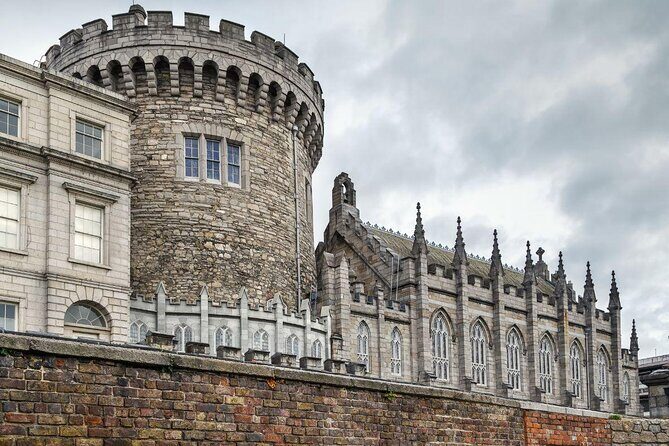
Your tour concludes at Dublin Castle, originally built by King John in 1204 and serving as the seat of British administration until 1922. This fortress-palace is where Irish independence was formally handed over to Irish leaders—a symbolic moment of immense importance.
The castle also sits atop the Dubh Linn (Black Pool), the body of water from which Dublin itself gets its name. Standing here, you’re at the literal source of the city’s identity, and your guide will help you understand how this building represented British power in Ireland for over 700 years. The final 10 minutes of your tour at this location provides a fitting conclusion, bringing together themes of colonization, resistance, and independence that have threaded through the entire experience.
What Travelers Are Actually Saying: Beyond the Star Ratings
The 4.9-star rating across 875 reviews tells you this tour is consistently excellent, but the actual comments from travelers reveal what makes it work so well. One traveler noted, “A fun and informative tour. A fantastic way to briefly learn about Ireland’s complicated history.” Another said the guide “conveyed a tremendous amount of information in a very engaging fashion.”
What’s particularly telling is how many reviews mention taking this tour at the start of their Dublin visit. One traveler wrote, “Took the tour on the day we arrived to Dublin. Gave us a great basic historical overview to start our Dublin trip.” This is precisely how the tour operator positions it, and the strategy works—you get context for everything you’ll see afterward, which deepens your understanding of the entire city.
Several reviewers specifically praised the guides’ ability to balance depth with accessibility. One wrote, “Eoin started with an easy to follow history of Dublin covering 5000 years in 5 minutes! Great overview upon which he provided more comprehensive detail at each stop.” This structure—big picture first, then detailed stops—makes complex history digestible.
The guides themselves earn consistent praise. Travelers mention guides by name (Jody, Eoin, Daragh, Colm, John, Owen) and describe them as “passionate,” “entertaining,” “animated,” and “knowledgeable.” One reviewer gushed, “Jody was a fantastic and engaging storyteller… As a graduate student of history, he offered a comprehensive yet cohesive review of thousands of years of Irish history, from the Celtic settlers to modern day Brexit.”
The One Honest Criticism Worth Considering
Among the 875 reviews, one traveler gave three stars and expressed that the tour was “way too in-depth into history and politics” and “way more political and dense than any others I’ve done.” They’d completed over 20 walking tours across Europe and found this one more challenging than others. The tour operator’s response is worth reading: “If you sign up for a ‘Historical Walking Tour of Dublin’ I think you should expect it to be, well, ‘historical’!”
This is honest feedback that matters. If you prefer light cultural commentary and pretty buildings, this tour might feel dense. If you like understanding the why behind history—the political movements, the conflicts, the personalities—you’ll find it revelatory. The tour isn’t trying to be everything to everyone; it’s specifically designed for people who want genuine historical education.
Practical Details That Matter
The tour departs from the Grattan statue on College Green, directly opposite Trinity College’s front gate. This is a highly visible, easy-to-find location in the city center, accessible by public transportation. You’ll receive a mobile ticket, so there’s nothing to print. The tour runs rain or shine (several reviewers mentioned completing it in freezing or rainy weather), so dress appropriately for Dublin’s unpredictable climate.
The tour is classified as moderate physical fitness level, which means you’re walking for two hours over Dublin’s city center streets. Comfortable shoes are essential—one traveler specifically mentioned, “wear comfy shoes!” You’re not climbing mountains, but you will cover distance at a steady pace. The maximum group size of 25 people means you won’t be crowded, and you’ll actually be able to hear your guide without struggling.
The tour typically books about 21 days in advance on average, suggesting you should plan ahead during peak season (summer months). However, availability varies, and you might find last-minute spots, especially in shoulder seasons. With free cancellation up to 24 hours before, there’s minimal risk in booking.
Is This Tour Worth Your Time and Money?
At under $23 per person, this tour costs less than a decent dinner in Dublin. You’re getting two hours with an educated historian who’s passionate about their subject, visits to eight major landmarks, and knowledge that will enhance everything else you do in Dublin. The fact that 97% of travelers recommend it speaks volumes.
We think this tour makes particular sense if you’re arriving in Dublin without much prior knowledge of Irish history. The context it provides will transform your subsequent explorations of the city. Instead of walking past Dublin Castle thinking “nice old building,” you’ll understand it as the symbolic seat of British power in Ireland for 700 years, which deepens your appreciation immeasurably.
It also works beautifully as a way to orient yourself geographically to Dublin’s city center. You’ll learn where things are, understand how different neighborhoods connect, and have a mental map that makes independent exploration easier and more confident.
FAQ: Questions Travelers Ask About This Tour
Q: Do I need to book in advance, or can I just show up?
A: The tour books about 21 days in advance on average, so booking ahead is recommended, especially during summer months. However, last-minute availability may exist depending on the season. Mobile tickets are provided immediately upon booking, making the process seamless.
Q: What’s included and what costs extra?
A: Your $22.98 covers the entire two-hour guided tour and access to all external sites. The Book of Kells at Trinity College requires separate paid admission and isn’t included. All other stops are viewed from outside or from public areas with no additional fees.
Q: Can I cancel if my plans change?
A: Yes, you have free cancellation up to 24 hours before the tour start time. If you cancel within 24 hours, you forfeit your payment. This generous cancellation policy means you can book with confidence.
Q: How many people are typically on these tours?
A: The maximum group size is 25 people, which is small enough to hear your guide clearly and ask questions, but large enough to provide a social atmosphere. Exact group sizes vary by tour date.
Q: What’s the physical difficulty level?
A: The tour is classified as moderate fitness level. You’ll walk for two hours over city center streets at a steady pace. It’s not strenuous hiking, but comfortable, well-broken-in shoes are essential.
Q: When does the tour end?
A: The tour concludes at Christ Church Cathedral on Christchurch Place near Wood Quay. From there, you’re free to continue exploring independently or head to lunch. The rest of your day is completely open.
Q: What if the weather is bad?
A: The tour operates in all weather conditions. Several reviews mention travelers completing it in freezing temperatures and rainy weather. Dress appropriately with a waterproof jacket and layers, and you’ll be fine.
Q: Are there any stops where we go inside buildings?
A: The tour visits external sites and public areas. You won’t be going inside Trinity College buildings, the Bank of Ireland, or other locations—you’ll view them from outside while your guide provides context. This keeps the pace moving and costs down.
Q: Who are the guides, and what qualifications do they have?
A: All guides are history postgraduates, meaning they’ve studied history at the university level. This background shows in the depth and quality of information provided. Guides are consistently praised by travelers for their knowledge, enthusiasm, and ability to explain complex historical concepts clearly.
2-Hour Historical Walking Tour from Dublin
Final Verdict: A Smart Investment in Understanding Dublin
This tour is one of the best values in Dublin, delivering genuine historical education from credentialed guides in a small-group setting for under $23 per person. The consistently high reviews (97% recommendation rate) reflect guides who actually care about their subject matter and can communicate complex history in engaging ways. It’s ideal for travelers arriving in Dublin who want context for the city’s major landmarks, history enthusiasts who appreciate depth and political nuance, and anyone seeking to understand Ireland’s complicated past. The only travelers who might be disappointed are those seeking a casual, light-hearted stroll focused more on Instagram moments than historical understanding. If you value knowledge, authenticity, and excellent value for money, this tour belongs on your Dublin itinerary.