
I like this afternoon tour because it’s a smart way to get your bearings fast in Birmingham’s center. You start at the Library of Birmingham near Centenary Square and then walk through major civic, cultural, and canal-area spots like Gas Street Basin and the ICC. It runs about 2 hours at 1:30pm, and it uses a mobile-friendly live audio setup.
Two things I really like are the caliber of the guides and how much you cover for the price. People consistently mention guides such as Jonathan and Michael as knowledgeable, funny, and genuinely invested in Birmingham—exactly what you want when you’re learning on foot. Second, the route blends polished landmark views (including top-floor perspectives at The Mailbox area) with the city’s working history, especially the canal story.
One thing to consider: the tour is labeled as Canals, Victorians & Today, but a small number of travelers felt it leaned more broadly across the city than strictly canal-focused. If you’re expecting a long, slow canal walk with tons of canal-side time, you may want to read that into your expectations.
- Key Highlights You’ll Care About
- A Quick Reality Check: What This Tour Feels Like
- Where You Meet: The Library of Birmingham as Your Anchor
- Price and Value: What .80 Buys in Real Life
- The Listening Setup: Audio Receivers That Actually Help
- How the Route Works: A City-Center Loop
- Stop-by-Stop Breakdown: What You’ll See and Why It Matters
- Stop 1: Library of Birmingham (Start + Orientation)
- Stop 2: International Convention Centre Birmingham and Symphony Hall Area
- Stop 3: Brindleyplace (Past Industrial, Now Modern)
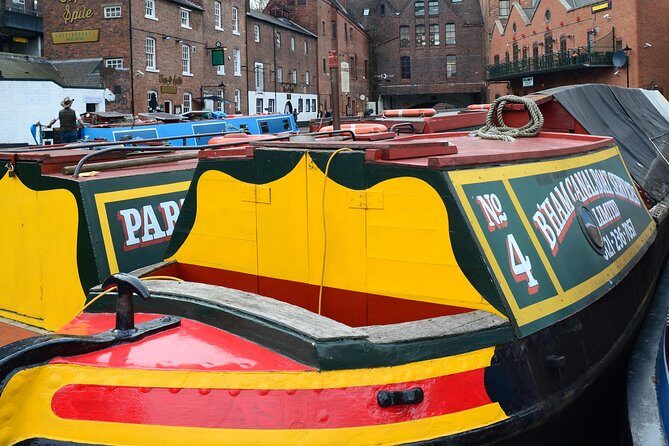
- Stop 4: Gas Street Basin (The Canal Story Comes Alive)
- Stop 5: Victoria Square (Victorians, Public Art, and Urban Development)
- Stop 6: Chamberlain Square (Moving Into the Future)
- Stop 7: Birmingham Museum & Art Gallery (1880s Double Portico)
- Stop 8: The Mailbox (Conversion of a Former Sorting Office)
- Stop 9: The Cube (Views From Upper Floors)
- Ikon Gallery (Architectural Roots as a School)
- Stop 10: Hall of Memory (Art Deco Memorial With Multiple Conflicts)
- Stop 11: ICC Mall (Route From Centenary Square to the Canalside)
- Stop 12: Birmingham Town Hall (1834 Civic Legacy)
- Who This Tour Is Best For (and Who Might Skip)
- Practical Notes: Comfort, Accessibility, and Weather
- Cancellation Policy (Free Refund Rules)
- The Bottom Line: Should You Book This Birmingham Walk?
- FAQ
- What time does the Birmingham walking tour start?
- Where do I meet the guide?
- Is the tour free to enter at each stop?
- Are there audio devices on this tour?
- How far will I walk?
- How large is the group?
- What is the cancellation policy?
Key Highlights You’ll Care About
- Small-group pace (max 35) that still covers a lot in about 2 hours
- Live audio with receivers so you can hear the guide without crowding in
- Canals + civic Birmingham through stops like Gas Street Basin and ICC
- Victoria Square and Chamberlain Square for the Victorian-to-modern development story
- Museum and culture breaks with Birmingham Museum & Art Gallery and the Mailbox
- Worlds-on-a-street feel: art, memorials, and modern events all in one walk
A Quick Reality Check: What This Tour Feels Like
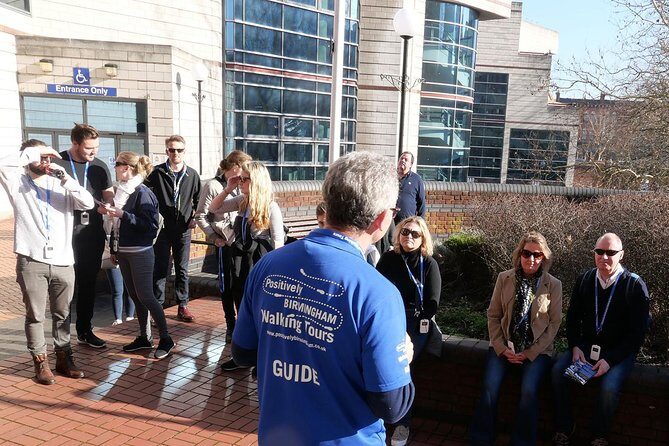
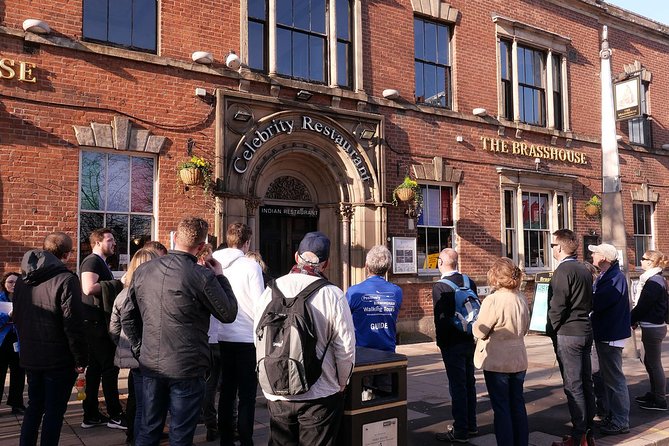
This isn’t a “bus window” kind of sightseeing. It’s a guided walk that helps you connect the dots between eras: Victorian civic ambition, the canal-era industrial backbone, and the modern reinvention you can still see street by street.
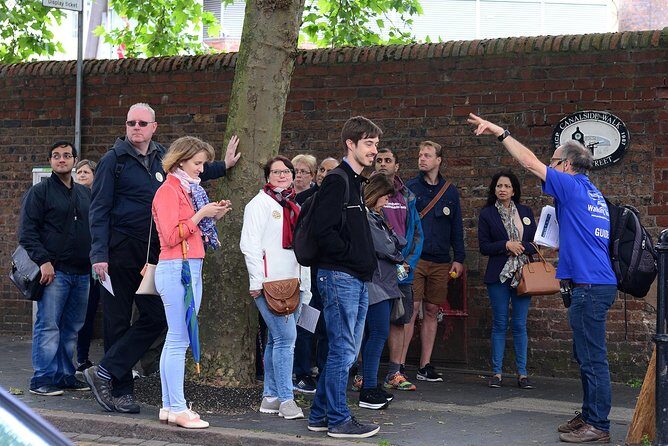
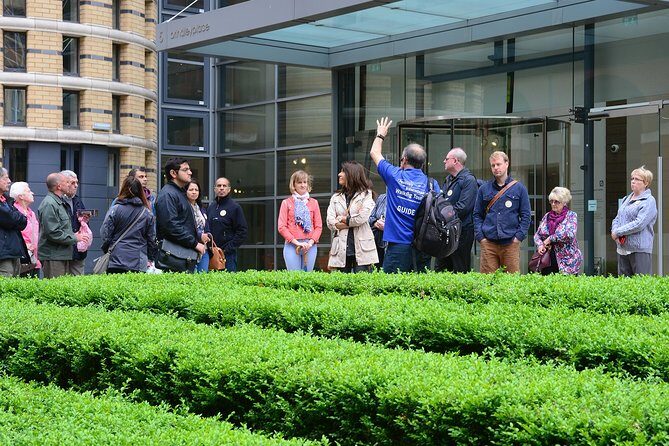
The pace is set for walking, but it’s also built to keep you listening. Several travelers praised the clear audio setup, saying it makes it easier to follow the guide without constantly leaning in or craning your neck.
Where You Meet: The Library of Birmingham as Your Anchor
You meet and end at the Library of Birmingham in Centenary Square (B1 2ND). That matters more than you might think. Starting at a major hub keeps the whole experience easy—no complicated transit maze before you begin, and you’re not stuck figuring out your return at the end.
The tour also uses this building as a first “wow” moment. You’ll get oriented while looking at one of Birmingham’s biggest modern attractions right at the start.
Price and Value: What $20.80 Buys in Real Life
At $20.80 per person for roughly 2 hours, this is priced like a practical orientation tour. It’s not trying to be a museum day with long entrances and long waits.
You’ll still get meaningful stops, including places where admission is noted as free and a couple where admission is included. That mix is key: you’re paying mainly for the guide’s storytelling and the time-efficient route, not just for access to buildings.
And because people rate it extremely high (with many saying it helped them “acquaint” themselves with the city), you’re buying something travel-scarce: local interpretation.
The Listening Setup: Audio Receivers That Actually Help
This tour uses a live audio system. Each guest is loaned a receiver, and the guide wears a radio transmitter. You either use your own earphones with a 3.5mm socket, or you’re provided a new pair.
That’s a small detail, but it changes the whole experience on a busy city sidewalk. You can keep your place, look at what the guide is pointing out, and still hear the story clearly. Some other walking tours force you to stand right next to the guide—this one tries to give you freedom.
One note: the information also says the tour may use audio but not always. Still, when it’s running, travelers consistently mention it as a win.
How the Route Works: A City-Center Loop
The stops are spread across a compact area, so you’re not burning time on long transfers. You’ll go from Centenary Square toward the cultural and convention spaces, then toward the canal-side atmosphere around Gas Street Basin, and finally through Victorian-era and memorial landmarks back toward the city’s civic core.
Because it’s a loop that returns to the meeting point, it feels easy to fit into a weekend schedule. You don’t need a separate plan for where you’ll end up.
Stop-by-Stop Breakdown: What You’ll See and Why It Matters
Stop 1: Library of Birmingham (Start + Orientation)
You begin at the Library of Birmingham, with admission free. It’s positioned as the perfect first stop because it’s instantly recognizable and gives you a clean starting reference point.
I like using an anchor building like this because it helps the rest of the walk click into place. You’re not just moving from landmark to landmark—you’re building a map in your head.
Stop 2: International Convention Centre Birmingham and Symphony Hall Area
Next up: the International Convention Centre Birmingham (near Symphony Hall). You’ll look at the ICC and talk about its role in the city.
This is one of those stops that can sound boring on paper—until you realize it’s about how Birmingham presents itself today. Convention and event spaces shape foot traffic, business, and even how new developments are planned around them.
Stop 3: Brindleyplace (Past Industrial, Now Modern)
At Brindleyplace, you’ll hear the history and also what the area looks like now. This kind of transformation is one of Birmingham’s signature themes: industrial-era bones, repurposed for modern use.
For travelers, it’s a useful contrast stop. You get to see how the city repackages its identity without starting completely from scratch.
Stop 4: Gas Street Basin (The Canal Story Comes Alive)
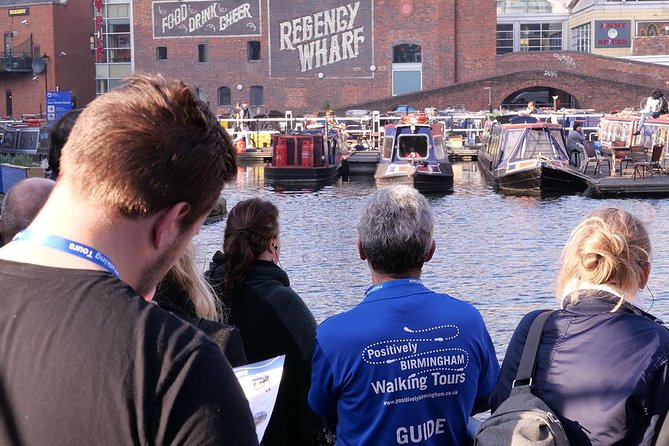
This is the heart of the canal portion: Gas Street Basin. The tour frames it as part of the arrival of canals and highlights its atmospheric role in the country’s canal network.
Even if you’re not a canal person, you’ll probably enjoy this stop because it offers a different kind of Birmingham view—less purely civic, more watery and textured. It also gives you a chance to slow down slightly compared with the straight-line street sections.
A small caution from traveler feedback: some people wanted more canal emphasis. Still, for a 2-hour walk, you do get a real canal focal point.
Stop 5: Victoria Square (Victorians, Public Art, and Urban Development)
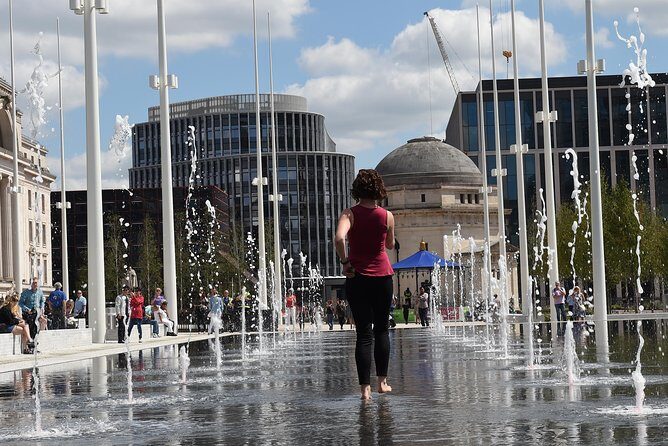
At Victoria Square, you’ll look at public art and discuss Victorian-era development, plus how the city evolved up to today.
This stop works well because it’s not just a timeline. You’ll connect the Victorian civic mindset—what the city wanted to project—with what you see now in the public realm.
If you enjoy city design and how public space shapes behavior, this is one of the more rewarding stops.
Stop 6: Chamberlain Square (Moving Into the Future)
Then you shift to Chamberlain Square, where the talk turns to the city moving forward.
Think of it as a bridge stop: you’ve just covered Victorian-to-modern change at Victoria Square, and now you’re getting the “what next” angle.
In a short walk, these pacing moments are smart. They prevent the tour from feeling like a straight history lecture.
Stop 7: Birmingham Museum & Art Gallery (1880s Double Portico)
You pass the entrance and focus on the 1880s design of the double portico. Admission here is noted as included, even though the time given is brief.
This is a “look up and notice details” stop. Portico architecture is the kind of thing you’d miss if you were rushing, and the guide’s job is to point out why it’s meaningful in the city’s visual language.
Stop 8: The Mailbox (Conversion of a Former Sorting Office)
At The Mailbox, you’ll see the conversion of a former post office sorting office into a mixed-use space, including the Birmingham headquarters of the BBC.
This is the sort of stop that hits practical reality. Old industrial infrastructure didn’t just vanish—it got reprogrammed. That’s an everyday part of Birmingham’s story, and it’s exactly the kind of transformation many travelers appreciate once they see it explained.
Stop 9: The Cube (Views From Upper Floors)
Next: The Cube. You’ll spend a short moment here, and you’ll hear that views from the upper floors are among the best in the city.
Even if you don’t have long inside time, a stop like this changes how you see the area. It pushes you to think vertically, and it helps tie the skyline and layout into the tour’s storyline.
If you’re a photo person, this is the moment to bring that mindset: don’t just look—notice lines and sight angles.
Ikon Gallery (Architectural Roots as a School)
The route also includes the Ikon Gallery, noted as originally built as a school and as one of over forty works by the architects Martin & Chamberlain.
This stop is great for architecture-minded travelers. It also reinforces a theme you keep seeing on this walk: buildings in Birmingham often carry multiple lives—education, culture, civic identity—rather than staying stuck in one role forever.
Stop 10: Hall of Memory (Art Deco Memorial With Multiple Conflicts)
At the Hall of Memory, you’ll hear about its Art Deco style and its original purpose as a First World War memorial in 1925. The tour also notes it now includes later conflicts, with features like William Bloye tablets.
This stop brings emotional weight to the itinerary, and it’s also visually interesting. Art Deco details are easy to miss if you’re staring straight ahead, so expect the guide to point out what to look for.
If you’re sensitive to war memorials, this is the part where you’ll likely appreciate the pacing and context.
Stop 11: ICC Mall (Route From Centenary Square to the Canalside)
The ICC Mall is described as the main route from Centenary Square toward the canalside. It’s a connective stop—less about one single building and more about how the city moves people.
These “route interpretation” stops are underrated. They explain why Birmingham feels the way it does at street level.
Stop 12: Birmingham Town Hall (1834 Civic Legacy)
Finally, you reach Birmingham Town Hall, described as the oldest building in Victoria Square dating from 1834.
For me, this is a satisfying closing beat. After covering modern conversions, convention spaces, and canal atmosphere, you land on a civic anchor with an older timeline behind it.
It gives the walk a clean ending: a sense of continuity, even as the city keeps reinventing itself.
Who This Tour Is Best For (and Who Might Skip)
You’ll probably love this if:
- You want a quick, guided orientation to central Birmingham
- You like history that’s explained through buildings and street-level changes
- You value clear communication—especially with an audio system
It may be less ideal if:
- You only want a long canal-focused walk and don’t want the citywide civic stops
- You’re expecting a slow, stop-and-stare museum day instead of a moving city walk
Travelers consistently described the guide as engaging and the tour as good pace with lots of ideas. That points to a strong fit for first-timers and weekend visitors.
Practical Notes: Comfort, Accessibility, and Weather
You’ll want a moderate physical fitness level since it’s a walking tour. There’s no long transit listed between stops, but you are on your feet for the whole loop.
Service animals are allowed, and the meeting point is described as near public transportation. The tour also notes it requires good weather; if poor weather cancels it, you’ll be offered another date or a full refund.
Cancellation Policy (Free Refund Rules)
You can cancel for a full refund up to 24 hours before the experience. If you cancel less than 24 hours in advance, the amount you paid won’t be refunded.
Free cancellation is tied to the experience’s local time. If weather is the reason for cancellation, you’ll get a different date or a full refund.
The Bottom Line: Should You Book This Birmingham Walk?
If you want a high-value intro to Birmingham—canals, Victorian civic spaces, and today’s developments in one tight route—this tour is an easy yes. The combination of guides, a practical audio system, and the fact that you see a lot without long waiting times is exactly what many travelers seem to want when they book.
My main “maybe” is expectation management. It’s not a dedicated canal-only stroll, even though Gas Street Basin is a highlight. If you’re okay with a broader city story, you’re likely to leave feeling like you understand the city better than you arrived.
Consider booking if it fits your schedule and weather looks good. With a maximum group size of 35, it’s also the kind of tour where you should be able to ask questions and still keep moving.
Birmingham Walking Tour: Canals, Victorians & Today (1:30pm)
FAQ
What time does the Birmingham walking tour start?
The tour starts at 1:30 pm and runs for about 2 hours (approx.).
Where do I meet the guide?
You meet at the Library of Birmingham, Centenary Sq, Birmingham B1 2ND, UK.
Is the tour free to enter at each stop?
Some stops are listed as free admission, while others have admission included. For example, the Library of Birmingham and several other locations are marked free, and Birmingham Museum & Art Gallery and The Mailbox are marked as included.
Are there audio devices on this tour?
The tour uses a live audio system where each guest is loaned a receiver. You can use your own earphones with a 3.5mm plug, or you may be provided one.
How far will I walk?
It’s a walking tour with multiple stops across central Birmingham, taking about 2 hours total. The info advises moderate physical fitness.
How large is the group?
The tour has a maximum of 35 travelers.
What is the cancellation policy?
You can cancel up to 24 hours before the experience for a full refund. If you cancel within 24 hours of the start time, the amount paid isn’t refunded. The tour also requires good weather and will offer a different date or full refund if canceled due to poor weather.