Hakone With Kids
Hakone was the trip that nearly didn’t happen. We’d planned a packed Tokyo week with the kids, and adding an overnight somewhere felt like too much faff — more luggage shuffling, more train stress, more “are we there yet.” But a friend who’d lived in Japan for years told me, quite firmly, that skipping Hakone would be the biggest mistake of our trip. She was right.
Hakone is a mountain hot spring town about 90 minutes from central Tokyo. It sits in the shadow of Mount Fuji — on a clear day, the views are extraordinary — and it’s been a popular escape from the city for centuries. For families, it’s the easiest overnight trip from Tokyo, and the one I’d recommend above almost any other. You get volcanic valleys, a pirate ship on a lake, cable cars over steaming craters, and the chance to sleep on tatami mats in a traditional ryokan. The kids still talk about it.
- Getting to Hakone From Tokyo
- The Hakone Free Pass — Worth It?
- The Hakone Loop — The Classic Route
- Hakone Tozan Railway
- Hakone Ropeway
- Lake Ashi Pirate Ship
- Hakone Checkpoint (Hakone Sekisho)
- Owakudani — Volcanic Valley and Black Eggs
- Hakone Open-Air Museum
- Staying Overnight — Ryokan and Onsen
- Mount Fuji Views — Managing Expectations
- Day Trip vs Overnight
- Practical Tips for Families
Getting to Hakone From Tokyo

Two options worth considering.
The Romancecar express runs direct from Shinjuku Station to Hakone-Yumoto. It takes about 85 minutes, costs ¥2,330 per adult, and is the easier choice with children. Reserved seats. No changes. Big windows. Our lot pressed their faces against the glass for the entire journey, which is exactly the kind of quiet time you want before a full day of activities. Book seats on the left side heading out of Tokyo for the best scenery.
The budget alternative: take any JR train to Odawara (covered by the Japan Rail Pass if you’ve got one), then switch to the Hakone Tozan Railway for the final stretch into Hakone. It’s cheaper but involves a change, and Odawara station with luggage and tired children isn’t my favourite place on earth.
If you’re doing a day trip, the Romancecar is a no-brainer. If you’ve got a JR Pass and you’re counting pennies, go via Odawara. Either way, you’ll be in the mountains before lunch.
The Hakone Free Pass — Worth It?
Almost certainly yes.
The Hakone Free Pass covers most transport within the Hakone area: the Tozan Railway, cable cars, ropeway, the pirate ship on Lake Ashi, and local buses. A two-day pass costs ¥6,100 for adults and ¥1,100 for children. There’s a three-day version too, but two days is plenty for families.
The pass pays for itself if you’re doing the classic Hakone Loop (more on that in a moment). Without it, you’d be buying individual tickets for every leg, which adds up fast and means queueing repeatedly with impatient small people. The pass also includes the return journey from Odawara, so factor that in when doing the maths.
One thing to note: the pass does not cover the Romancecar supplement. You can still ride the Romancecar, but you’ll pay the surcharge on top. We decided it was worth the extra for the outbound journey and used the regular trains on the way back when the kids were half-asleep anyway.
The Hakone Loop — The Classic Route
This is what most families come to Hakone for, and honestly, it deserves the hype. The “loop” is a circuit of different transport types that takes you through the mountains, over a volcanic valley, across a lake, and back again. Each leg is a different vehicle, which is basically a dream itinerary if you’re travelling with transport-obsessed children.
Here’s how it works, in order.
Hakone Tozan Railway
This little mountain train climbs from Hakone-Yumoto up through forested hillsides using a series of switchbacks. The train actually reverses direction partway up. Multiple times. Our six-year-old lost his mind with excitement. Adults get lovely views of deep green valleys and, in June, hydrangeas lining the tracks. It takes about 40 minutes to reach Gora at the top.
Fair warning: some of the stations have steep steps and no lifts. If you’re travelling with a stroller, you’ll be carrying it. The trains themselves are manageable — small but not cramped — and there’s something wonderfully old-fashioned about the whole experience.
Hakone Ropeway
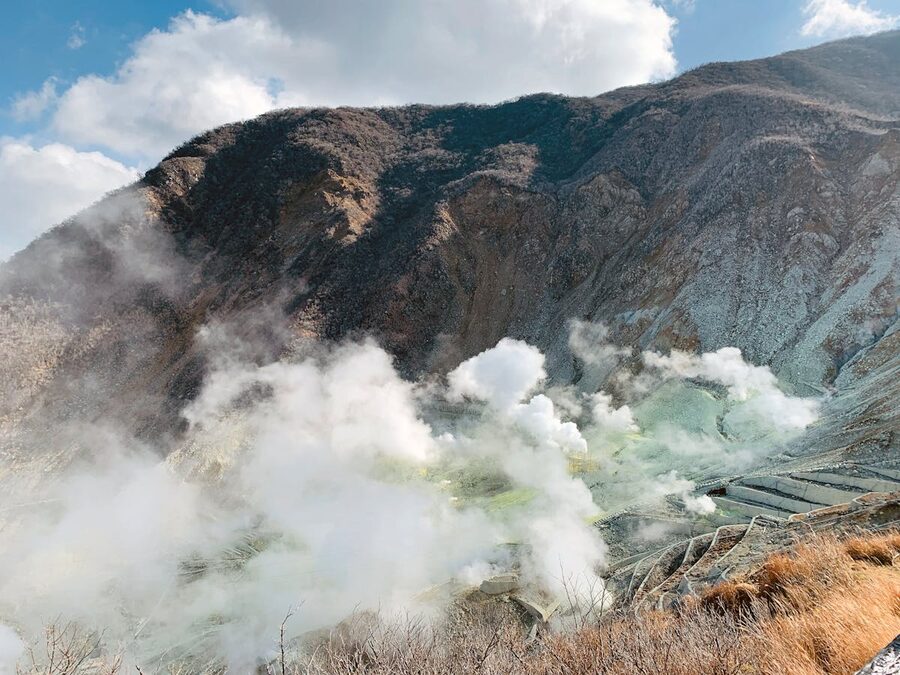
From Gora, you take a funicular (cable car on rails) up to Sounzan, then transfer to the Hakone Ropeway — a proper gondola that swings you out over Owakudani, an active volcanic valley. The views are spectacular. Below you, steam pours out of the earth, the rocks are stained yellow with sulphur, and the smell hits you even inside the gondola. Some children find this thrilling. Others find it terrifying. Ours were somewhere in between.
The ropeway runs for about 30 minutes total, with a stop at Owakudani station where you can get off and explore (see below). On clear days, Mount Fuji appears right in front of you as you descend towards Lake Ashi on the far side. Genuinely breathtaking when the weather cooperates.
Important: the ropeway closes during high winds, volcanic activity, or heavy fog. Check the status before you set out. Being stuck halfway round the loop with no ropeway running is not fun — the bus alternatives exist but they’re slow and crowded.
Lake Ashi Pirate Ship
Yes, really. A pirate ship. On a volcanic lake. In the mountains of Japan.
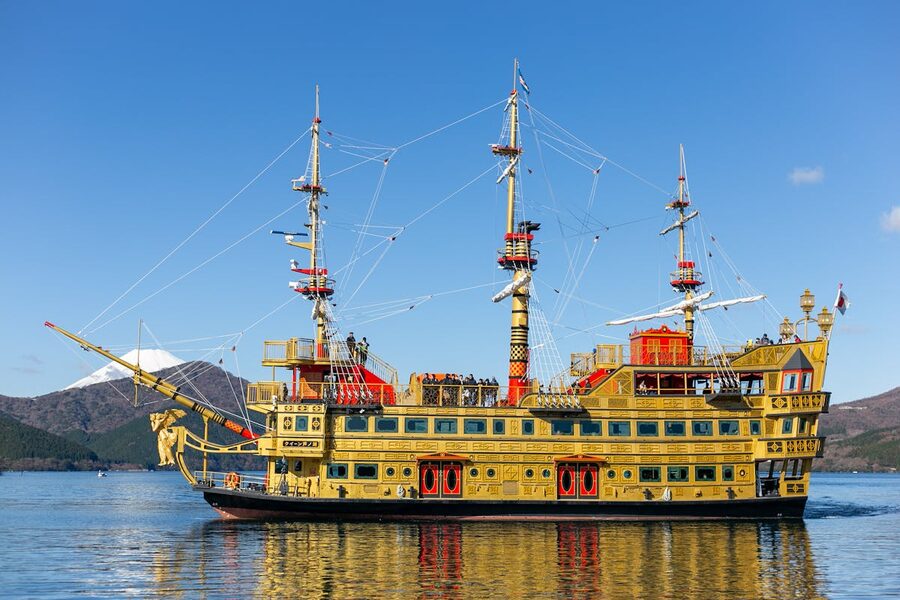
The sightseeing boats on Lake Ashi are styled as baroque pirate galleons, complete with carved figureheads and gold trim. They look completely absurd and the children absolutely adored them. The cruise takes about 30 minutes, crossing the lake from Togendai to Hakone-machi or Moto-Hakone. Covered by the Free Pass.
Mount Fuji views from the deck are the postcard shot of Hakone, if the weather plays along. We visited in October and got a perfect clear morning — Fuji reflected in the lake, snow on the summit, the lot. But I’ve spoken to plenty of families who saw nothing but cloud. Don’t pin your hopes on it.
The ships have indoor seating, a snack bar, and toilets. Perfectly manageable with young children, though the upper deck gets windy. There’s a “special cabin” upgrade available but I wouldn’t bother — the regular deck is fine and the views are the same.
Hakone Checkpoint (Hakone Sekisho)
Near the southern shore of Lake Ashi, you’ll find a reconstruction of the old Edo-period checkpoint where the Tokugawa government controlled travel along the Tokaido road. There’s a small museum with displays about life in feudal Japan — samurai armour, travel permits, that sort of thing.
Honest assessment: mildly interesting for older kids who’ve got some context about Japanese history. Completely lost on under-sevens. We spent about 20 minutes here and that felt right. It’s free with some passes or ¥500 otherwise. Not essential, but if you’re waiting for a bus connection, it fills the time.
Owakudani — Volcanic Valley and Black Eggs
Owakudani is the bit everyone remembers. An active volcanic zone where steam hisses from vents in the hillside, the ground is an otherworldly shade of yellow-grey, and the air reeks of sulphur. It feels genuinely dramatic — like standing on another planet.
The main attraction for kids: black eggs. Ordinary eggs boiled in the volcanic hot springs, which turns the shells jet black. They taste like normal eggs, but legend says each one adds seven years to your life. A bag of five costs ¥500. Our children ate them with enormous solemnity, doing the maths on how long they’d now live. Brilliant.
The sulphur smell is strong, though. Really strong. Some kids handle it fine. Our youngest gagged and wanted to leave immediately. If your child is sensitive to strong smells, be prepared for a short visit. There’s also an exclusion zone around the most active vents that you can’t enter — the walking area is limited to a paved path near the station and the egg shop.
Owakudani closes periodically when volcanic gas levels rise. It happened during our second trip to Hakone and we couldn’t visit at all. Check the official status on the day. There’s no way around this one — safety comes first.
Hakone Open-Air Museum

This is the single best family attraction in Hakone. Full stop. If you do nothing else, do this.
The Hakone Open-Air Museum is a sprawling outdoor sculpture park set against a mountain backdrop. Entry is ¥1,600 for adults and ¥800 for children. It’s big — you’ll want at least two hours, three if your kids are the exploring type.
What makes it brilliant for families is that the children can actually interact with the art. There’s a giant crocheted structure they can climb inside. A stained-glass tower with a spiral staircase. Enormous abstract sculptures that become climbing frames and hiding spots. Our kids treated the entire place as the world’s most beautiful playground, and nobody told them off. That’s the point.
There’s also a Picasso collection housed in a separate building — over 300 works spanning his entire career. Parents can take turns doing a quick loop while the other watches the kids outside. And at the far end of the grounds, there’s a natural hot spring foot bath where you can soak your tired feet while the children run around on the grass nearby. After a morning of hiking and cable cars, that foot bath felt like heaven.
The museum is mostly accessible for strollers, though some paths are gravel and a few sculptures sit on hillsides. It’s manageable, but an infant carrier would be easier than a pushchair for the steeper bits.
Staying Overnight — Ryokan and Onsen
Here’s my strongest recommendation: don’t make Hakone a day trip. You can, and it works, but you’ll miss the best part.
Hakone is the easiest place to experience a traditional ryokan stay from Tokyo. A ryokan is a Japanese inn with tatami-mat rooms, futon bedding on the floor, multi-course kaiseki dinners, and — crucially — an onsen (natural hot spring bath). For children, it’s an adventure. Sleeping on the floor! Wearing yukatas! Eating dinner in your room! Our kids have never been more excited about bedtime.
Many Hakone ryokans offer rooms with private onsen baths, which makes the whole thing much easier with small children. Public onsen have rules about tattoos, noise, and very young children that can feel stressful for families. A private bath means everyone can relax. Literally.
Expect to pay from about ¥25,000 per person per night for a mid-range ryokan including dinner and breakfast, less for children. It’s not cheap. But it includes two meals, and the experience is genuinely unlike anything else. We’ve written a full guide to family-friendly ryokans in Japan if you want specific recommendations.
Mount Fuji Views — Managing Expectations
Let’s be realistic. Hakone is famous for Mount Fuji views, but seeing Fuji is not guaranteed. Not even close.
The mountain creates its own weather system and spends a lot of time hiding behind clouds, especially in summer. Your best chances are early morning during autumn and winter — October through February — when the air is clearest. Spring can be good too. Summer is the worst; we visited in August once and didn’t see Fuji at all across two days.
The best viewpoints: Lake Ashi (from the pirate ship or the southern shore), the Hakone Ropeway descent towards Togendai, and various spots along the old Tokaido Highway. If you’re staying overnight, set an alarm and check from your ryokan window first thing. Fuji often appears at dawn and disappears by mid-morning.
Don’t let the kids build it up too much. Frame it as a bonus, not the main event. If Fuji shows up, wonderful. If not, you’ve still got volcanic valleys, pirate ships, and black eggs. That’s more than enough.
Day Trip vs Overnight
A day trip from Tokyo works if you’re pressed for time. Leave Shinjuku by 8am, do the Hakone Loop, visit the Open-Air Museum, and catch a Romancecar back by 6pm. It’s a long day but it’s doable, especially with older children.
But overnight is better. Significantly better. The ryokan experience alone justifies staying, and there’s something about waking up in the mountains — the quiet, the mist, the onsen before breakfast — that a day trip can’t replicate. The Hakone Loop also feels less rushed when you can split it across two days instead of cramming everything into one.
If your Japan itinerary allows it, give Hakone one night. Two nights is lovely but not necessary. One night gets you the ryokan dinner, the morning onsen, and enough time to see everything without sprinting between stations.
Practical Tips for Families
Strollers: Doable but limiting. The Open-Air Museum and Lake Ashi are fine. The Hakone Tozan Railway stations have steep steps with no lifts. Mountain paths around Owakudani are paved but steep. If your child is under two, consider a carrier instead — you’ll have a much easier time on the loop.
Food: Hakone-Yumoto (the main town at the base) has the most restaurant options. Up in the mountains, choices narrow quickly. The Owakudani station has a food court with udon, curry rice, and the famous black eggs. The Open-Air Museum has a decent cafe. Pack snacks for the ropeway and pirate ship legs — there’s nowhere to buy food between stops.
Luggage: If you’re doing an overnight trip, send your main luggage ahead to your ryokan using a takkyubin delivery service (available at most hotels and convenience stores for about ¥2,000 per bag). Doing the Hakone Loop with suitcases is miserable. Travel with a day bag only.
Timing: Weekdays are dramatically quieter than weekends. The ropeway and pirate ship both get long queues on Saturdays and during school holidays. If you have any flexibility at all, go midweek.
Weather backup: If it’s raining, the Open-Air Museum still works (bring waterproofs — the sculptures look gorgeous in the rain). The ropeway may close in high winds. Have a backup plan: the Hakone Yumoto area has several indoor onsen facilities and a cute high street with shops selling traditional crafts.
Hakone gave us one of the best 24 hours of our entire Japan trip. The combination of scenery, transport adventures, and the ryokan experience is hard to beat anywhere else this close to Tokyo. It’s the kind of trip where every member of the family finds something to love — and if you’re lucky with the weather, you’ll see Fuji too. Even if you don’t, you’ll eat a black egg, ride a pirate ship, and sleep on a tatami floor. That’s a pretty good day by anyone’s standards.
Planning the rest of your Japan trip? Start with our complete guide to Japan with kids, or if you’re still deciding where to base yourselves in the capital, check our guide to where to stay in Tokyo with kids.