
Japan doesn’t really have a bad season. That’s the honest truth. Every month offers something worth flying twelve hours for. But some months offer it with comfortable temperatures, thinner crowds, and prices that don’t make you wince at checkout. Those are the months you want — especially with kids in tow.
We’ve been to Japan in both spring and autumn with our lot, and we’ve spent an unreasonable number of evenings researching the months we haven’t tried yet. Here’s our proper breakdown of every season, written specifically for UK families trying to match Japanese weather with school holidays and small people who fall apart in extreme heat.
- Spring: March to May
- Cherry Blossom Season (Late March to Mid-April)
- Golden Week (Late April to Early May): Avoid Completely
- May: The Month Nobody Mentions
- Summer: June to August
- Rainy Season (June to Mid-July)
- Late July and August: Brutal Heat
- Autumn: September to November
- September
- October: Our Top Recommendation for UK Families
- November: Peak Autumn Colour
- Winter: December to February
- Christmas Illuminations and Skiing
- The New Year Catch
- Matching UK School Holidays to Japan
- Our Verdict
Spring: March to May
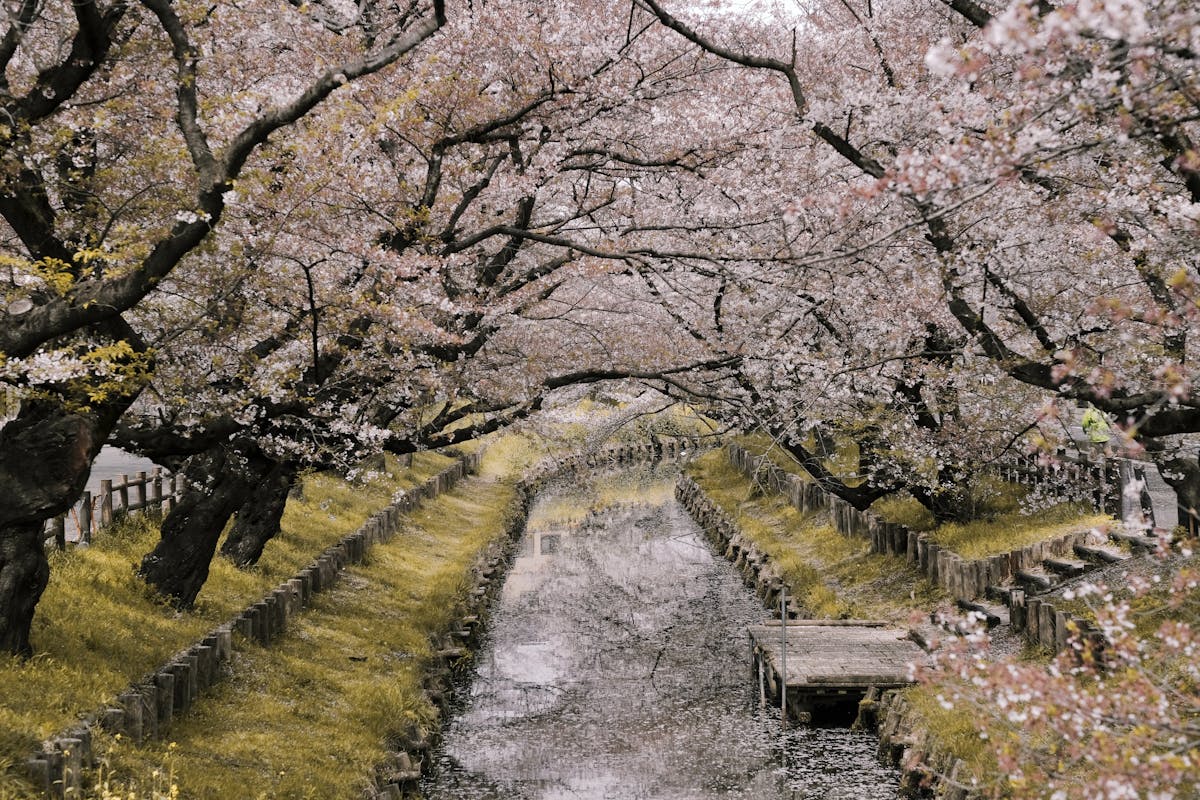
Cherry Blossom Season (Late March to Mid-April)
This is the one everyone pictures. Pink and white canopies over every park, river, and temple path. Kids running through drifts of fallen petals. Families on blue tarpaulins eating bento under the trees. It really is that stunning. No exaggeration.
The trouble is, the entire world has had the same idea.
Hotels in Kyoto and Tokyo fill up months in advance during peak bloom. Prices jump 30-50% on flights and accommodation alike. The famous spots — Philosopher’s Path, Ueno Park, Meguro River — get absolutely packed. Shoulder-to-shoulder at the most popular viewing points. Trying to navigate that with a pushchair and a melting-down three-year-old is nobody’s idea of a good time.
And cherry blossom timing is annoyingly unpredictable. The bloom depends on winter temperatures, and the window for full bloom at any single location is about ten days. You could book flights nine months out and arrive to find bare branches. Or brown, spent petals on the ground. It’s a genuine gamble.
If you do go: book six to eight months ahead. Not a suggestion. A requirement. Consider less famous viewing spots too — Yoshino in Nara Prefecture, or Hirosaki Castle in the north, where blooms come later and crowds are far thinner.
Easter holidays sometimes overlap with peak bloom, which is convenient. Check dates carefully each year — the alignment shifts.
Golden Week (Late April to Early May): Avoid Completely
Golden Week is a cluster of Japanese national holidays from around 29th April to 5th May. The whole country goes on holiday at once. Every train is packed. Hotels are either fully booked or charging double. Theme parks have two-hour queues before lunch. Restaurants have queues out the door.
This is not a time to visit Japan. Not with children. Not without children. Not under any circumstances. Skip it.
May: The Month Nobody Mentions
Here’s what experienced Japan travellers know. May — specifically mid to late May, once Golden Week has cleared — is genuinely brilliant. Temperatures sit around 20-25°C. Warm but not hot. The rainy season hasn’t arrived. Cherry blossom travelers have gone home. Summer crowds haven’t materialised. Everything is green and lush and calm.
You get temples without the crush. Restaurants without the wait. Hotel rooms at sensible prices. Your kids can actually run around a garden without being hemmed in by tour groups.
May half-term lines up perfectly for UK families. If your school breaks up around the 23rd, you’re landing in Japan at one of the best possible times to be there. Cheaper than spring, cooler than summer, quieter than both. We think May is the most underrated month for families visiting Japan. Properly underrated.
Summer: June to August
Rainy Season (June to Mid-July)
Japan’s rainy season — tsuyu — runs roughly from early June to mid-July across most of the country. It’s not non-stop torrential rain. More like spells of heavy showers mixed with humid, overcast days. Some days are perfectly dry. Others are a total washout.
The humidity is the real problem. Even when it stops raining, the air hangs thick and damp. Kids get grumpy faster. Clothes won’t dry. Everything feels slightly clammy and uncomfortable.
The upside? Tourist numbers thin out properly. This is one of the quieter periods for international visitors, so you’ll find shorter queues and better hotel availability. If you’re happy to carry rain gear and stay flexible with plans, June can work. Just know what you’re getting into.
Worth noting: Hokkaido, Japan’s northern island, largely misses the rainy season entirely. A good option if summer is your only window.
Late July and August: Brutal Heat
We won’t sugar-coat this. Tokyo and Osaka in August regularly hit 35°C with suffocating humidity. The heat index — what it actually feels like on your skin — can push past 40°C. Adults wilt. Kids struggle worse. We’ve heard far too many stories of families spending half their holiday hiding in air-conditioned shopping centres just to cool down.
Summer festivals are a genuine highlight. Fireworks, food stalls lining the streets, kids in cotton yukata, the buzz of a proper Japanese matsuri. But they’re also exhausting when the temperature is trying to cook you. If your children are under about seven, you’ll need to plan very carefully around shade, rest breaks, and constant hydration. Heat exhaustion in small kids is a real risk. Not something to be casual about.
Mid-August brings Obon — the Buddhist festival of the dead, when Japanese families travel to their ancestral hometowns. It’s a domestic travel peak. Think the M25 on Christmas Eve, but for a solid week. Trains fill up, popular areas book out, and prices spike.
Summer does align with UK school holidays, which is its one advantage. But we’d steer any family towards the shoulder months if they can possibly manage it.
Autumn: September to November
Right then. This is our pick. If we had to choose a single season for a family trip to Japan, it’s autumn. Not even a competition.
September
Early September can still feel summery — low 30s in Tokyo and Osaka — but the worst humidity has usually broken by mid-month. Late September settles into the mid-20s. Comfortable walking weather. The kind where nobody’s moaning about being too hot every ten minutes.
Typhoon season runs through September and into October. Sounds frightening, but it’s rarely as bad as it sounds. Most typhoons graze coastal areas, the weather service gives good warning, and you might lose a day to indoor activities at worst. Rarely more.
October: Our Top Recommendation for UK Families
October is, in our firm opinion, the best month to visit Japan with kids. Full stop.
Weather is gorgeous. Daytime temperatures around 18-22°C in Tokyo and Kyoto. Clear skies. Cool enough that the children can walk for hours without overheating. Warm enough that you don’t need heavy layers. Ideal for temples, parks, castle grounds, markets — all the outdoor stuff that makes Japan so good with kids.
Autumn colours start appearing in the north — Hokkaido, Tohoku — from early October and creep south through the month. By late October, Kyoto and Tokyo are beginning to turn. You might not catch the full blaze of colour, but you’ll see the start of something special.
And here’s what makes this work for UK families: October half-term falls right in the sweet spot. A week off school. Reasonable flight prices — cheaper than cherry blossom season by a good margin. Weather that cooperates. Crowds that exist but don’t overwhelm. You can take a photo at Fushimi Inari without forty strangers photobombing it. Hotels have availability without booking half a year out.
This is the best alignment of UK school holidays and Japanese conditions that exists. We’re absolutely convinced of that.
November: Peak Autumn Colour
If cherry blossom is Japan’s spring headline, autumn colour — koyo — is the autumn equivalent. And it’s arguably more beautiful. Kyoto’s temples framed by blazing red maples, burnt oranges, deep golds against dark wooden architecture. Tofuku-ji’s bridge over a sea of fiery leaves. Eikando at dusk. Our kids actually went quiet for about thirty seconds when we turned a corner and saw it. Thirty seconds of silence from children. That’s the measure of how good it is.
Peak colour in Kyoto and Tokyo typically falls mid to late November. Crowds are growing during koyo season, but it’s still noticeably less frantic than cherry blossom. Temperatures drop to around 10-15°C during the day, colder in the evenings. Layers are essential. Nothing a decent fleece and a waterproof can’t handle.
The obvious drawback for UK families: late November doesn’t align with any school holiday. You’d need to pull the kids out for a week. Some schools are more relaxed about this than others, and we’d argue that two weeks in Japan is more educational than most things happening in a Year 4 classroom. But that’s your call.
Winter: December to February
Winter in Japan is genuinely underrated for families. Not for everyone, but better than you’d think.
Temperatures in Tokyo and Kyoto hover between 0-10°C — roughly like the UK, perhaps a touch drier. Cold but manageable with proper layers. Clear winter skies mean sharp visibility and that lovely low-angled light that makes everything glow.
Christmas Illuminations and Skiing
Japan has adopted Christmas illuminations with extraordinary enthusiasm. Tokyo, Osaka, and Kobe go all out from late November through December — whole districts transformed into tunnels and canopies of light. Kids absolutely love them. And yes, the Japanese tradition of eating KFC on Christmas Eve is completely real. Your children will find this deeply funny.
The big draw for active families is skiing. Japan gets some of the best powder snow on earth. Hokkaido — Niseko, Furano, Rusutsu — is world-class. Nagano has excellent family-friendly resorts like Hakuba and Nozawa Onsen. Lift passes are a fraction of Alpine prices, and ski schools are well run. Finish a day on the slopes with an onsen hot spring bath and the kids will sleep like the dead.
The New Year Catch
From roughly 28th December to 3rd January, Japan effectively shuts down. Many restaurants, shops, and attractions close or run reduced hours. It’s the country’s most important family holiday. Not great for travelers. If you visit over Christmas, aim to leave before the 28th or arrive after the 3rd.
February half-term is a better bet for winter. New Year closures are long past, crowds are at their lowest all year, and you can combine city sightseeing with a few days skiing. Flights in February are often the cheapest you’ll find — we’ve seen direct returns well under six hundred pounds per person.
Matching UK School Holidays to Japan
Let’s be practical. Most of us can’t just swan off whenever we fancy.
February half-term: Cold but quiet. Good for a ski-and-city combination. Cheap flights. Solid option.
Easter: Possible cherry blossom overlap. Timing varies by year. If it lines up, brilliant but expensive. Book early.
May half-term: Warm, uncrowded, good prices. Our favourite for a spring visit. Give this one serious thought.
Summer holidays: Manageable in June. Brutal in August. Head north if you must go in summer.
October half-term: Our overall top pick. Best ratio of weather to crowds to price in the entire year.
Christmas: Illuminations are wonderful. Possible skiing. Avoid the days either side of New Year.
Three periods to avoid completely, regardless of UK school dates: Golden Week (late April to early May), Obon (mid-August), and New Year (late December to early January). These are Japan’s domestic travel peaks and they make everything harder, busier, and more expensive.
Our Verdict
Gun to our heads, one answer only: October half-term. Best combination of comfortable weather, manageable crowds, reasonable prices, and school-holiday alignment. It’s the safest bet for a first trip.
Close behind: late November. The autumn colours in Kyoto are on another level entirely. You need to navigate the term-time absence question, but if you can make it work, it’s magical.
And the dark horse? May half-term. Nobody raves about Japan in May because there’s no headline spectacle — no blossoms, no fiery leaves. But that’s precisely the point. You get Japan at its most relaxed and your kids get space to actually enjoy it without being carried along in a river of travelers. Seriously underrated.
Whatever you choose, Japan will deliver. Timing matters, but it matters less than you’d think. A slightly imperfect month in Japan still beats a perfect week almost anywhere else.
For more detail, have a look at our complete guide to family travel in Japan, our tips on flying to Japan with kids, and our two-week Japan itinerary for families that maps out how it all fits together.