Looking at this tour through the lens of what thousands of travelers have experienced, we find a genuinely compelling day trip that delivers on its promise of Alpine drama. What really stands out is the combination of two distinct experiences—the sophisticated mountain resort of St. Moritz and the engineering marvel of the Bernina Red Train—packaged together in a single, well-organized excursion.
We appreciate how this tour solves a real traveler problem: getting to see the Swiss Alps’ most photogenic scenery without needing to rent a car or navigate Swiss train schedules on your own. The UNESCO-listed Bernina line is legitimately one of Europe’s most scenic train routes, and the tour handles all the logistics so you can simply show up and enjoy the views.
That said, this is unquestionably a long day—we’re talking roughly 12 hours from pickup to drop-off, with substantial time spent on buses and trains. If you’re the type who finds extended coach travel draining, or if you prefer a slower pace with deeper exploration of fewer places, this tour might feel rushed despite its comprehensive scope.
This experience works best for visitors who have limited time in the Milan area but want to see genuine Alpine scenery, appreciate scenic train journeys, and don’t mind a full day of travel in exchange for unforgettable views. It’s ideal for families, couples, photography enthusiasts, and anyone curious about how Switzerland’s mountain communities actually function.
- The Logistics: Getting There and Back
- St. Moritz: A Taste of Alpine Luxury
- The Bernina Red Train: The Heart of the Experience
- What’s Included and What Isn’t
- The Practical Realities: What Reviewers Actually Experienced
- The Value Proposition: Is It Worth the Money?
- Practical Considerations Before You Book
- When to Go: Seasonal Considerations
- Frequently Asked Questions
- Final Verdict
- The Best Of Milan!
- More Tour Reviews in Milan
The Logistics: Getting There and Back
The tour begins early—very early. You’ll meet at Piazza Duca d’Aosta, right next to Milan’s central train station, where you’ll board an air-conditioned coach. The early start means departing before sunrise, which sounds rough until you realize it’s the only way to fit everything in and still return to Milan at a reasonable hour.
Your driver will navigate you north toward the Swiss Alps, and this isn’t just dead travel time. The route passes Lake Como, one of Italy’s most beautiful lakes, and you’ll stop for a breakfast break in Piantedo around 90 minutes into the journey. One traveler noted the “most wonderful savoury and sweet pastries and coffee” at this stop—not fancy, but genuinely appreciated after an early wake-up.
The road itself becomes increasingly dramatic as you climb toward the Alps. Multiple reviewers specifically praised the skill of the bus drivers, with one traveler noting amazement at how they “negotiated hair pin curves all the way down the mountain.” If you’re sitting on the right side of the bus during the descent back to Milan, you’ll get some thrilling views of switchback roads carved into mountainsides—though fair warning, the return journey happens after dark, which limits the scenery on that leg.
👉 See our pick of the Our Picks For The 15 Best Shopping & Market Tours In Milan
St. Moritz: A Taste of Alpine Luxury
You’ll arrive in St. Moritz roughly three hours after leaving Milan. This famous resort town sits at 1,856 meters (about 6,100 feet) elevation in Switzerland’s Engadin Valley and carries a reputation for exclusivity and elegance that’s immediately visible in its architecture and atmosphere.
Your time here is intentionally unstructured—you get about 90 minutes of free time to explore on your own. This is actually smart tour design, as it avoids the one-size-fits-none problem of group activities. Some travelers use this time to browse St. Moritz’s upscale shops, others to grab lunch (though be prepared for Swiss prices), and many simply to walk around and photograph the stunning mountain scenery surrounding the town.
One important note: if you’re visiting during low season (September through November), many shops will be closed. Winter and summer are the seasons when St. Moritz fully comes alive. Several reviewers mentioned sampling local chocolate here, which speaks to the quality of Swiss confectionery you’ll find, even in a touristy setting.
A couple of reviews mentioned wishing for more time in St. Moritz, particularly to enjoy a proper sit-down lunch rather than grabbing something quick. This is worth considering—you might want to research restaurant options beforehand and make a reservation if you’re determined to have a leisurely meal. Your tour guide will provide suggestions and meeting times before you head off, so pay close attention to those details.
You can also read our reviews of more tours and experiences in Milan.

The Bernina Red Train: The Heart of the Experience
After regrouping at your designated meeting point in St. Moritz, you’ll head to the train station to board the famous Bernina Red Train for the journey toward Tirano. This is the centerpiece of the tour, and it’s worth understanding what you’re actually getting.
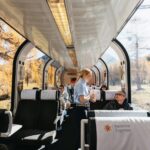
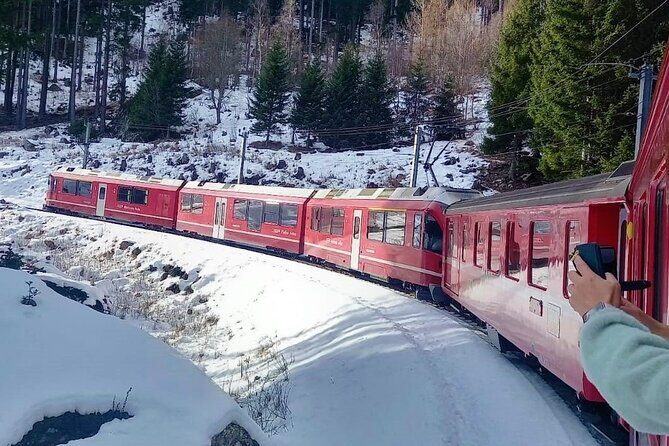
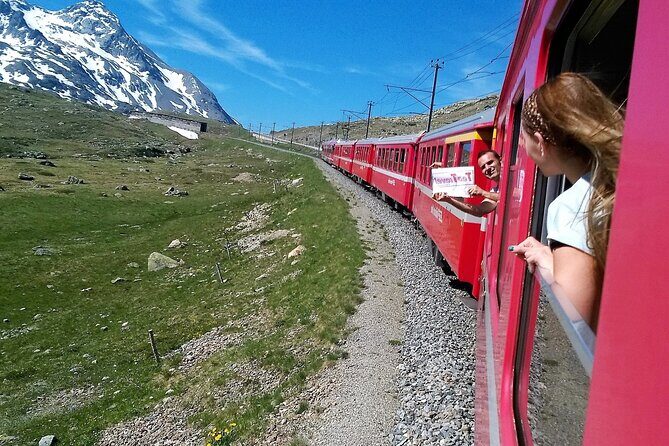
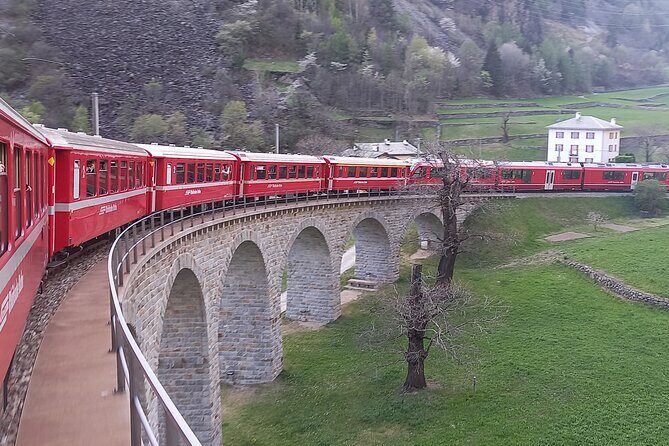
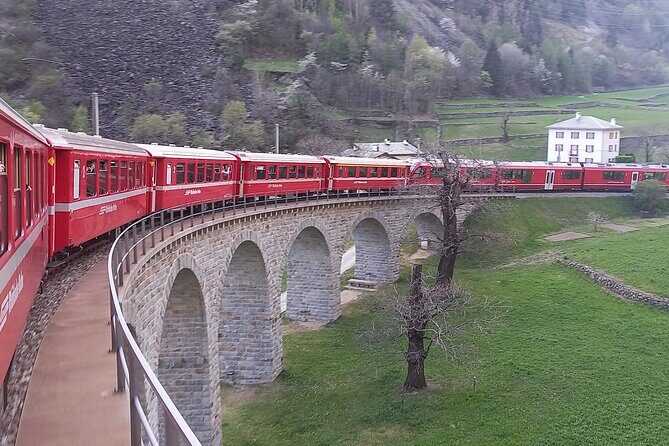
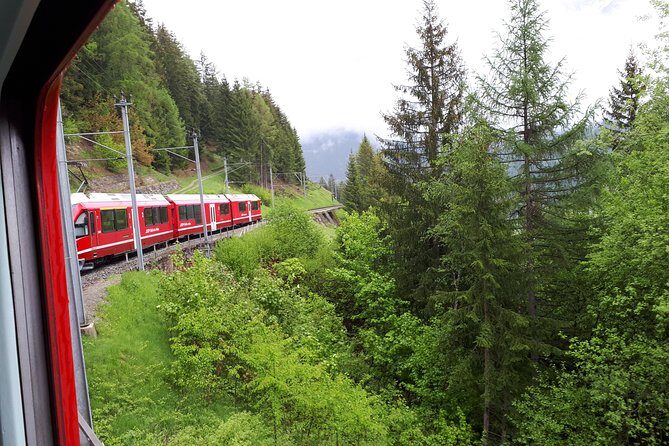
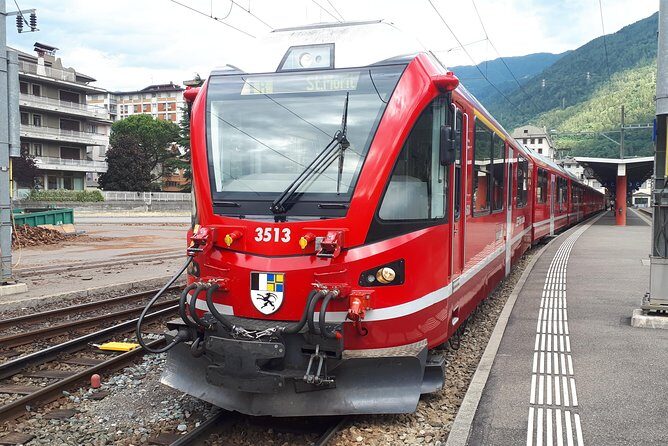
The tour includes a second-class ticket with opening windows—not the panoramic glass roof version that some travelers imagine, but practically speaking, the opening windows mean you can lean out for unobstructed photos and fresh air. As one traveler wisely noted, “It doesn’t matter what side of the train you sit on, as the train moves you get views from both sides at different times.” The train is constantly curving through valleys and across viaducts, so you’ll see different perspectives throughout the journey.
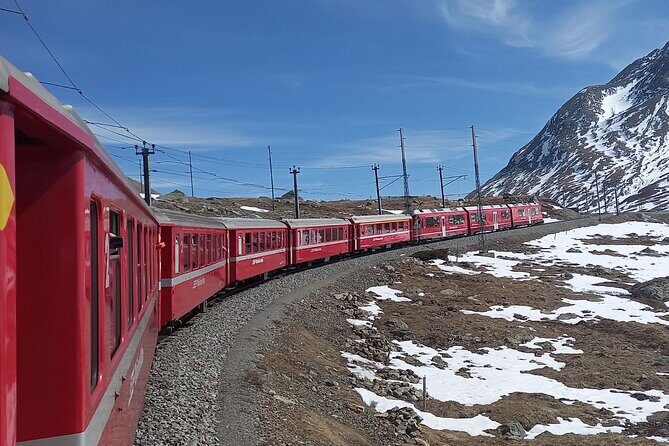
The route itself is genuinely remarkable from an engineering perspective. The Bernina Railway reaches 2,253 meters (7,390 feet)—among the highest points accessed by standard-gauge trains in Europe—and the UNESCO World Heritage designation reflects the historical and technical significance of this line, which opened in 1910. You’re not just riding a scenic train; you’re traveling on a piece of railway history.
The actual train ride lasts about two hours and twenty minutes, depending on which endpoint you use. During this time, your tour guide provides narration and context about what you’re seeing—the villages, the valleys, the engineering of the route itself. Multiple reviews praised guides for being “informative and helpful” and for giving “pointers” about what to photograph and when. This guidance genuinely enhances the experience because you’re not just looking out the window; you’re understanding what you’re looking at.
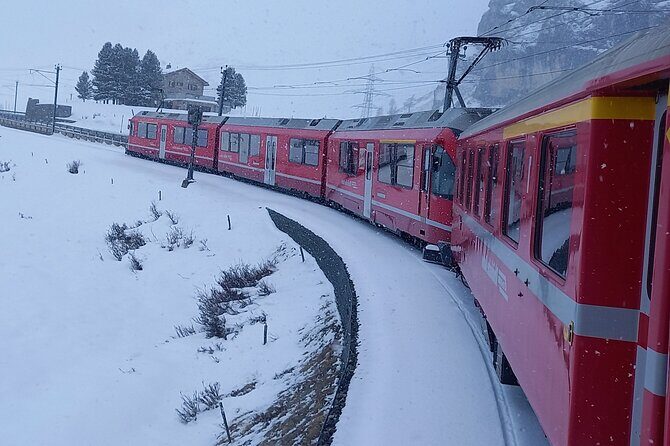
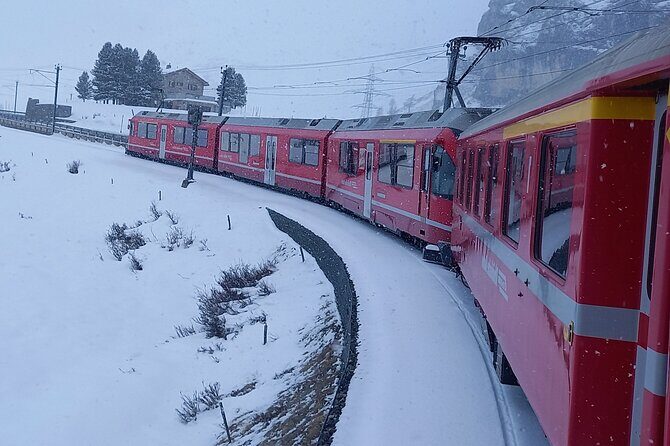
Weather makes a significant difference here. Several travelers mentioned snow adding drama to the views, and winter journeys create a particularly magical atmosphere. Summer offers different beauty—wildflower meadows, crystal-clear skies, and the contrast between green valleys and rocky peaks. Even overcast days, according to one reviewer, “did not disappoint,” suggesting the scenery is compelling regardless of conditions.
What’s Included and What Isn’t
At $168.09 per person, the tour includes several significant elements. Your second-class train ticket from St. Moritz to Tirano is included, as is all ground transportation via air-conditioned coach. An English-speaking guide accompanies your group throughout, and they provide ongoing commentary both on the bus and train. This is valuable because it contextualizes what you’re seeing rather than leaving you to figure out place names and historical details on your own.
What’s notably not included is food and drinks beyond the breakfast stop. You’ll need to budget for lunch in St. Moritz and any snacks or beverages for the journey. Swiss prices being what they are, a modest lunch could easily run $25-35 per person. Several reviewers specifically mentioned bringing snacks, suggesting this is worth planning for.
First-class train tickets aren’t included either, though you could upgrade if you prefer more spacious seating. Hotel drop-off isn’t included—you’ll return to the same meeting point near Milano Centrale train station.
The Practical Realities: What Reviewers Actually Experienced
With nearly 3,000 reviews and a 4.8-star average, this tour clearly works well for most people. But reviewing the actual feedback reveals some important patterns worth understanding.
The most consistent praise focuses on guide quality and the train experience itself. Specific guides are mentioned by name in review after review—Sabrina, Maria Christina, Monica, Alejandro, Barbara, Lina—all described as knowledgeable, friendly, helpful, and engaging. This suggests the tour company has invested in training and quality control. One traveler noted their guide “narrated all the important sites and let us know what was coming up next so we could get pictures,” which is exactly the kind of practical guidance that transforms a scenic ride into a memorable experience.
The views consistently get described as “breathtaking,” “stunning,” and “unforgettable.” Phrases like “postcard scenery” and “once in a lifetime experience” appear repeatedly. One traveler captured the sentiment well: “This day trip was everything we could have asked for and the photos don’t even do it justice!”
The length of the day is acknowledged in nearly every review as a trade-off. Travelers consistently note it’s a “long day” but almost universally consider it worthwhile. One reviewer summed up the perspective: “If you’re on the fence about it because it is a long all day experience, DON’T hesitate, it is worth every penny.”
However, not every experience is perfect. One reviewer gave the tour one star, citing uncomfortable bus seats, crowded train carriages, and a disengaged guide. The tour company’s response is worth noting—they essentially stood by the quality of the experience and their guide’s reputation, which is reflected in overwhelmingly positive feedback from other travelers. Individual experiences vary, and this tour’s success rate speaks for itself, but it’s worth acknowledging that a small percentage of travelers don’t connect with the experience.
A few logistical issues emerged in reviews: one traveler mentioned confusion about which coach to board (they received confirmation only two minutes before departure), and another noted that the return drop-off location wasn’t clearly marked after dark. These seem like isolated incidents rather than systemic problems, but they’re worth being aware of.
The Value Proposition: Is It Worth the Money?
At roughly $168 per person, you’re paying for a full day of organized transportation, a knowledgeable English-speaking guide, and a train ticket on one of Europe’s most famous scenic routes. If you tried to do this independently, you’d need to arrange your own transportation to St. Moritz (likely a rental car or multiple train changes), figure out the Bernina train schedule yourself, and navigate the logistics of getting back to Milan. The convenience factor alone justifies the price for most travelers.
The per-person cost also benefits from group discounts if you’re traveling with others, which the tour company explicitly offers. With up to 48 people per tour, you’re in a group but not an enormous one—large enough to share costs but small enough that your guide can still provide meaningful attention.
Comparing this to other Swiss Alpine day trips from Milan, the value is competitive. You’re getting access to a UNESCO-listed train route plus time in one of Switzerland’s most famous resort towns, all organized transportation included, for a price that’s accessible to most travelers.
Practical Considerations Before You Book
A valid passport or EU ID card is required—this is non-negotiable since you’re crossing the Italian-Swiss border. The tour requires good weather; if conditions are poor, you’ll be offered an alternative date or full refund, though the company notes that snow can actually enhance the experience.
Bookings are accepted up to one hour before departure, but the tour is frequently fully booked, so advance booking is recommended. The company suggests booking roughly 67 days in advance on average, which gives you a sense of how popular this experience is.
If you have luggage you want to store on the bus, check with your guide about availability—it depends on which train route you’re using and whether your return bus is the same vehicle. Some travelers have noted concerns about luggage storage, so it’s worth confirming this when you book.
The group size maxes out at 48 people, which is reasonable for maintaining quality while keeping costs down. However, this does mean the experience can feel crowded at certain points, particularly on the train itself during peak season.
Children are welcome but must be accompanied by adults. The tour is accessible to most people in reasonable physical condition, though the long day and multiple transitions between buses and trains might be challenging for those with mobility issues.
When to Go: Seasonal Considerations
The tour runs year-round, but the experience varies significantly by season. Winter offers snow-covered peaks and dramatic weather, which several reviewers found magical. Summer provides wildflower meadows, clearer skies, and longer daylight hours. Spring and fall offer their own charm with fewer crowds than peak season.
One reviewer specifically mentioned planning to book again “in summer for a completely different experience,” suggesting the seasonal variation is significant enough to warrant multiple visits if you’re in the region multiple times.
The low season (September-November) brings lower prices and fewer crowds, but many St. Moritz shops close during this period, which affects your free-time experience in town.
Frequently Asked Questions
Q: What time does the tour start and end?
A: The tour typically departs early morning (before sunrise) from Milan and returns after dark, for a total experience of approximately 12 hours. Exact times depend on the specific departure date and seasonal daylight hours.
Q: Is the train ticket first-class or second-class?
A: The tour includes a second-class ticket with opening windows. First-class upgrades are available but cost extra and aren’t included in the base price.
Q: How much free time do you get in St. Moritz?
A: You’ll have approximately 90 minutes of free time in St. Moritz to explore, shop, or grab food at your own expense.
Q: What’s included in the price?
A: The price includes round-trip coach transportation from Milan, the train ticket from St. Moritz to Tirano (or alternate route), an English-speaking guide throughout the day, and a breakfast stop. Food and drinks beyond breakfast are not included.
Q: Is this tour suitable for families with children?
A: Yes, children are welcome as long as they’re accompanied by an adult. However, the long day with multiple transitions might be challenging for very young children.
Q: What if the weather is bad?
A: The tour requires good weather. If it’s canceled due to poor weather conditions, you’ll be offered an alternative date or a full refund.
Q: Can you store luggage on the bus?
A: Luggage storage on the bus isn’t guaranteed and depends on which train route is being used and whether the return bus is the same vehicle. Check with your tour guide when you book.
Q: What documents do you need to bring?
A: A valid passport or EU ID card is required, as you’ll be crossing the Italian-Swiss border.
Q: Can you stay in St. Moritz and skip the return journey?
A: Technically possible, but you’d need to arrange your own return transportation. Contact the tour company beforehand if you’re considering this option.
Q: How large are the groups?
A: Tours accommodate a maximum of 48 people, organized on air-conditioned coaches with professional drivers and guides.
Bernina Red Train, Swiss Alps & St Moritz From Milan
Final Verdict
This tour genuinely delivers on what it promises: a full-day immersion into Alpine scenery and Swiss mountain culture, anchored by one of Europe’s most famous scenic train journeys. The combination of professional guides, excellent logistics, and stunning natural scenery explains the overwhelming positive reviews from nearly 3,000 travelers. Yes, it’s a long day, and yes, you’ll spend significant time on buses and trains. But if you’re visiting Milan and want to experience the Swiss Alps without the complexity of independent travel, this represents excellent value and a memorable experience. The quality of guide service stands out particularly—travelers consistently praise specific guides by name for their knowledge, friendliness, and practical helpfulness. Book in advance, bring snacks, and prepare to wake up early, and you’ll join the vast majority of travelers who describe this day as worth every penny.