
Hiroshima With Kids
Hiroshima was the stop on our Japan trip that I thought about most carefully in advance. How do you take children somewhere defined by one of the worst things humans have ever done to each other? Would it be too heavy? Too upsetting? Would they get anything meaningful from it, or would we just be dragging them through misery?
Here’s what I didn’t expect. Hiroshima isn’t a sad city. It’s one of the most hopeful places we’ve visited anywhere in the world. The city chose — deliberately, purposefully — to rebuild itself around a message of peace. Yes, the history is confronting. Parts of the museum made me cry. But the overall feeling of being in Hiroshima with our children was something closer to gratitude. They came away understanding something important about the world, and about why peace matters, in a way no textbook could have taught them.
It also happens to be a brilliant base for visiting Miyajima Island, which is flat-out one of the most beautiful spots in Japan. So you get both: a deeply meaningful cultural experience and a gorgeous island with deer and floating shrine gates and maple leaf cakes. Not a bad combination.
Getting to Hiroshima
The shinkansen makes this straightforward. From Osaka, it’s about 1 hour 20 minutes on the Hikari bullet train. From Kyoto, roughly 1 hour 40. Both are covered by the JR Pass, which takes the sting out of the cost. Book nothing in advance — just turn up at the station, tap through the gate with your pass, and hop on the next Hikari service heading west.
Quick note: the Nozomi is faster but isn’t covered by the JR Pass. Stick with the Hikari. The time difference is minimal and you’ll save yourself the hassle of buying separate tickets.
Can you do Hiroshima as a day trip from Osaka or Kyoto? Technically, yes. People do it. But I’d strongly recommend at least one night. There’s too much ground to cover — the Peace Memorial Park, the museum, the A-Bomb Dome, and ideally Miyajima Island too. Cramming all of that into a day trip means rushing through things that deserve your time and attention. One night gives you breathing room. Two nights if you want to be properly relaxed about it.
Peace Memorial Park and Museum
This is why you’re here. And it’s worth being honest about what it involves.
The Peace Memorial Park sits on a large, open stretch of land in the centre of the city — land that was once a busy residential and commercial district before the bomb destroyed it entirely on 6 August 1945. The park grounds themselves are calm, green, and peaceful. Families walk through. Children play near the fountains. There are monuments, memorials, and wide paths lined with trees. The atmosphere is contemplative but not grim. All ages can walk the park comfortably.
The museum is different. The Peace Memorial Museum was renovated in 2019, and the new exhibits are powerful. Devastating, actually. The focus has shifted towards personal stories — real people, real artifacts, real photographs. A child’s lunchbox. A school uniform. A watch stopped at the exact moment of the blast. The displays don’t sensationalise anything. They don’t need to. The facts are enough.
For children roughly eight and above, I think it’s an important educational experience. Our older two were quiet through the museum, asked thoughtful questions afterwards, and clearly processed something significant. For children under eight, it may be too much. You know your child. Some younger kids would cope fine. Others would be frightened or distressed by what they see. There’s no right answer here — use your judgement and don’t feel guilty either way.
Entry is remarkably affordable: ¥200 (~£1.05) for adults and ¥100 (~£0.55) for children. Audio guides are available in English. Budget at least 90 minutes, though you could easily spend longer.
The Atomic Bomb Dome
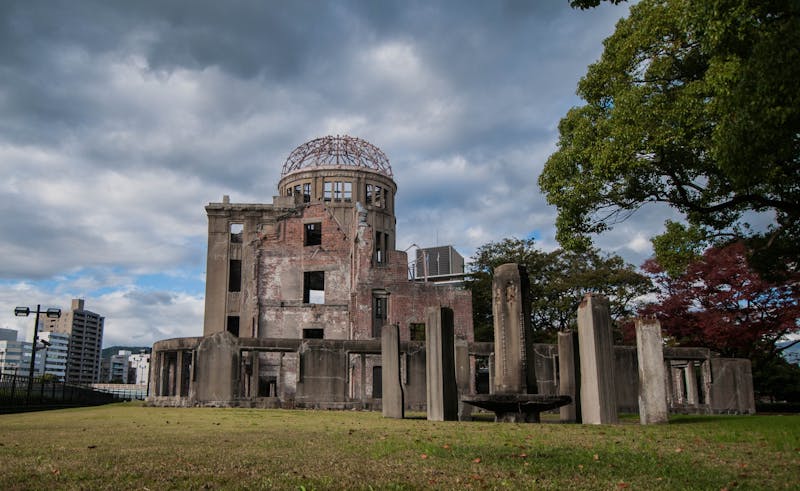
You’ll see this from the park. The A-Bomb Dome — or Genbaku Dome — is the skeleton of the former Hiroshima Prefectural Industrial Promotion Hall. It was almost directly below the point of detonation, and while the blast destroyed everything around it, this steel-and-concrete frame somehow remained standing. It’s been preserved exactly as it was in the aftermath. No restoration. No tidying up. Just the bare bones of a building, left as a permanent reminder.
It’s free to view from outside (you can’t enter the building). Striking is the word. Our kids stood and stared at it for a long time. There’s something about seeing a physical object — the twisted steel, the hollow windows, the exposed structure against the modern city skyline — that makes the history feel real in a way photographs can’t.
Lit up at night, it takes on a different character. Quieter. More haunting. Worth walking past again after dinner if you’re staying overnight.
Children’s Peace Monument
This is the memorial that connects most directly with children, and it’s built around a story they can grasp immediately.
Sadako Sasaki was two years old when the bomb fell. She survived the blast but developed leukaemia ten years later. While in hospital, she began folding paper cranes — in Japanese tradition, folding a thousand cranes grants a wish. She hoped to recover. She didn’t. She died at twelve.
The monument stands in her memory, and around it you’ll find glass cases filled with thousands upon thousands of colourful paper cranes sent by schoolchildren from around the world. Our kids were moved by Sadako’s story in a way that felt age-appropriate and genuinely touching. A girl their age. A simple, hopeful act. It opens a conversation about what happened here without being graphic or frightening.
If your children want to fold cranes and leave them at the monument, they can. Bring some origami paper, or pick some up at one of the shops near the park. It’s a small, meaningful gesture that gives kids something concrete to do with the big feelings this place stirs up.
Miyajima Island
Right. After the weight of the Peace Memorial, Miyajima arrives like a deep breath of fresh air. And honestly, for most families, this is the highlight of the Hiroshima trip.
Getting there is easy. Take the JR Sanyo line from Hiroshima station to Miyajima-guchi (about 25 minutes), then hop on the short ferry — roughly 15 minutes across. Both the train and the JR ferry are covered by the JR Pass, so there’s no extra cost. Brilliant.
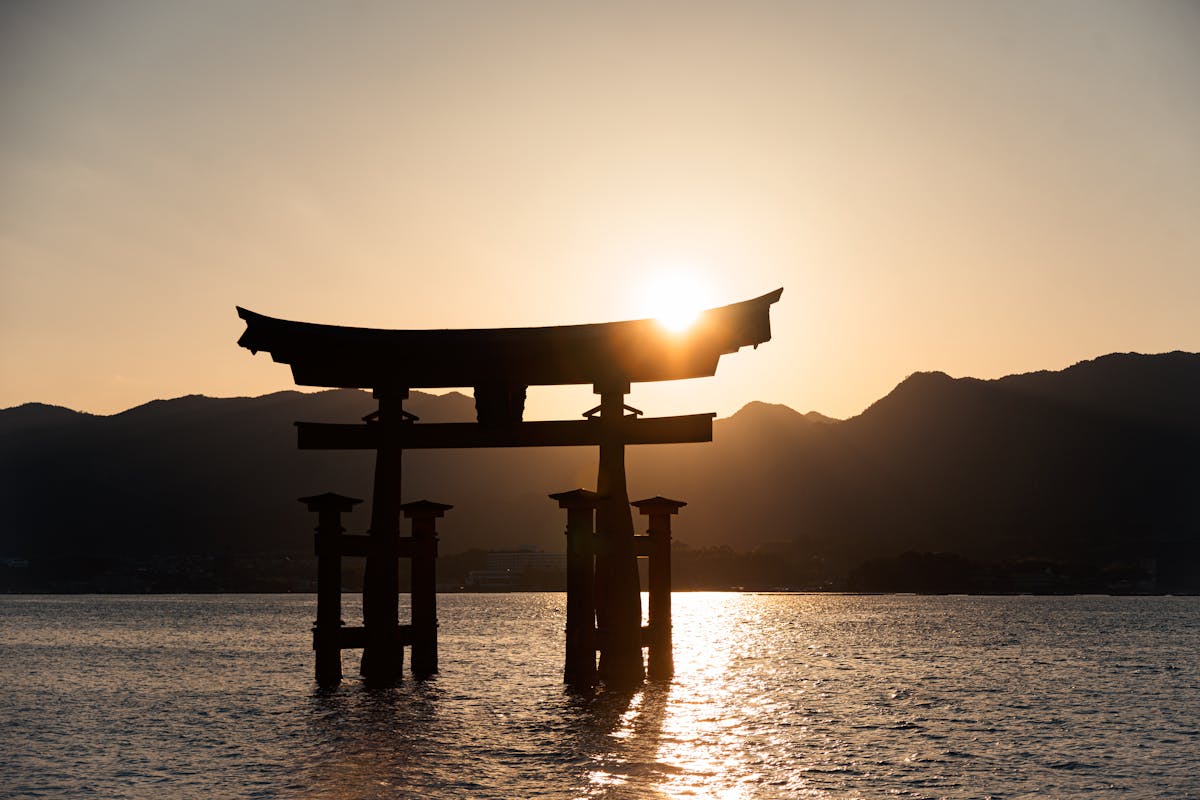
The first thing you’ll notice is the torii gate. The great floating gate of Itsukushima Shrine, standing in the water just offshore. At high tide it appears to float. At low tide you can walk right out to it across the sand and stand beneath it. Both are spectacular in different ways. Check the tide times before you go — there are charts posted at the ferry terminal — and if possible, try to see it at both tides.
The second thing you’ll notice is the deer. Yes, more deer. Like Nara but smaller and slightly less aggressive about stealing your lunch. They wander the streets, lie on the pavement, and photobomb your pictures of the shrine gate. Children adore them.
Itsukushima Shrine itself is a beautiful complex of vermillion buildings connected by wooden walkways over the water. Entry is ¥300 (~£1.60). It’s gorgeous, it’s a UNESCO World Heritage site, and young children find the water-and-walkway layout much more interesting than a standard temple.
For adventurous families, the Miyajima Ropeway carries you up to near the summit of Mount Misen — the highest point on the island, with panoramic views across the Inland Sea. The ropeway costs ¥1,800 (~£9.50) for adults and ¥900 (~£4.75) for children, and from the top station it’s about a 30-minute walk to the actual summit. Steep in places. Not ideal for toddlers, but manageable for kids who are steady on their feet and used to a bit of hiking.
And then there’s the food. Miyajima is famous for momiji manju — small maple-leaf-shaped cakes filled with red bean paste, custard, chocolate, or cheese. They’re sold everywhere. Warm from the press, they’re irresistible. Our lot ate approximately forty-seven of them over the course of the afternoon. I lost count.
Hiroshima-Style Okonomiyaki
You have to eat okonomiyaki in Hiroshima. Have to. It’s different from the Osaka version and — this is a hill I will die on — it’s better.
Osaka-style okonomiyaki mixes everything together into a thick pancake. Hiroshima-style builds it up in layers: a thin crepe, mountains of shredded cabbage, bean sprouts, pork, a layer of yakisoba noodles, and a fried egg on top. The whole thing is pressed together on the griddle until the outside is crispy and the inside is soft and steaming. It’s magnificent.
Prices are cheap. ¥800-1,200 (~£4.20-6.30) for a full okonomiyaki that will fill an adult. Kids can easily share one or order a smaller portion.
The classic spot is Okonomi-mura, a building near the Peace Park with multiple floors of small okonomiyaki restaurants, each with its own counter and griddle. Pick a floor, pick a stall, sit at the counter and watch them build your meal from scratch. Kids find the whole production fascinating. There’s usually a short queue at the most popular stalls, but turnover is fast.
How Long to Spend
One night minimum. That gives you a full day to split between Hiroshima’s Peace Memorial sites in the morning and Miyajima Island in the afternoon. It’s doable but brisk.
Two nights is more comfortable. Day one: Peace Memorial Park, museum, A-Bomb Dome, okonomiyaki for dinner. Day two: full day on Miyajima with the ropeway and plenty of manju-eating time. This pace suits families with younger children especially, because nobody’s rushing and there’s space for naps and meltdowns.
A day trip from Osaka or Kyoto is possible if you skip Miyajima. Train in early, do the Peace Memorial sites, eat okonomiyaki, train back. But you’d be missing Miyajima, which would be a real shame. Work it into your Japan itinerary properly if you can.
Hiroshima as a Teaching Moment
I want to come back to this, because it’s the thing I got wrong in my expectations before we visited.
I’d anticipated Hiroshima being heavy and sombre. A place to get through. Important but grim. And some of it is heavy — the museum, particularly. But the city as a whole isn’t defined by grief. It’s defined by what came after. The deliberate choice to become a city of peace. The monuments aren’t saying “look how terrible this was” (though it was). They’re saying “this must never happen again.”
That distinction matters, especially for children. They didn’t come away frightened or sad. They came away with a sense that terrible things can happen and people can choose to respond with hope rather than hatred. Our daughter wrote about it in her school journal when we got home. Our son still brings it up occasionally — something he saw in the museum, a detail from Sadako’s story. It stuck with them. Good things stuck with them.
Don’t skip Hiroshima because you’re worried it’ll upset your kids. Prepare them for what they’ll see, talk about it together, and let the city do what it does so well — turn the worst chapter of its history into something that teaches compassion.
Practical Bits
Hiroshima is flat. Genuinely, properly flat, which makes it a dream after places like Kyoto where every temple seems to sit at the top of a hill. Strollers are no problem anywhere in the city centre.
The main public transport is trams. Hiroshima has an extensive streetcar network that covers all the main tourist areas. A single ride costs ¥220 (~£1.15), or you can get a one-day tram pass for ¥700 (~£3.70). The trams are old-fashioned and charming — some of them are original 1950s cars that survived the post-war period. Kids like riding them.
Cycling is another good option. The city’s flat layout makes it ideal for bikes, and there are rental shops near the station. Handy if you want to cover ground quickly between the Peace Park and the station, or just enjoy the riverside paths.
The weather follows typical Western Honshu patterns: hot and humid in summer, mild in spring and autumn, cold but manageable in winter. Autumn (October-November) is particularly good — comfortable temperatures and the maple leaves on Miyajima are spectacular. Cherry blossom season in late March/early April is gorgeous too, with trees throughout the Peace Park.
One last thing. Hiroshima people are warm. Genuinely, noticeably friendly, even by Japan’s already high standards of politeness and helpfulness. We had strangers offer to help us with directions, restaurant staff fuss over our children, and an elderly man at the Peace Park who spent ten minutes explaining a monument to our kids through a combination of broken English and enthusiastic gestures. The city’s dedication to peace and hospitality isn’t abstract. You feel it in how people treat you.
Go. Take your kids. It’s worth it.