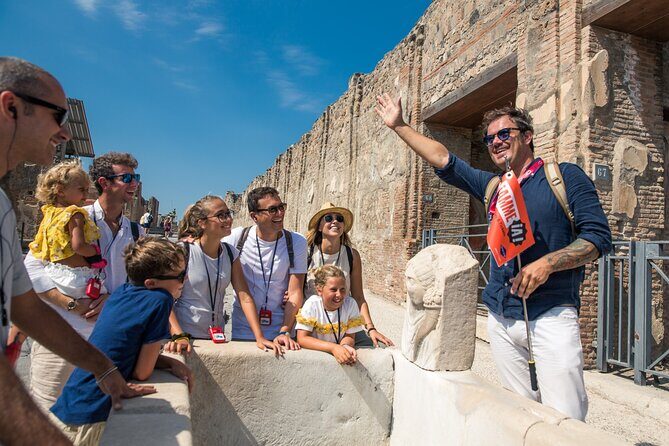
If you’re staying in Sorrento and want to see Pompeii without spending half your day in ticket queues, this guided tour deserves serious consideration. We’ve reviewed the experiences of hundreds of travelers, and what emerges is a genuinely well-executed excursion that respects both your time and your wallet. The skip-the-line access alone saves you precious hours, but what really sets this tour apart is how the guides transform what could be a confusing maze of ancient stones into a compelling narrative about Roman life frozen in time.
The main thing we love about this experience is the combination of early-morning departures and expert local guides who know exactly which highlights to prioritize and how to tell the stories behind them. You’re not wandering aimlessly; you’re getting curated access to the most significant ruins with someone who can actually explain what you’re looking at. The second major strength is the logistics—the central meeting point in Sorrento’s main square, comfortable air-conditioned coach transport, and the fact that you’re back by mid-afternoon means you can still enjoy the rest of your day.
One consideration worth noting upfront: Pompeii’s ancient streets are genuinely uneven and challenging to walk. The site isn’t wheelchair accessible, and the terrain requires a reasonable level of mobility and fitness. If you have significant walking limitations, this tour might be more frustrating than enjoyable, though the guides we read about were generally accommodating to those who needed rest breaks.
This tour works best for history enthusiasts, families with kids old enough to walk for a few hours, and anyone who values guided context over self-exploration. If you’re the type who prefers someone else to handle the logistics while you focus on learning and soaking in the experience, you’ve found your match.
- What You’re Getting for .70
- The Journey: From Sorrento to the Slopes of Vesuvius
- Two Hours to Understand an Ancient City
- The Forum: The Heart of Roman Public Life
- Via dell’Abbondanza: The Ancient Main Street
- The Stabian Baths: Roman Spa Culture
- The Lupanar: A Window into Social History
- The House of the Faun: Wealth and Taste
- Teatro Grande: Entertainment and Culture
- The Guides Make the Difference
- Practical Considerations That Matter
- Who Should Book This Tour (And Who Shouldn’t)
- Logistics You Should Know
- The Bottom Line
- Frequently Asked Questions
- The Best Of Sorrento!
- More Guided Tours in Sorrento
- More Tours in Sorrento
- More Tour Reviews in Sorrento
What You’re Getting for $90.70
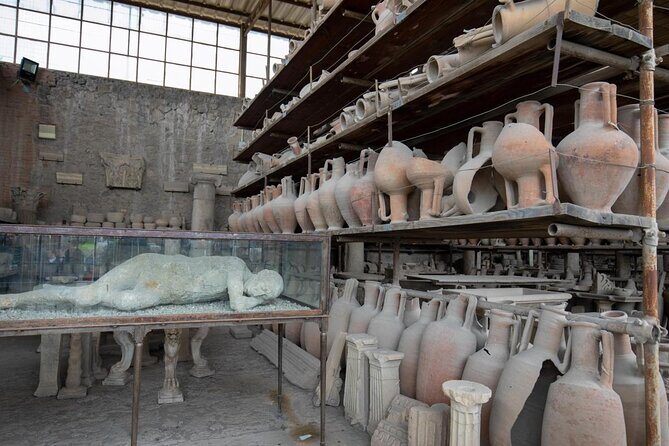
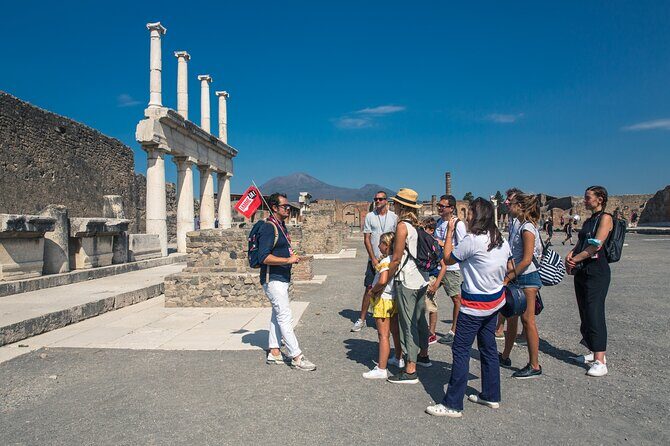
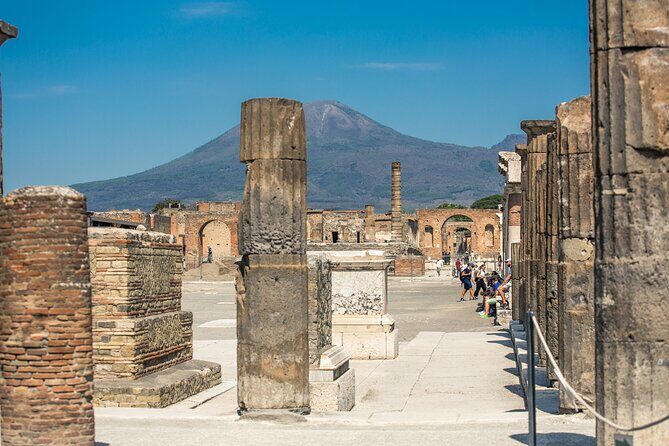
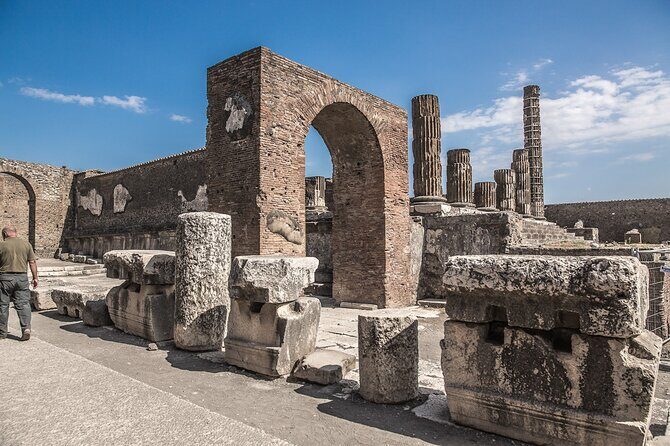
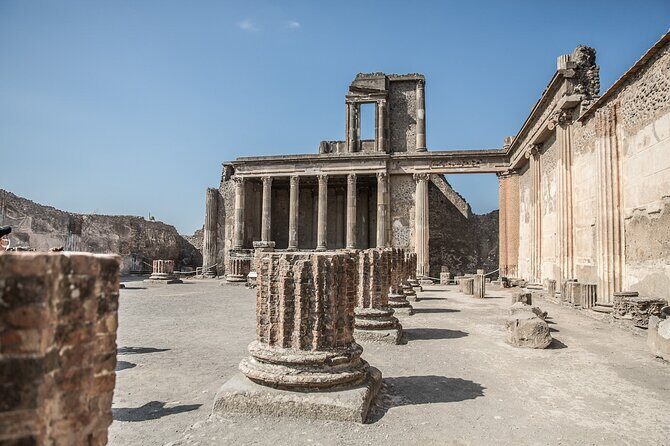
At just under $91 per person, this tour represents solid value when you factor in what’s included. You’re paying for round-trip transportation from a central location, skip-the-line admission (which alone can save 45 minutes to over an hour depending on the season), and two hours of guided exploration with a professional archaeologist or historian. The air-conditioned coach matters more than you might think—the drive to Pompeii takes about 90 minutes each way, and being comfortable in a coach beats sweating in a personal car or on public transit.
For comparison, if you were to buy Pompeii admission separately, arrange your own transportation, and hire a private guide, you’d be looking at roughly $150-$200 per person. Group discounts are available if you’re traveling with others, which can push the per-person cost even lower. The fact that this includes mobile tickets means you’re not juggling printed vouchers or waiting at will-call windows.

👉 See our pick of the Sorrento’s 7 Best Snorkeling Experiences (With Prices & Reviews)
The Journey: From Sorrento to the Slopes of Vesuvius
Your day starts at the IAMME IA! Gray Line office in Piazza Torquato Tasso, right in Sorrento’s central square where you can actually find the meeting point without confusion. You’ll depart in a comfortable, air-conditioned coach—reviewers consistently praised the quality and comfort of the vehicles, which matters when you’re spending 90 minutes each way on the road.
The drive itself is worth paying attention to. You’re traveling through the Campania region, moving from the coastal charm of Sorrento toward the interior where Mount Vesuvius looms. One traveler noted that choosing the early morning departure meant “we were one of the first couple groups into Pompeii,” which fundamentally changes your experience. Early morning at Pompeii means smaller crowds, better light for photographs, and less heat beating down on ancient stone.
Your tour guide on the coach provides context for what you’re about to see, which helps frame the experience. By the time you arrive at the Archaeological Park, you’re not showing up cold—you have a mental framework for understanding the tragedy and the remarkable preservation of this Roman city.
You can also read our reviews of more guided tours in Sorrento


Two Hours to Understand an Ancient City
Once you arrive at Pompeii, you skip the general admission lines and head directly inside with your guide. Two hours might sound short for a site that covers 163 acres, but your guide has planned an efficient route hitting the major highlights rather than trying to see everything. One family with five kids noted that the tour “was good for kids of all ages,” suggesting the pacing works across different ages and fitness levels.
The Forum: The Heart of Roman Public Life
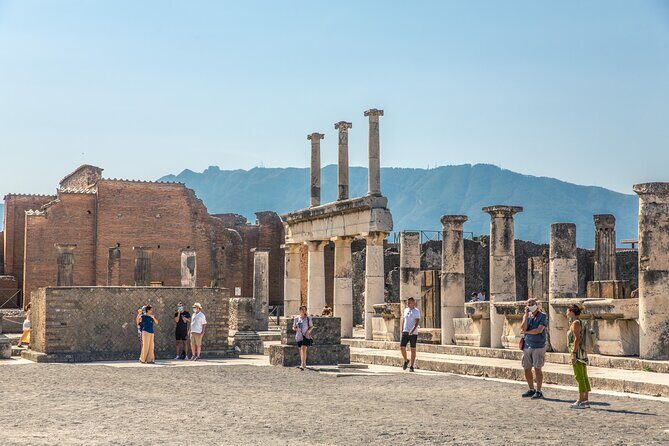
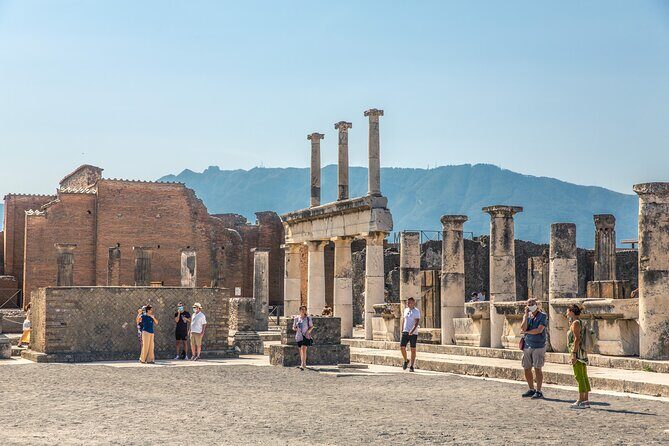
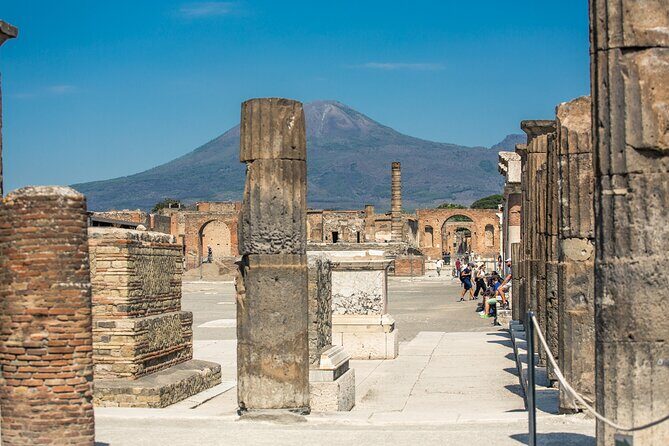
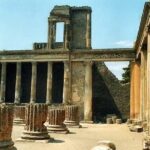
Your exploration typically begins at the Civil Forum, which served as the center of daily life in ancient Pompeii. This wasn’t just a plaza—it was where government, justice, commerce, and worship all intersected. Your guide will point out how the Romans organized their civic space, and suddenly those scattered ruins make sense as part of a deliberate urban design.
The Temple of Jupiter dominates the north side of the Forum, with Mount Vesuvius rising dramatically behind it—a view that’s both beautiful and deeply unsettling once you understand what that mountain did to the people who once worshipped in that temple. The temple was renovated when Pompeii became a Roman colony in 80 BC, featuring three cult statues (Jupiter, Juno, and Minerva) that mimicked the Capitolium in Rome itself. This detail matters because it shows how Roman colonists brought their religious practices and civic traditions to provincial cities.
Nearby stands the Macellum, the market building, where you can see the physical infrastructure of Roman commerce. There are niches for statues, separate rooms for different functions, and evidence of the imperial cult—the worship of the emperor that was woven into daily civic life. Your guide will explain how ordinary Romans moved through these spaces, buying food, conducting business, and participating in the religious and political life of their community.
Via dell’Abbondanza: The Ancient Main Street
This east-west street was Pompeii’s primary thoroughfare, and walking it is genuinely evocative. In ancient times, it would have been crowded and noisy with shops, workshops, cafes, and snack bars. Today, you can still see the storefronts, the worn stone thresholds where countless feet have passed, and the evidence of commerce and daily life. One reviewer specifically mentioned that their guide “kept us from getting lost in the vast street network of Pompeii”—and that’s genuinely helpful because the streets do form a maze.
The Stabian Baths: Roman Spa Culture
The Stabian Baths reveal how Romans approached leisure and hygiene. These weren’t simple bathhouses; they were social centers with separate facilities for men and women, different temperature rooms (cold, warm, and hot), and a clear sense of ritual and routine. The baths date to immediately after the colony’s founding in 80 BC, meaning they were less than 150 years old when Vesuvius erupted. They were heavily damaged in the earthquake of 62 AD but were being repaired when the eruption occurred—another small detail that brings the human reality of living in this city into focus.
You can also read our reviews of more tours and experiences in Sorrento


The Lupanar: A Window into Social History
This is the most famous brothel in Pompeii, and your guide will explain its significance beyond the sensational elements. The building is purpose-built, with five small rooms on the ground floor featuring built-in masonry beds. Above the doors are erotic frescoes—likely serving as a visual menu of services—and the walls are covered with graffiti left by visitors. This graffiti is actually invaluable to historians because it contains names, dates, and crude jokes that reveal how ordinary people actually spoke and thought.
The building belonged to Quintus Poppaeus Sabinus of the Poppei family, relatives of the Empress Poppea Sabina. This connection to imperial circles is another reminder that Pompeii wasn’t a backwater town but a thriving city with connections to Rome’s highest circles. Your guide will help you see past the modern tendency to sensationalize and instead understand this as evidence of how Romans organized their society and commerce.
The House of the Faun: Wealth and Taste
One of Pompeii’s largest and most luxurious private residences, the House of the Faun occupies an entire city block and showcases Hellenistic influence in Roman architecture. It’s named after the bronze dancing faun statue found in its main atrium, but what really captures attention is the Alexander Mosaic—a depiction of Alexander the Great’s battle against Darius III of Persia.
This mosaic is a masterpiece of ancient art, and seeing it in situ (even though you’re looking at a reproduction, as the original is in Naples) helps you understand the wealth and sophistication of Pompeii’s elite. Two peristyle gardens, intricate floor mosaics, and the sheer scale of the residence tell you that this was a city of considerable refinement, not a rough provincial outpost.
Teatro Grande: Entertainment and Culture
The Large Theater was built on a hillside, with the Romans cleverly using the natural slope to create an impressive auditorium divided into five sectors. Greek and Roman tragedies were performed here, which again speaks to the cultural sophistication of Pompeii. Your guide will help you imagine the performances, the crowds, and the role of theater in Roman civic and social life.
The Guides Make the Difference
What emerges most clearly from reading hundreds of reviews is that the quality of your guide fundamentally shapes your experience. Guides like Louisa (also called Lulu), Lucio, Patricia, and Isabella are consistently praised for being “knowledgeable,” “entertaining,” “friendly,” and able to “bring the place to life.” One traveler noted that “without a guide it is just a pile of rocks,” and that’s the honest truth—Pompeii’s significance lies in understanding the human stories behind the ruins.
The guides we read about share a talent for telling stories that make history accessible. One reviewer mentioned that their guide “told interesting stories and kept us from getting lost in the vast street network,” while another noted that their guide was “knowledgeable and funny, he brought the place to life and pointed out things that you would maybe miss without a guide.”
That said, one review noted a guide who “kept on walking as he was talking” and didn’t wait for the group to catch up, causing some people to miss explanations and even trip and fall. This is the exception rather than the rule based on the overall rating, but it’s worth noting that your experience does depend partly on which guide you get.
Practical Considerations That Matter
Group Size and Atmosphere: The tour maxes out at 29 travelers, which is larger than a small group tour but smaller than a massive bus excursion. One reviewer specifically appreciated that “the coach was full” in a neutral way, suggesting the size felt right. The headphones provided for groups larger than 10 people mean you can actually hear your guide even when the group is at maximum capacity.
Timing and Crowds: Multiple reviewers emphasized the value of the early morning departure. One traveler said they were “thrilled we got ourselves up and out of bed early for the 7:30am tour, clearly the way to go to avoid the crowds.” Another noted that “as we were leaving, it was getting very crowded and warm,” confirming that morning access is genuinely better. If you’re booking, strongly consider the early departure option.
Physical Demands: The terrain is genuinely challenging. One reviewer with mobility issues gave a three-star review specifically because of the uneven rocks and fast pace, noting that “wheelchairs are not allowed but strollers are okay.” The guides are generally accommodating to those who need rest breaks, but you need to be honest with yourself about your walking ability. The site involves “steps and inclines” and “uneven rocks,” not a flat, easy stroll.
Free Time Consideration: One reviewer noted that the guide “used all of the time to guide us around—there was no free time to see things on your own.” If you’re hoping for unstructured exploration time to wander at your own pace, this tour doesn’t provide that. It’s a guided experience from start to finish, which some people love (because you don’t get lost and you see the highlights) and others find restrictive.
What’s Not Included: Food and drinks aren’t provided, though you’ll have time for bathroom breaks and snacks. The tour company is thoughtful about this—reviewers mentioned being given “ample time at the beginning and ending of tour to use the facilities and get a snack,” which is practical since you’re spending several hours on site.
Who Should Book This Tour (And Who Shouldn’t)
Book this if you:
– Want to see Pompeii’s major highlights without spending hours figuring out what matters
– Value having expert context and historical explanation
– Prefer organized logistics and don’t want to navigate transportation yourself
– Appreciate early morning departures to beat crowds
– Have reasonable mobility and can walk on uneven terrain for a couple of hours
– Are traveling with kids and want a guide who can make history engaging for different ages
– Want to maximize your day and get back to Sorrento by mid-afternoon
Skip this if you:
– Have significant mobility limitations or can’t walk on uneven ancient stone
– Prefer complete freedom to explore at your own pace without a guide
– Want to spend several hours at Pompeii doing deep exploration
– Are looking for a budget option (though $91 is actually reasonable)
– Prefer solo travel and find group tours constraining
Logistics You Should Know
Cancellation: You can cancel free of charge up to 24 hours before your tour, which provides flexibility if your plans change. Cancellations within 24 hours forfeit your payment, so book with confidence but don’t procrastinate on canceling if needed.
What to Bring: Wear comfortable walking shoes with good grip (those ancient stones are worn smooth). Bring sun protection, water, and a hat or cap. The site offers limited shade, and you’ll be walking in the Mediterranean sun for a couple of hours.
Meeting Point: The central location in Piazza Torquato Tasso is genuinely easy to find—it’s Sorrento’s main square. Multiple reviewers mentioned that the “easy check-in point, right in the center of town” and “easy to find” meeting point made logistics simple.
Confirmation and Tickets: You’ll receive confirmation at time of booking, and your tickets are mobile (digital), so you don’t need to print anything.
The Bottom Line
This tour represents excellent value for travelers who want expert-guided access to Pompeii’s most significant ruins without the hassle of self-navigation or long ticket lines. The $90.70 per person price includes transportation, skip-the-line admission, and two hours with a guide—something you simply can’t assemble yourself for less money, especially when you factor in transportation costs and the value of expert interpretation. The consistently high ratings (4.5 out of 5 stars across 722 reviews) reflect a well-oiled operation that has figured out how to move groups through one of Italy’s most important archaeological sites efficiently and educationally.
The tour works best for history-minded travelers, families with kids, and anyone who values having someone else handle the logistics so you can focus on learning and experiencing. The early morning departures genuinely make a difference in avoiding crowds and getting good light for photographs. If you’re staying in Sorrento and want to see Pompeii done right without spending your entire day on logistics, book this tour with confidence.
Skip-the-Line Pompeii Guided Tour from Sorrento
Frequently Asked Questions
How far in advance should I book this tour?
On average, travelers book this tour about 58 days ahead of time, which suggests it does fill up during peak season. That said, availability likely varies by season and day of the week. We’d recommend booking at least a few weeks in advance to secure your preferred departure time, especially if you want the early morning option.
What’s the difference between the morning and afternoon departures?
The tour data doesn’t specify exact departure times, but multiple reviews specifically praise early morning departures for avoiding crowds. One reviewer stated they were “one of the first couple groups into Pompeii” with an early departure, while another noted that “as we were leaving, it was getting very crowded and warm.” This strongly suggests the morning option is superior for experiencing Pompeii, though the tour data doesn’t specify exact times.
Is this tour suitable for children?
Yes, if your children can walk for a couple of hours on uneven terrain. One family specifically mentioned traveling “with five kids and it was good for kids of all ages.” The guides are accustomed to working with families, and the pacing allows for questions and engagement. However, very young children or those with limited walking stamina might find the terrain challenging.
What happens if I have mobility issues?
The tour is not wheelchair accessible, and the terrain involves “steps and inclines” on ancient, uneven stone. One reviewer with mobility issues gave a three-star rating specifically because of these challenges, noting the guide was “accommodating” but the pace and terrain were difficult. If you have significant mobility limitations, this tour might be frustrating. The operator does note that strollers are allowed (though it’s hard to imagine pushing a stroller across ancient stone), but wheelchairs are not.
Will I have free time to explore on my own?
The tour is guided throughout your two hours at Pompeii. One reviewer noted there was “no free time” to wander independently or revisit areas for photos or the bookstore. If unstructured exploration time is important to you, you should know the tour keeps you with the guide the entire time, which some people love and others find limiting.
What should I bring for this tour?
Wear comfortable walking shoes with good grip—the ancient stones are worn smooth and can be slippery. Bring sun protection (hat, sunscreen), sunglasses, and water. The site offers limited shade, and you’ll be exposed to Mediterranean sun for a couple of hours. The tour data doesn’t mention food service, so bringing snacks or money for the site’s cafes is wise.
How much walking is involved?
You’ll walk roughly two hours over uneven terrain. The tour covers major highlights rather than the entire 163-acre site, but the path involves hills, steps, and worn stone. One reviewer described it as a “hard walk” but said “the guides were sure to help those who needed a rest.” This isn’t a leisurely stroll; it’s moderate to moderately challenging walking.
Can I visit the museum instead of the archaeological site?
The tour is specifically for the Archaeological Park (the actual ruins), not the museum in Naples where some original artifacts are housed. One reviewer with mobility issues mentioned considering “the museum instead,” suggesting that’s an alternative if the site’s terrain is too challenging. However, this tour doesn’t include museum access.
The Best Of Sorrento!






More Guided Tours in Sorrento



More Tours in Sorrento



More Tour Reviews in Sorrento
- Sorrento Farm and Food Experience including Olive Oil, Limoncello, Wine tasting
★ 5.0 · 2,524 reviews