
You’ll find Uruguay offers Latin America’s oldest democracy with strong safety rankings, though you’ll need solid Spanish skills for daily life and integration. Residency requires around $1,500 monthly income, while comfortable family living costs $2,500-3,000 due to higher regional prices. Universal healthcare covers public and private options, and Montevideo blends urban amenities with coastal access. Inflation trends favor USD savings strategies, and efficient public transit makes car ownership optional. Explore what else awaits your family’s progression.
- Safety and Democratic Stability Make Uruguay Stand Out in Latin America
- Multiple Residency Pathways Available for International Families
- Income Requirements and Financial Documentation for Legal Residence
- Cost of Living Runs Higher Than Regional Averages
- Universal Healthcare System Offers Public and Private Options
- Education Quality Ranks Among the Best in Latin America
- Spanish Language Skills Essential for Daily Life and Integration
- Cultural Traditions Center Around Family and Community Gatherings
- Montevideo Provides Urban Amenities While Coastal Areas Offer Beach Living
- Public Transportation Makes Car Ownership Optional in Cities
- Inflation Rates Encourage USD Savings Strategies
- Pet-Friendly Housing Market Welcomes Family Animals
- The Sum Up
Safety and Democratic Stability Make Uruguay Stand Out in Latin America

While many Latin American countries grapple with political instability and security challenges, Uruguay stands out as a beacon of democratic resilience and relative safety that makes it particularly appealing for families considering relocation or extended stays.
You’ll find Uruguay holds Latin America’s oldest continuous democracy, with strong rule of law and stable political transitions that create predictable institutions.
The country ranks second in Latin America on the Global Peace Index for 2024, demonstrating its comparative safety.
Though Uruguay’s homicide rate sits around 10.5 per 100,000 inhabitants, serious crime remains concentrated in specific Montevideo neighborhoods and border areas rather than typical residential or tourist zones. The violence levels have shown notable fluctuations over the past decade, with rates varying between 7.5 and 11.2 per 100,000 inhabitants from 2014 to 2024.
Criminal groups lack the capacity to challenge state authority, and you’ll discover that tourism guides consistently describe Uruguay as comparatively safe for visitors and residents.
Multiple Residency Pathways Available for International Families
Uruguay’s stable political environment and safety record create an ideal foundation for families exploring residence options, and the country offers several distinct pathways to legal residency that can accommodate different family situations and financial circumstances.
If you’ve got steady passive income from abroad, you’ll qualify for residency by independent means (“rentista”), which covers your entire family under one application. The minimum income requirement is approximately $1,500 monthly, though this amount varies based on family size.
Property investment provides another route, establishing economic ties while securing residence for spouses and dependent children.
Employment sponsorship, digital nomad permits, and student visas offer additional pathways, though these typically start as temporary status.
Family reunification helps close relatives of citizens or residents obtain residence.
Most paths eventually lead to permanent residency and citizenship—after three years if married, five if single—with dual citizenship generally permitted.
Income Requirements and Financial Documentation for Legal Residence

Understanding Uruguay’s income requirements becomes essential once you’ve identified your preferred residency pathway, as the country maintains clear financial thresholds designed to guarantee applicants can support themselves without relying on public assistance.
You’ll need demonstrable monthly income of at least $1,500 USD as a single applicant, with families requiring proportionally higher earnings. Acceptable sources include employment contracts, pension statements, investment income, and bank transfers from abroad.
Your rentier visa demands stable passive income from outside Uruguay, while retirees can access accelerated procedures with confirmed monthly pension income.
All documentation requires apostille certification and Spanish translation by Uruguay-certified translators. Income proof can’t exceed 30 days old, and criminal records must be within six months. The entire residency processing timeline typically spans 6-12 months from initial application submission.
You’ll benefit from potential 11-year tax holidays on foreign income during initial residency years.
Cost of Living Runs Higher Than Regional Averages
Though Uruguay offers exceptional safety and political stability, you’ll find your monthly expenses running considerably higher than neighboring South American countries.
While rent costs 65% less than the U.S., Uruguay ranks as Latin America’s second most expensive nation. Your family’s housing will range from $400-700 monthly in smaller towns to $800-1,200 for two-bedroom apartments in Montevideo’s desirable Pocitos or Punta Carretas neighborhoods.
Expect grocery bills between $630-880 monthly for a family of four, with inflation currently running 4.09% annually. Imported goods cost significantly more due to import taxes, though local products help maintain quality while reducing expenses.
Overall, you’ll need approximately $2,500-3,000 monthly for comfortable family living.
Coastal areas like Punta del Este command 20-30% premiums, making careful location selection vital for your budget planning.
Universal Healthcare System Offers Public and Private Options

When planning your family’s healthcare coverage, you’ll discover Uruguay’s universal system provides both extensive public care and premium private options through its integrated SNIS framework.
You’re entitled to free or low-cost treatment through ASSE’s nationwide network of hospitals and clinics, funded by general taxation. The PIAS benefit package guarantees all-encompassing hospital care, outpatient services, and medicines across all FONASA-funded institutions.
If you’re employed and contributing to the system, you can choose Mutualista cooperatives offering shorter wait times and broader provider access for a monthly fee. These non-profit plans are popular among middle-income families and expatriates. Over 40 private Mutualista plans serve as membership options to private hospitals, offering no deductibles or lifetime caps.
High-cost procedures like dialysis and cancer treatments receive national coverage through the FNR fund, ensuring financial protection regardless of your chosen provider.
Education Quality Ranks Among the Best in Latin America
Uruguay’s education system stands out as a regional leader, offering your family 14 years of free, compulsory schooling from pre-primary through secondary education. Your children will benefit from the highest literacy rates in Latin America at 98%, with nearly universal primary enrollment.
The innovative Ceibal Plan guarantees your kids receive laptops and technology access in public schools, while 91% of urban elementary schools now offer English instruction. Uruguay leads Latin America in education quality according to PISA 2018 rankings, though scores remain below OECD averages.
Your family can choose from multiple secondary tracks including general, technological, and technical-professional programs. Enrollment requires presenting identification documents and health records at your chosen school.
Higher education options include the prestigious University of the Republic with 85,000+ students, plus several quality private universities for your children’s future academic pursuits.
Spanish Language Skills Essential for Daily Life and Integration

While Uruguay’s excellent education system provides strong academic foundations, your family’s success depends heavily on developing solid Spanish language skills for everyday interactions and social integration.
Spanish serves as the primary communication language nationwide, making intermediate command essential for routine interactions with native speakers.
You’ll need at least B1 proficiency for university studies, while advanced programs require C1 or C2 levels.
Most universities require five semesters of college-level Spanish for admission, though placement tests determine your exact level upon arrival.
Consider intensive language courses before relocating.
Academia Uruguay and similar schools offer certification programs, while DELE exams through Instituto Cervantes provide internationally recognized credentials. The DELE diploma remains valid indefinitely, making it a worthwhile long-term investment for your family’s educational future.
Cultural immersion accelerates learning through daily social interactions, making language acquisition both practical and rewarding.
Cultural Traditions Center Around Family and Community Gatherings
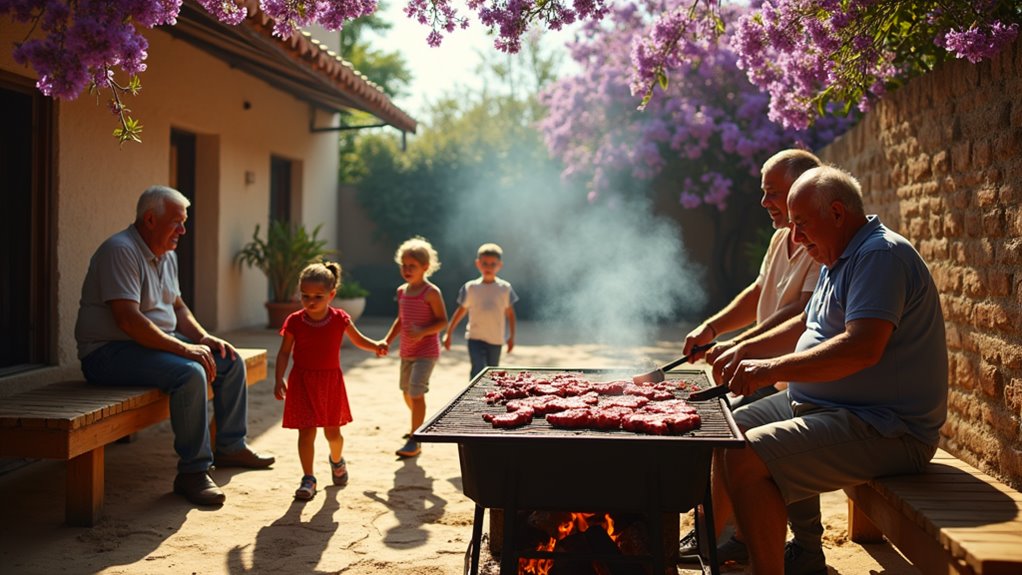
Family gatherings form the cornerstone of Uruguayan social life, where you’ll discover that cultural traditions revolve around intimate community bonds rather than large-scale celebrations. With average family sizes of 3.4 members, you’ll find tight-knit structures influenced by Italian immigrants creating strong kinship ties.
You’ll experience mate sharing rituals everywhere—at home, work, or during walks. This national drink from Charrúa and Guaraní traditions becomes your recognizable symbol of belonging. Uruguayans consume more yerba mate per capita than anywhere else in South America.
Every 29th, you’ll join nationwide Día de los Ñoquis celebrations, eating potato gnocchi with coins under plates for prosperity.
Religious festivals like February’s massive Iemanjá beach celebrations draw hundreds of thousands. You’ll encounter Gaúcho culture through agro-tourism, December’s Bierfest with wood cutting competitions, and Candombe performances reflecting African influences throughout these community-centered traditions.
Montevideo Provides Urban Amenities While Coastal Areas Offer Beach Living

As Uruguay’s capital, Montevideo concentrates nearly half the country’s population while delivering Latin America’s highest quality of living according to Mercer rankings.
You’ll find dense cultural infrastructure including museums, theaters, and the world’s longest Carnaval celebration lasting 1.5 months.
Central neighborhoods like Pocitos offer 80-150 restaurants within walking distance, though housing costs reflect this convenience with one-bedroom apartments ranging from $85,000 to $140,000.
Montevideo’s unique advantage lies in its coastal urban living—the Rambla provides beach access steps from downtown.
Coastal neighborhoods blend seaside recreation with city services, offering 18-35% green space coverage. Safety varies significantly across the city, with upscale areas like Carrasco maintaining just 8 incidents per 1,000 residents while central districts experience higher crime rates.
Outside the capital, you’ll discover quieter beach towns with limited infrastructure but closer contact with nature, creating a clear trade-off between urban amenities and peaceful coastal living.
Public Transportation Makes Car Ownership Optional in Cities
Beyond owning a car, Uruguay’s cities offer robust public transportation that can handle your family’s daily mobility needs. Montevideo’s extensive bus network covers residential, commercial, and school zones with high-frequency service during peak hours.
You’ll find commuting to work and school entirely feasible without a private vehicle.
The city operates two bus rapid transit corridors spanning 6 kilometers, moving 168,000 passengers daily through dedicated lanes that beat traffic congestion. These BRT lines integrate seamlessly with the broader bus network, creating efficient transfers across the city.
Safety adds another compelling reason to choose public transit. Uruguay achieves 3-star safety ratings on 82% of national roads, while ongoing infrastructure improvements enhance pedestrian safety around bus stops, making family travel more secure. The assessment covered 50 school zones in Montevideo and surrounding areas, identifying improvements for safe crossings and footpaths that benefit families using public transportation.
Inflation Rates Encourage USD Savings Strategies

Uruguay’s inflation rate hit 5.4% in 2025, pushing above the Central Bank’s 4.5% target and creating a compelling case for families to contemplate USD savings strategies. When your peso purchasing power erodes at rates exceeding official targets, diversifying into dollar holdings becomes a practical hedge against domestic economic pressures.
You’ll find that food and beverage costs, representing 26.1% of the consumer price index, particularly drive families toward currency diversification. Core inflation reached 4.38% annually, affecting essential household expenses beyond volatile items like vegetables and fuel.
Despite peso strength projections reaching UYU/USD 42.1 by December 2025, historical volatility—including September 2022’s 9.95% monthly peak—demonstrates why USD stability appeals to cautious savers. External sector resilience supports dollar holdings as reliable protection against inflation’s wealth erosion. The Central Bank’s restrictive stance on monetary policy signals that current inflationary pressures will persist, making dollar savings even more attractive for protective wealth management.
Pet-Friendly Housing Market Welcomes Family Animals
While inflation concerns might dominate your financial planning, finding pet-friendly housing in Uruguay presents another practical challenge that’ll directly impact your family’s relocation success.
With 58-65% of Uruguayan households owning pets, competition for pet-accepting rentals runs fierce, especially in Montevideo, Canelones, and Maldonado.
You’ll discover less than 10% of “pet-friendly” properties accept animals without breed or size restrictions. Most landlords impose weight limits, require additional security deposits, and demand current vaccination records.
Building bylaws in condominiums often restrict pets in common areas or ban them entirely.
Review lease contracts carefully for specific pet clauses covering noise, cleanliness, and damage responsibilities. Families securing pet-inclusive housing typically experience longer tenancy periods, averaging 21% more stability than those without pets.
Service animals receive stronger legal protection, but standard pets face significant rental market constraints that could affect your housing options.
The Sum Up
You’ll find Uruguay offers a compelling package for international families seeking stability in Latin America. While you’ll pay higher costs than neighboring countries, you’re getting excellent healthcare, solid infrastructure, and genuine safety. Don’t overlook the multiple residency pathways available – they’re more accessible than you’d expect. Start building your USD savings now to hedge against inflation, and remember that coastal living doesn’t mean sacrificing urban conveniences in this unique destination.