
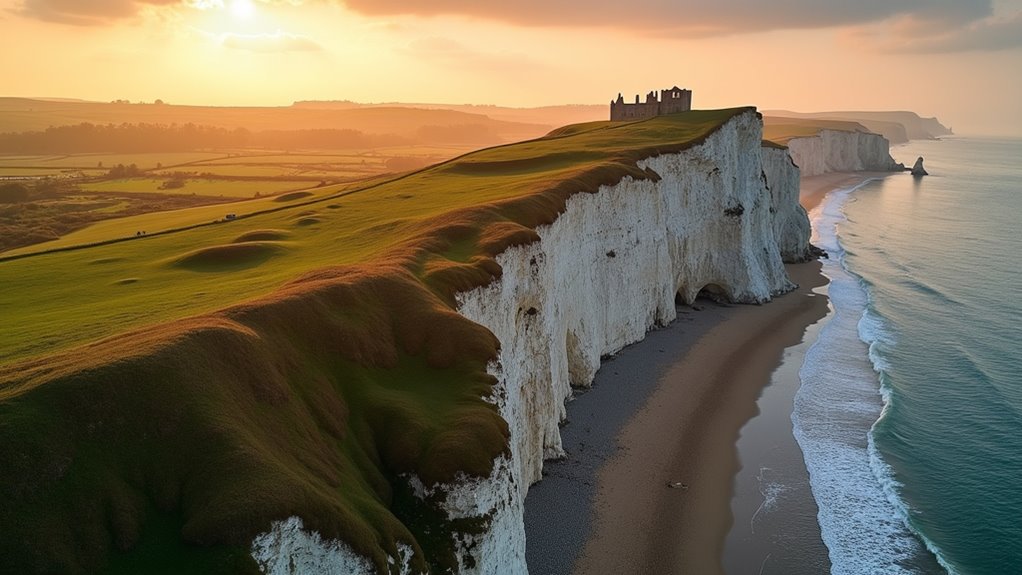
You’ll discover amazing historical treasures across the Isle of Wight, from the 6,000-year-old Longstone standing stone to Roman villas with intricate mythological mosaics. Explore medieval St Catherine’s Oratory lighthouse, hunt for 125-million-year-old dinosaur footprints at Hanover Point, and visit the unique Russian-style Hoy Monument built for Tsar Alexander I. Don’t miss the spooky ruins of Appuldurcombe House or the Bronze Age burial mounds scattered across the dramatic downlands that hold fascinating secrets waiting to be uncovered.
- The Longstone Standing Pillar and Mottistone Neolithic Barrow
- Tennyson Down Bronze Age Burial Mound
- Brook Down’s “Five Barrows” Cemetery Complex
- St Catherine’s Oratory – “The Pepperpot” Medieval Lighthouse
- Hoy Monument’s Russian-Style Architecture
- Hanover Point Dinosaur Footprint Exposures
- Dinosaur Isle Museum and Fossil Hunting Grounds
- Newport Roman Villa’s Mosaic Floors and Bath Suite
- Brading Roman Villa’s Mythological Artworks
- Appuldurcombe House Baroque Ruins and the Worsley Scandal
- The Sum Up
The Longstone Standing Pillar and Mottistone Neolithic Barrow
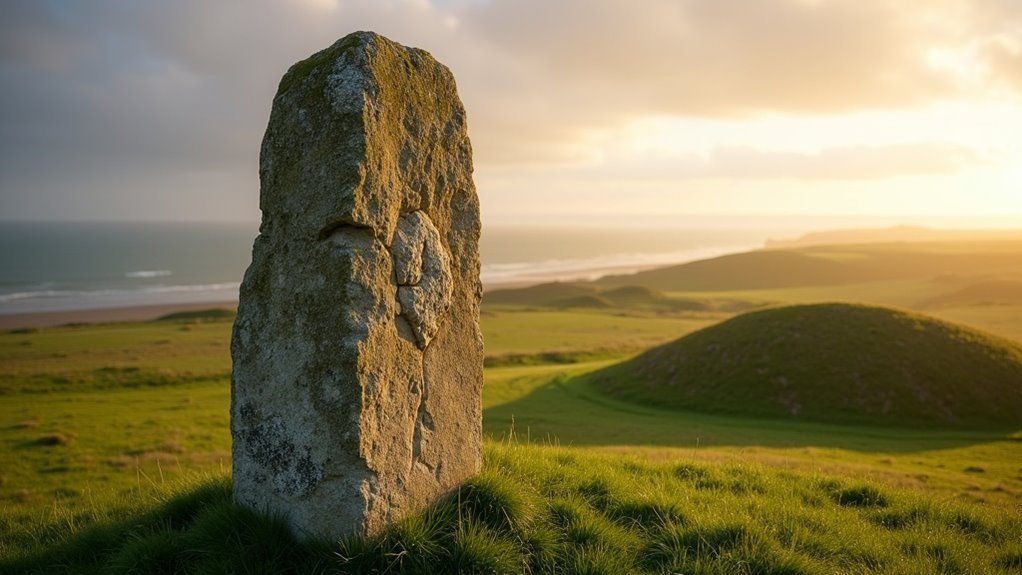
When you visit the quiet village of Mottistone on the Isle of Wight, you’ll discover one of Britain’s most mysterious ancient monuments standing proudly at the foot of a hill.
The Longstone towers 13 feet tall next to its fallen companion stone, both made from iron sandstone. These massive rocks are 6,000 years old, dating back to 3000 BC when ancient people built a long barrow here for burying their dead.
You can easily reach the stones via a public footpath managed by the National Trust.
The village’s name actually comes from this ancient meeting place!
While most of the original burial mound has disappeared over time, these surviving stones still hold fascinating legends about giants and devils throwing rocks across the island. Today, the site continues to serve as a spiritual gathering place where Island Druids celebrate seasonal festivals including solstices, equinoxes, and Samhain.
Tennyson Down Bronze Age Burial Mound
Have you ever wondered what secrets lie beneath the rolling hills of Tennyson Down? You’re walking over a 4,000-year-old Bronze Age burial mound! This ancient round barrow sits on chalk downland managed by the National Trust, where over 240 burial mounds dot the landscape.
You can explore this incredible site near Freshwater, where Bronze Age people buried their dead around 1600-1400 B.C. What’s really cool is there’s also a Neolithic ‘mortuary enclosure’ nearby, showing people used this special place for thousands of years before the Bronze Age mound was built.
The chalk downs have protected these ancient monuments for millennia. Many of these ancient burial sites have been damaged by early excavations, ploughing, or animal activity over the centuries. When you visit, you’re literally standing on one of the Isle of Wight’s most important prehistoric sites!
Brook Down’s “Five Barrows” Cemetery Complex
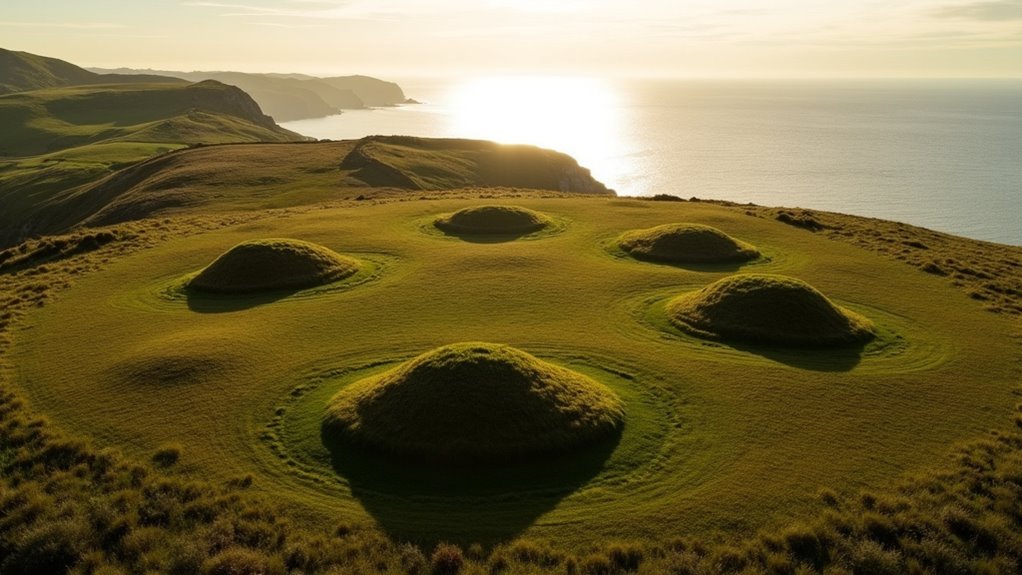
Despite its name suggesting just five burial mounds, Brook Down’s “Five Barrows” cemetery actually contains nine ancient Bronze Age barrows scattered across the chalk ridge! You’ll discover seven bowl barrows, one bell barrow, and one disc barrow dating back 3,500-4,000 years.
These weren’t ordinary graves – they’re where Bronze Age elite were buried with special ceremonies.
You can spot these earthwork mounds easily as they create an iconic skyline along the Tennyson Trail. The site’s positioned perfectly on the downs’ crest, giving you spectacular views over Brook Bay and the English Channel to the south, plus the Solent to the north.
It’s about a half-kilometer walk from parking, making it accessible for families wanting to explore this fascinating glimpse into prehistoric island life.
St Catherine’s Oratory – “The Pepperpot” Medieval Lighthouse
Perched on one of the Isle of Wight’s highest points, St Catherine’s Oratory stands as Britain’s only surviving medieval lighthouse – though locals affectionately call it “The Pepperpot” because of its distinctive octagonal shape!
Built in 1328 as penance by Walter de Godeton after he stole wine from a shipwreck, this 35-foot stone tower once guided ships safely past dangerous rocks.
You’ll find eight rectangular openings at the top where medieval priests maintained fires to warn sailors. The lighthouse features a unique design with an octagonal exterior but a four-sided interior space.
The walk from the car park takes about ten minutes across fields, but it’s worth it for the spectacular sea views.
Best of all, it’s completely free to visit during daylight hours!
Hoy Monument’s Russian-Style Architecture
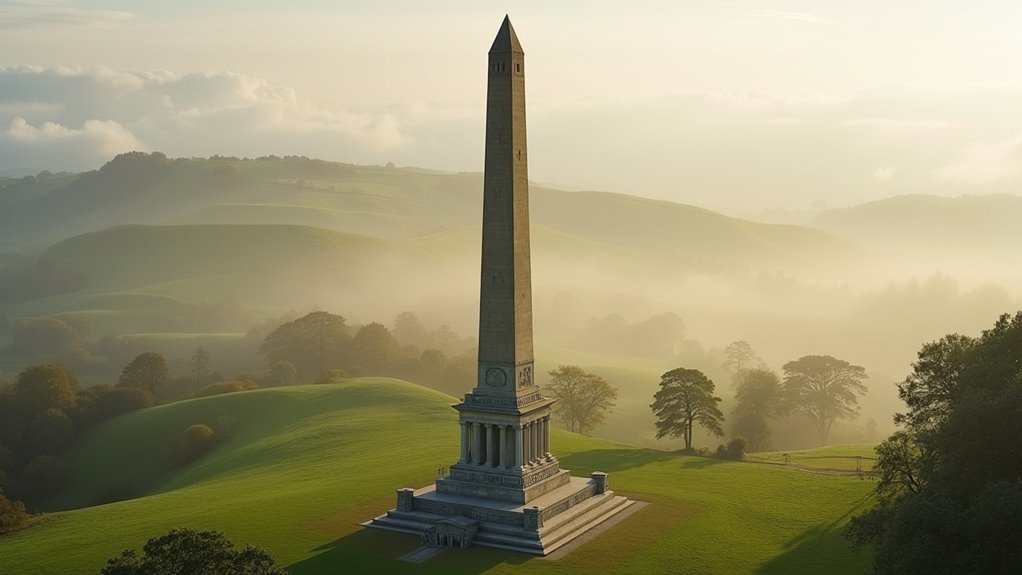
Why would a Russian merchant build a towering monument on an English hilltop? You’ll discover the answer when you visit Hoy Monument on St. Catherine’s Down. In 1814, wealthy Russian trader Michael Hoy erected this 72-foot column to honor Tsar Alexander I‘s visit to Britain.
Hoy had grown rich through trade and owned 1,700 acres on the island, living at nearby Medina Hermitage.
You can’t miss this towering tribute – it’s visible for miles across the Isle of Wight! The monument features distinctive Russian-style design elements that make it stand out against the English countryside.
After climbing 237 meters up the chalk down, you’ll find inscriptions remembering both the Tsar and Crimean War soldiers. The monument stands at the northern end of St. Catherine’s Down, offering commanding views across the island. It’s Britain’s first memorial linked to the Russian Imperial Family.
Hanover Point Dinosaur Footprint Exposures
When the tide rolls out at Brook Beach, you’ll discover one of the world’s most incredible fossil treasure hunts waiting on the foreshore. At Hanover Point, you can walk among 125-million-year-old dinosaur footprints preserved in ancient rock! These amazing tracks were made when giant plant-eating dinosaurs like 10-meter-long Iguanodons stomped through muddy riverbanks during the Cretaceous period.
You’ll find over 150 footprints scattered across loose boulders that’ve tumbled from the crumbling cliffs. Look for broad, round prints from herbivores and smaller, pointy tracks from meat-eating dinosaurs. The soft clay cliffs erode constantly, revealing fresh fossils including dinosaur bones, teeth, and ancient oyster shells.
Join expert-led fossil walks for the best experience, and always visit during low tide for safety! This entire stretch forms part of the Wealdon Outcrop, an 11-mile coastline that regularly uncovers incredible dinosaur discoveries between Compton and Sandown.
Dinosaur Isle Museum and Fossil Hunting Grounds
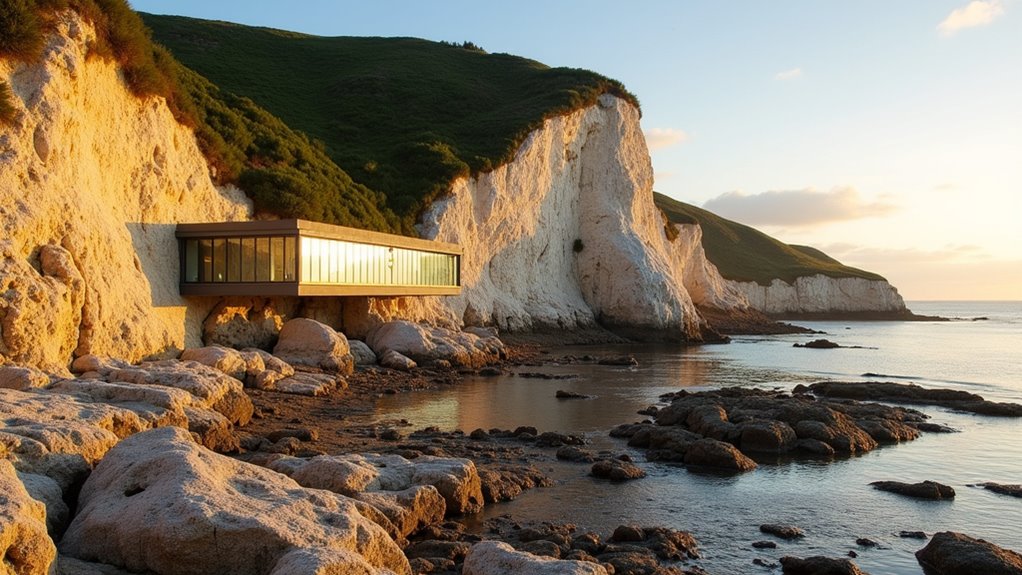
The world’s coolest dinosaur museum sits right in Sandown, shaped like a massive pterosaur ready to take flight! You’ll discover Europe’s first custom-built dinosaur museum, housing an incredible 40,000 specimens including nearly 200 different types. Don’t miss Pink Iggy, the famous Iguanodon skeleton discovered in 1976, or the life-size Polacanthus model that’ll make you feel tiny!
The museum’s field trips take you to actual fossil hunting sites across the island, where you can search for Cretaceous to Ice Age treasures on local beaches. You’ll explore past ecosystems spanning millions of years, from Pleistocene giants to ancient marine life. Inside, you can chat with resident paleontologists and watch them work on real specimens.
Though it’s currently closed for maintenance, it’s reopening in early 2026 with exciting new features waiting for your visit!
Newport Roman Villa’s Mosaic Floors and Bath Suite
While ancient dinosaurs roamed this island millions of years ago, humans have also left their mark in spectacular ways! At Newport Roman Villa, you’ll discover an incredible 1,700-year-old farmhouse with stunning mosaic floors that’ll make your jaw drop. These colorful stone patterns, called tesserae, are still perfectly preserved under a protective building.
But here’s the coolest part – you can explore a complete Roman bath suite with underfloor heating! The hypocaust system pumped hot air beneath raised floors, creating ancient central heating. You’ll see the furnace, cold rooms, warm rooms, and hot rooms where wealthy Romans once relaxed.
Don’t miss the painted wall fragments and window glass pieces that show how luxurious life was here. The site was almost reburied after excavation but was saved through passionate public and local support. It’s like stepping into a Roman time machine!
Brading Roman Villa’s Mythological Artworks
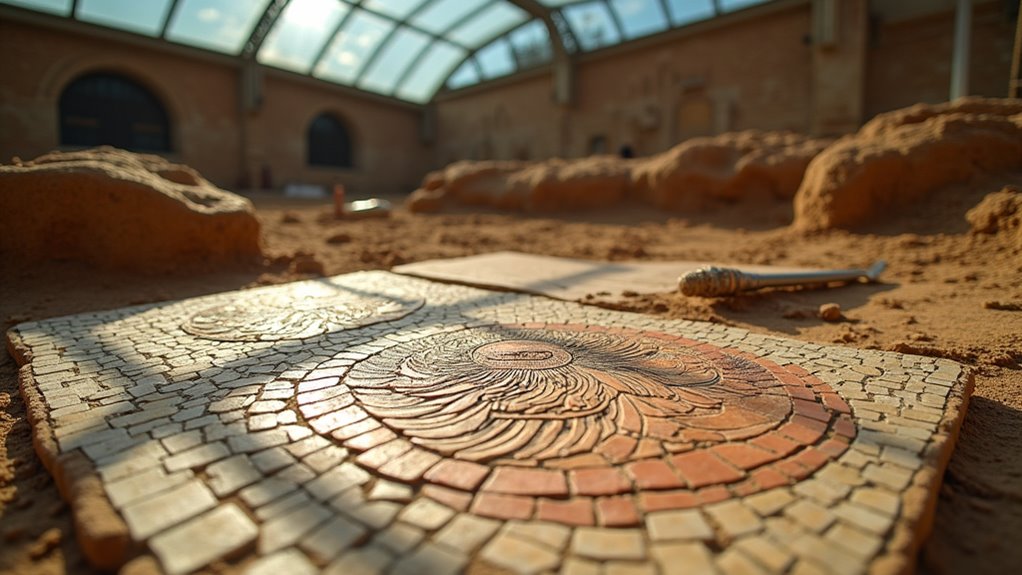
Just down the road from Newport, Brading Roman Villa houses some of the most mind-blowing mythological artwork you’ll ever see! You’ll discover five rooms packed with incredible mosaics showing ancient Roman gods and goddesses, including the fearsome Medusa with her snake hair.
There’s also Orpheus, the legendary musician, and Bacchus, the party-loving god of wine.
The coolest piece? A mysterious chicken-headed man surrounded by griffins – experts think it represents a soul’s journey to heaven! You’ll spot gladiators battling and scenes of farming that show how wealthy the villa owners were. The villa remained occupied for centuries, with Roman coins found at the site indicating continued use until AD 395.
These 4th-century mosaics were created by local craftsmen using pattern books, making each room a treasure trove of Roman mythology and storytelling.
Appuldurcombe House Baroque Ruins and the Worsley Scandal
Although Appuldurcombe House now stands as a magnificent shell, this Baroque mansion once hosted one of Britain’s juiciest scandals! You’ll explore the grandest house that ever graced the Isle of Wight, designed by architect John James in 1702.
Sir Richard Worsley’s marriage to 17-year-old Seymour Fleming created headlines when she admitted to having 27 lovers during their explosive 1782 court case!
You can wander the atmospheric ruins where Capability Brown designed ornamental grounds in 1779. The estate also features Cooke’s Castle, a romantic folly built to enhance the scenic views from the mansion’s grounds.
A German bomber damaged the roof in 1943, and it was never repaired.
English Heritage manages the site, welcoming visitors Sunday-Friday from April-October.
You’ll find ghost walks on Thursday evenings if you’re brave enough to meet the resident phantoms!
The Sum Up
You’ve discovered just nine of the Isle of Wight’s coolest historical treasures! From ancient stone circles to Roman mosaics, there’s so much more waiting for you to explore. Pack your walking shoes, bring a camera, and don’t forget snacks for your adventures. Whether you’re hunting for fossils or climbing ancient burial mounds, each site tells an amazing story that’ll make you feel like a real-life time traveler exploring Britain’s past!