
You’ll navigate Germany confidently with essential phrases like “Hallo!” for greetings, “Einen Tisch für zwei, bitte” when dining out, and “Wo ist der Park?” for directions to family attractions. Master “Ich hätte gern” for ordering kid-friendly meals, “Gibt es kinderfreundliche Einrichtungen?” for child amenities, and emergency phrases like “Ich brauche einen Arzt.” Don’t forget “Ich danke Ihnen” to show appreciation to helpful locals. These fundamentals will transform your German family adventure into a smoother, more enjoyable experience.
- Greeting Hotel Staff and Restaurant Workers
- Asking for Directions to Family Attractions
- Ordering Food for Children at Restaurants
- Shopping for Souvenirs and Family Essentials
- Requesting Help When Traveling With Kids
- Booking Family Activities and Tours
- Handling Payment at Tourist Destinations
- Finding Child-Friendly Facilities
- Communicating During Medical Emergencies
- Navigating Public Transportation With Family
- Checking Into Family Accommodations
- Expressing Gratitude During Your Stay
- The Sum Up
Greeting Hotel Staff and Restaurant Workers
When you step into a German hotel lobby or restaurant during your family vacation, knowing the right phrases can transform an awkward encounter into a warm interaction. Start with “Hallo!” for a friendly hello, or use time-specific greetings like “Guten Morgen!” (Good morning), “Guten Tag!” (Good afternoon), or “Guten Abend!” (Good evening). These simple phrases immediately show respect for local customs and are essential for initial communication with hotel staff.
When introducing yourself, say “Mein Name ist [your name]” to share your name clearly.
At restaurants, you’ll find “Einen Tisch für zwei, bitte” (A table for two, please) invaluable for seating requests. Don’t forget “Entschuldigen Sie bitte” (Excuse me please) to politely get a waiter’s attention. These basic courtesies create positive first impressions and smoother service throughout your stay.
Asking for Directions to Family Attractions
Once you’ve settled into your hotel and enjoyed your first German meal, you’ll want to explore the city’s family-friendly attractions with your children. Start with polite phrases like “Entschuldigung, wo ist…?” (Excuse me, where is…?) or “Können Sie mir helfen?” (Can you help me?) to get locals’ attention.
For specific destinations, ask “Wo ist der Park?” (Where is the park?) or “Wo ist das Museum?” (Where is the museum?). Don’t forget practical questions like “Ist es weit von hier?” (Is it far from here?) and “Gibt es einen Bus, der dorthin fährt?” (Is there a bus that goes there?). Germans typically provide precise directions with attention to landmarks and estimated travel times.
Listen for directions: “Gehen Sie geradeaus” (Go straight ahead) or “Biegen Sie links ab” (Turn left). Always request “Können Sie es mir auf der Karte zeigen?” (Can you show me on the map?) for clarity.
Ordering Food for Children at Restaurants
After working up an appetite exploring German attractions, you’ll need to navigate restaurant menus with your little ones in tow.
Start with polite ordering phrases like “Ich hätte gern” (I would like) or “Ich nehme” (I’ll take) when selecting children’s meals. Don’t forget “bitte” (please) to show courtesy.
If your child has dietary restrictions, use “Ich bin allergisch gegen” (I’m allergic to) followed by the ingredient, or ask “Gibt es vegetarische Optionen?” (Are there vegetarian options?).
For portions, specify “klein” (small) or “groß” (large), and use “mit” (with) for customizations like “mit Käse” (with cheese). When ordering cake for dessert, ask for ein Stück followed by the type, such as “ein Stück Apfelkuchen” for apple cake.
Need takeaway? Simply add “zum Mitnehmen” (to go) to your order.
Shopping for Souvenirs and Family Essentials
Whether you’re hunting for authentic German souvenirs or need to pick up forgotten essentials for the kids, knowing key shopping phrases will make your retail adventures much smoother.
Start with basics like “Wie viel kostet das?” (How much does this cost?) and “Wo finde ich [Produkt]?” (Where can I find [product]?).
When souvenir shopping, ask “Ist das aus der Region?” (Is this local?) to find genuine items.
If you’re buying gifts, mention “Es soll ein Geschenk sein” (It’s for a present). Always ask “Kann ich bitte eine Quittung bekommen?” (Can I have a receipt, please?) for purchase records.
For clothing, you’ll need “Kann ich das anprobieren?” (Can I try this on?) and “Wo sind die Umkleidekabinen?” (Where are the fitting rooms?).
At checkout, “Kann ich mit Karte zahlen?” (Can I pay by card?) will clarify payment options smoothly.
Requesting Help When Traveling With Kids
Shopping trips can quickly turn stressful when you’re steering unfamiliar German stores with children in tow, but knowing how to ask for help will transform challenging moments into manageable ones. “Entschuldigung” becomes your most valuable phrase—it politely gets attention from staff, locals, or fellow travelers when you need assistance.
When you’re lost with little ones, “Wo ist…?” helps locate essential places like restrooms or stations. “Ich bin verloren” clearly communicates you need directions.
For urgent situations, “Ich brauche einen Arzt” requests medical help, while “Krankenhaus” works in emergencies.
On public transport, “Zweimal nach… bitte” gets tickets for parents, and “Wann fährt er ab?” checks departure times. Remember “Können Sie mir helfen?” for general assistance and “Sprechen Sie Englisch?” to find English speakers when traveling with children. If someone speaks too quickly or uses unfamiliar dialect, simply ask “Können Sie das bitte wiederholen?” to request clear repetition.
Booking Family Activities and Tours
How do you secure the perfect family activities without the language barrier turning booking into a battle? Start with “Gibt es eine Tour für Kinder?” (Is there a tour for children?) to find kid-friendly options.
When you’ve found something promising, ask “Was empfehlen sie?” (What do you suggest?) for insider tips.
Ready to book? Say “Ich habe eine Reservierung” (I have a reservation) if you’ve pre-booked, or “Kann ich bitte…” (May I have…) followed by your ticket needs.
Always confirm costs with “Wie viel kostet das?” (How much does it cost?) before committing. Remember that most Germans aged 18-50 in large cities will speak at least basic English, making communication easier if you get stuck.
For directions, use “Wo ist der Ticketschalter?” (Where is the ticket window?) or “Zeigen Sie mir das bitte auf der Karte?” (Show me on the map please). These phrases ensure smooth family adventure bookings.
Handling Payment at Tourist Destinations
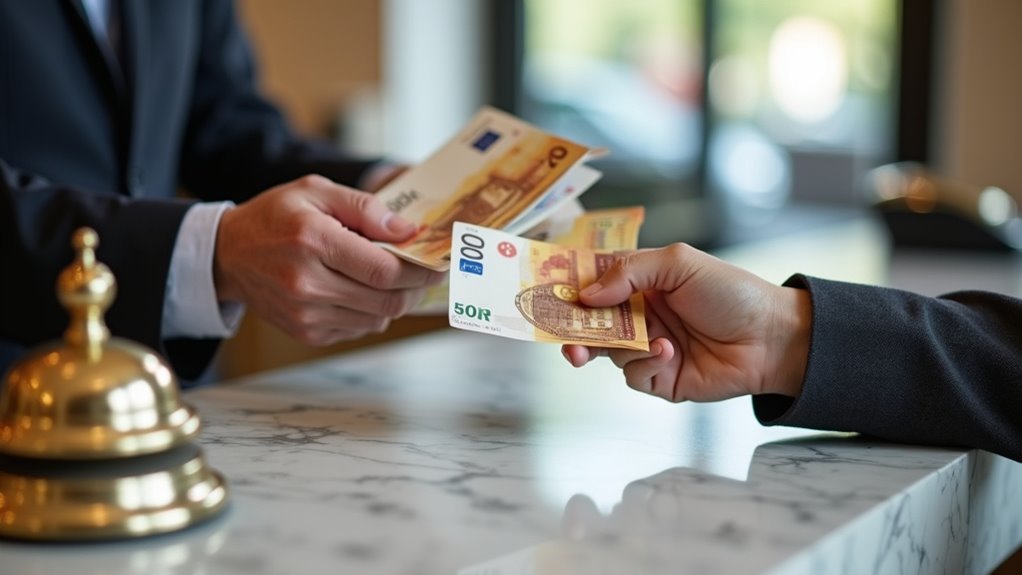
When you’re ready to make purchases at German tourist destinations, knowing the right payment phrases can save you from awkward fumbling at checkout counters. Start with “Wie viel kostet das?” (How much is that?) to ask prices, then confirm payment methods by asking “Nehmen Sie Kreditkarten?” (Do you accept credit cards?).
However, many cashiers reject cards, so carry sufficient cash and use “Darf ich mit Bargeld bezahlen?” (May I pay with cash?). Learning these essential phrases demonstrates respect for local culture and helps prevent potential exploitation by vendors.
When dining out, request your bill with “Die Rechnung, bitte” (The bill, please) and ask “Ist Trinkgeld inklusive?” (Is tip included?). Remember that 10% tipping is standard in restaurants.
If prices seem high, try “Haben Sie etwas Billigeres?” (Do you have something cheaper?) and always request “Darf ich eine Quittung haben, bitte?” (Can I have a receipt, please?).
Finding Child-Friendly Facilities
Where can you find the best child-friendly facilities during your German family holiday? You’ll discover that Germany takes childcare seriously, with over 59,300 daycare centers nationwide. When traveling with little ones, look for “Kinderbetreuung” (childcare) signs at hotels and tourist destinations.
Eastern regions typically offer more extensive facilities for children under three, while nationwide coverage for older kids is excellent. Don’t hesitate to ask locals about nearby “Kita” (daycare centers) or family-friendly attractions using phrases like “Gibt es hier kinderfreundliche Einrichtungen?” (Are there child-friendly facilities here?).
Remember that Germany’s commitment to early childhood development means you’ll often find well-equipped playgrounds and activity areas. Many facilities emphasize physical activity, great for keeping energetic children happy during your travels. This reflects the fact that 47% of Germans now consider their country to be child-friendly, showing a positive shift in attitudes toward family accommodations.
Communicating During Medical Emergencies

Medical emergencies can happen anywhere, and knowing key German phrases could make the difference between getting quick help or struggling to communicate when every second counts. Start with the basics: “Hilfe” (help) and “Notfall” (emergency).
If you’re hurt, say “Ich bin verletzt” (I am injured) or “Ich habe Schmerzen” (I have pain). For serious situations, use “Ich brauche einen Arzt” (I need a doctor) or “Es ist ein medizinischer Notfall” (This is a medical emergency). When speaking with emergency personnel, remember to use clear, slow speech and state “Ich spreche nicht gut Deutsch” if your German proficiency is limited.
Remember Germany’s emergency numbers: 112 for general emergencies and 110 for police. You can also say “Rufen Sie einen Krankenwagen” (Call an ambulance).
If you need directions, ask “Wo ist das nächste Krankenhaus” (Where is the nearest hospital). These phrases will help you get assistance quickly.
Navigating Public Transportation With Family
Beyond medical situations, you’ll find that Germany’s public transportation system becomes your family’s best friend for exploring cities and getting around efficiently. The Deutschlandticket at 58 euros monthly offers unlimited access to local transport nationwide, great for extended family stays.
You’ll navigate easily with integrated networks covering S-Bahn (suburban rail), U-Bahn (underground trains running every 5-15 minutes), buses stopping every 300 meters, and trams. Remember that many U-Bahn lines actually run above ground, despite the common misconception that they’re entirely underground.
Single tickets work across all modes within transport zones, simplifying group travel.
Download official apps for real-time schedules and route planning with children. Purchase tickets from machines or apps before boarding.
Bus stops’ frequent spacing means short walks for little legs, while weekend night services extend your evening adventures when exploring Germany’s vibrant cities.
Checking Into Family Accommodations
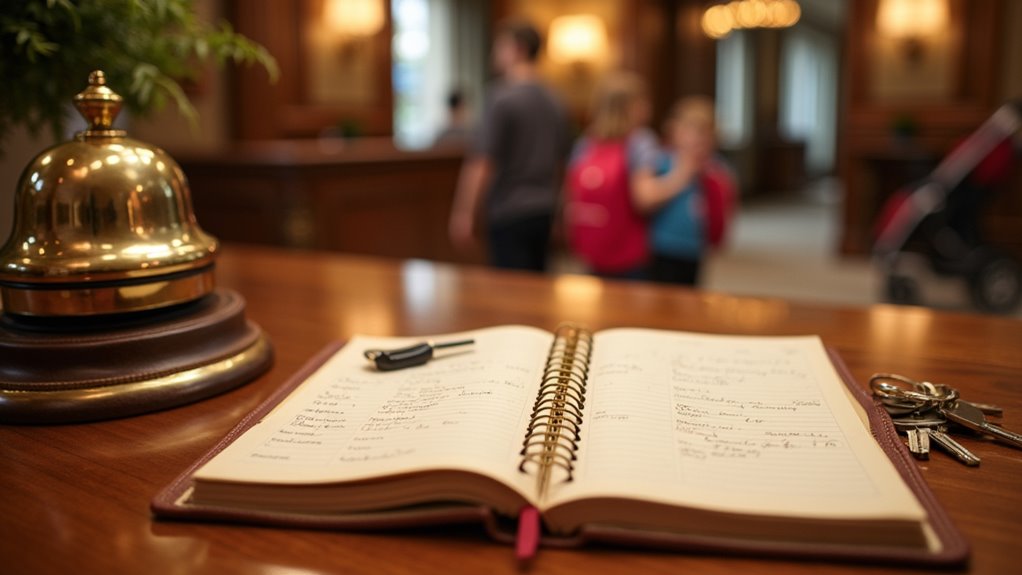
For families, ask “Haben Sie Familienzimmer oder Zimmer mit Kinderbetten?” to confirm your room arrangements.
Once everything’s verified, request your key with “Könnte ich bitte den Schlüssel haben?”
Don’t forget to inquire about essential amenities: “Frühstück inbegriffen?” for breakfast, “WLAN im Zimmer verfügbar?” for Wi-Fi, and “Parkplatz vorhanden?” for parking availability. If you need assistance finding your accommodation, use “Könnten Sie mir zeigen, wo mein Zimmer ist?” to ask for directions to your room.
Expressing Gratitude During Your Stay
For formal situations with elders, try “Ich danke Ihnen” or “Ich bin Ihnen sehr dankbar.”
Address specific kindnesses with phrases like “Danke, sehr aufmerksam” for thoughtful gestures.
When thanking multiple family members, “Danke an alle” works perfectly.
Remember to respond graciously when receiving thanks by saying “Bitte schön” or simply “Bitte.” For expressing gratitude before family members complete a favor, use “Danke im Voraus” in written communication like holiday planning emails.
The Sum Up
You’ve got the essential German phrases to make your family holiday smoother and more enjoyable. Don’t worry about perfect pronunciation—locals appreciate your effort to speak their language. Keep these phrases handy on your phone or write them down for quick reference. Remember, a smile goes a long way when you’re trying to communicate. Practice a few key phrases before you go, and you’ll feel more confident steering Germany with your family.