

Contact your credit card company before departure to set travel alerts and avoid blocked transactions. Choose cards without foreign transaction fees like Capital One or American Express Gold to save money. Always decline Dynamic Currency Conversion at checkout—it costs 3-12% more than paying in local currency. Download your bank’s mobile app to monitor transactions in real-time and instantly lock cards if needed. Carry multiple card brands since acceptance varies by region, and these strategies will help you navigate international payments confidently.
- Contact Your Credit Card Company Before Departure
- Choose Cards Without Foreign Transaction Fees
- Know Which Card Brands Are Accepted Worldwide
- Decline Dynamic Currency Conversion at Checkout
- Download and Set Up Mobile Banking Apps
- Carry Multiple Payment Methods for Backup
- Monitor Your Accounts for Suspicious Activity
- Understand Local Payment Customs and Practices
- Plan Your Cash Strategy Alongside Card Use
- Keep Emergency Contact Information Accessible
- Last Words
Contact Your Credit Card Company Before Departure
Before you pack your bags, reaching out to your credit card company might save you from awkward payment declines at foreign restaurants or hotel check-ins.
While many major issuers like American Express, Capital One, and Chase no longer require travel notifications due to advanced fraud detection, others such as Barclays, Citi, Discover, and US Bank still recommend setting alerts.
You can easily set up travel notices through your issuer’s website or mobile app by browsing to “Travel Notifications” and adding your trip details.
Alternatively, call the customer service number on your card’s back.
Don’t forget to update your contact information—current email and phone numbers ensure you’ll receive immediate fraud alerts while abroad, helping protect your finances during travel. When you book flights or hotels through your card issuer’s travel portal, this automatically signals your trip details to their fraud detection system.
Choose Cards Without Foreign Transaction Fees
While foreign transaction fees might seem insignificant at 1% to 3% per purchase, they’ll quickly drain your travel budget when you’re buying meals, booking tours, and making everyday purchases abroad. Choose cards that eliminate these charges entirely to safeguard your finances.
Capital One stands out by waiving foreign transaction fees on all U.S.-issued credit cards, including no-annual-fee options like the VentureOne and Platinum cards. Their Venture card earns 2X rewards on all purchases without international charges.
Other solid options include American Express Gold Card, select Chase cards, and Bank of America’s international-friendly products. These cards often provide travel protections and bonus earning rates on dining and travel expenses. Many of these cards also offer transfer partners and flexible redemption options to maximize the value of earned points and miles.
Apply for your no-fee international card well before departure to ensure approval and card delivery.
Know Which Card Brands Are Accepted Worldwide
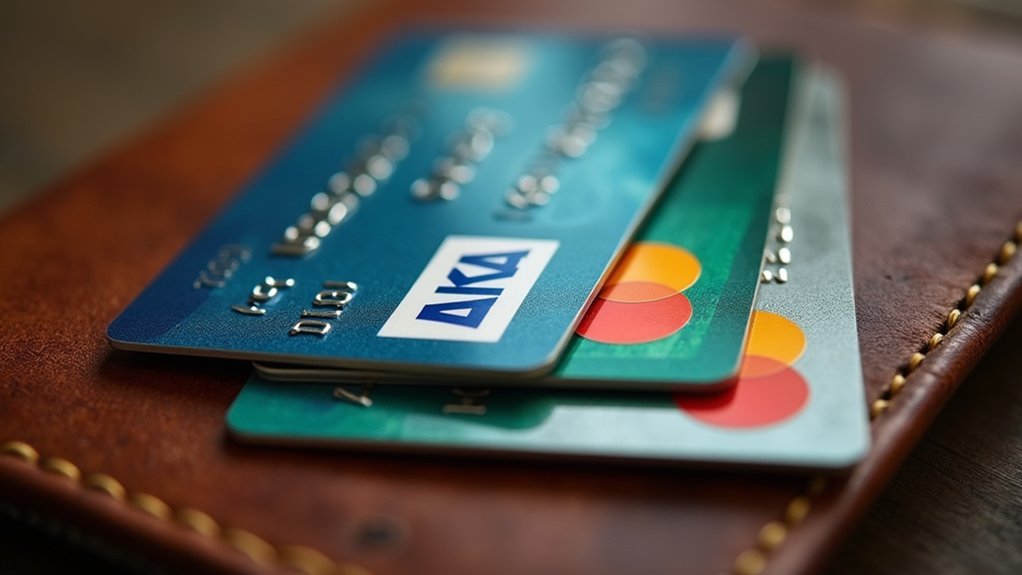
Where will your credit cards work when you’re halfway around the world? Visa and Mastercard dominate global acceptance, operating in over 200 countries with millions of merchant locations. You’ll find Visa accepted virtually everywhere, making it the top choice for international travel backup cards.
Mastercard offers comparable worldwide reach with strong European presence.
American Express faces significant limitations outside North America, despite premium travel perks. While it’s accepted at 99% of U.S. merchants, international acceptance drops dramatically, particularly in Asia and developing markets. Amex’s limited global reach stems from higher processing fees charged to merchants compared to other major networks.
Discover remains primarily U.S.-focused with limited global utility.
Pack multiple card brands for maximum coverage. Consider regional payment schemes like Girocard in Germany or UnionPay in China for specific destinations.
Always carry cash alternatives when traveling to remote locations.
Decline Dynamic Currency Conversion at Checkout
When merchants or ATMs offer to charge your card in dollars instead of local currency, you’re facing Dynamic Currency Conversion (DCC) – a costly convenience that can inflate your purchase by 3% to 12%. Always decline this option and choose local currency payment instead.
DCC’s upfront transparency comes at a steep price. You’ll pay exchange rate markups plus profit margins that far exceed your bank’s standard foreign transaction fees.
Studies show British consumers alone lose £500 million annually to DCC charges.
Your card issuer’s conversion rates are consistently better than DCC’s inflated rates. When you pay in local currency, you’ll only face your bank’s foreign transaction fee, typically saving 3-5% per transaction. DCC operates through real-time conversion at the point of payment, making it seem convenient but ultimately more expensive.
Don’t let convenience cost you money – always select local currency at checkout.
Download and Set Up Mobile Banking Apps
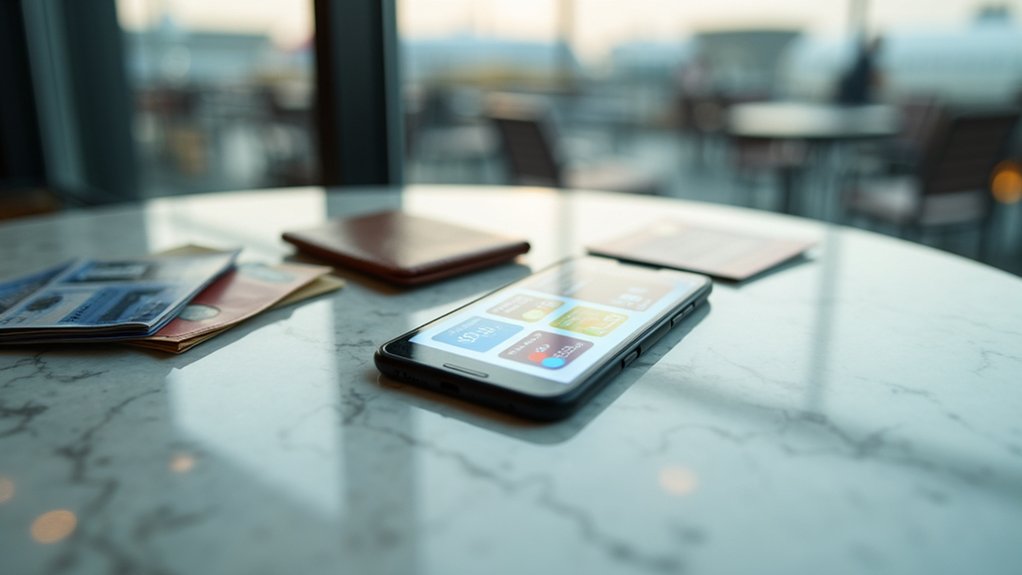
Smart payment choices at checkout matter, but your smartphone can become your most powerful financial tool abroad when properly configured. Download essential mobile wallet apps like Apple Pay or Google Pay, plus your bank’s official app before departure. Install authenticator apps like Google Authenticator for secure access without SMS reliance. Update everything to access the latest security features.
Confirm your cards support international transactions, then add them to wallet apps using the plus icon. Complete bank verification and enable biometric authentication. Set up travel notifications in banking apps with your destinations and dates to prevent account freezes.
Test mobile payments domestically first to ensure compatibility abroad. Consider fintech apps like Wise for multi-currency management and low-fee international transactions. Use these mobile banking tools to monitor account activity regularly while traveling, as frequent checks help identify any suspicious transactions quickly.
Carry Multiple Payment Methods for Backup
Although mobile payments offer convenience, diversifying your payment options protects you from unexpected rejections and technical failures abroad. You’ll need backup methods since 43% of travelers find their credit cards aren’t accepted during trips.
Pack at least four payment methods like most international travelers do. Include your primary credit card, a backup credit card from a different network, a debit card, and some cash. This strategy works—77% of consumers successfully use multiple payment methods for international transactions.
Cash remains essential for 94% of travelers, even as digital payments grow. When merchants reject your card, you’ll have alternatives ready. Keep payment methods separate—store backup cards and cash in different locations. Payment preferences vary significantly by destination, with some regions like Singapore favoring cash over cards while others prefer different methods entirely.
This diversification prevents you from being stranded without spending power when technical issues or merchant preferences create payment obstacles.
Monitor Your Accounts for Suspicious Activity
Having backup payment methods won’t protect you if fraudsters compromise your accounts while you’re abroad. You’ll need to actively monitor your financial activity to catch fraudulent charges quickly.
Enable real-time transaction alerts before traveling. Set up notifications for purchases over specific amounts, ATM withdrawals, and international transactions via text, email, or phone. Update your contact information in online banking to ensure you’ll receive fraud alerts promptly.
Check your account activity daily through your mobile app while traveling. Tourist areas carry higher fraud risks, making close oversight essential. Use your mobile banking app’s Manage Cards feature to set location restrictions and instantly turn cards on or off as needed.
Review all transactions thoroughly when you return home.
If you spot suspicious activity, immediately lock your card through your app and contact your issuer. Report the issue via phone, secure messaging, or app features for quick resolution.
Understand Local Payment Customs and Practices
Before you swipe your card at that charming café in Prague or bustling market in Bangkok, you’ll need to comprehend how payment preferences vary dramatically across regions.
While Europeans commonly use cards for cross-border purchases, representing 12% of all international card spending, local customs differ markedly. In Bulgaria, travelers prefer cards abroad despite using cash domestically. Some countries like Iran don’t support international card transactions at all.
Research your destination’s payment culture before departing. In certain regions, cash remains king for small purchases, while tourist areas readily accept cards. Understanding these preferences helps you avoid awkward situations and ensures you’re carrying appropriate backup payment methods.
This knowledge also prevents you from being caught off-guard when your preferred payment method isn’t welcomed. Different countries implement varied measures to regulate foreign exchange fees, so fee transparency levels can differ significantly depending on your destination.
Plan Your Cash Strategy Alongside Card Use
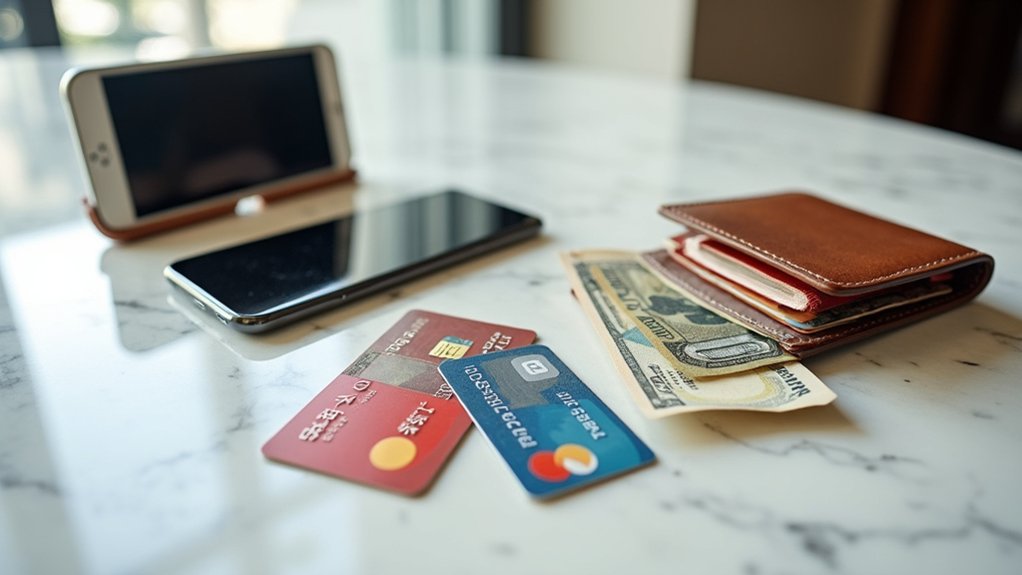
While credit cards offer convenience and security for most travel purchases, you’ll need a strategic cash plan to handle situations where plastic won’t work. Carry cash specifically for tips, taxis, mass transit, and street vendors who don’t accept cards.
Exchange a maximum of $100 at your local bank before departure, calling ahead to confirm availability of your destination’s currency. Set up price alerts through currency apps to monitor exchange rates and exchange money when rates are more favorable.
Use ATMs only at reputable high street banks to avoid skimming scams and excessive fees. Consider remittance services to collect cash without exposing your card details abroad.
Keep daily cash limited to what you need, storing excess in your hotel safe. Always carry USD in $20 and $50 denominations as emergency backup for unexpected situations.
Keep Emergency Contact Information Accessible
Beyond carrying cash and cards, you need instant access to emergency contact information when travel plans go sideways. Create credit-card-sized emergency cards containing your name, passport number, citizenship, phone, email, and at least one ICE contact.
Include toll-free numbers for your card issuers: American Express (1-800-528-4800), Visa (1-800-847-2911), MasterCard (1-800-627-8372), and Discover (1-800-347-2683).
Add your medical insurance company name, policy number, and emergency hotline. These cards assist first responders by clearly displaying medical and citizenship details during critical situations. Scatter these laminated cards throughout your belongings—wallet, luggage, day bag—so you’re covered if items get lost or stolen.
This preparation guarantees others can access critical information if you can’t communicate during emergencies.
Last Words
You’re now equipped with the essential knowledge to use credit cards safely and cost-effectively while traveling. Remember, preparation is your best defense against fraud and unexpected fees. Don’t leave home without notifying your bank, downloading their app, and memorizing emergency numbers. Keep multiple payment options available, stay vigilant about your spending, and always prioritize security over convenience. These smart habits will protect your finances and give you peace of mind abroad.