
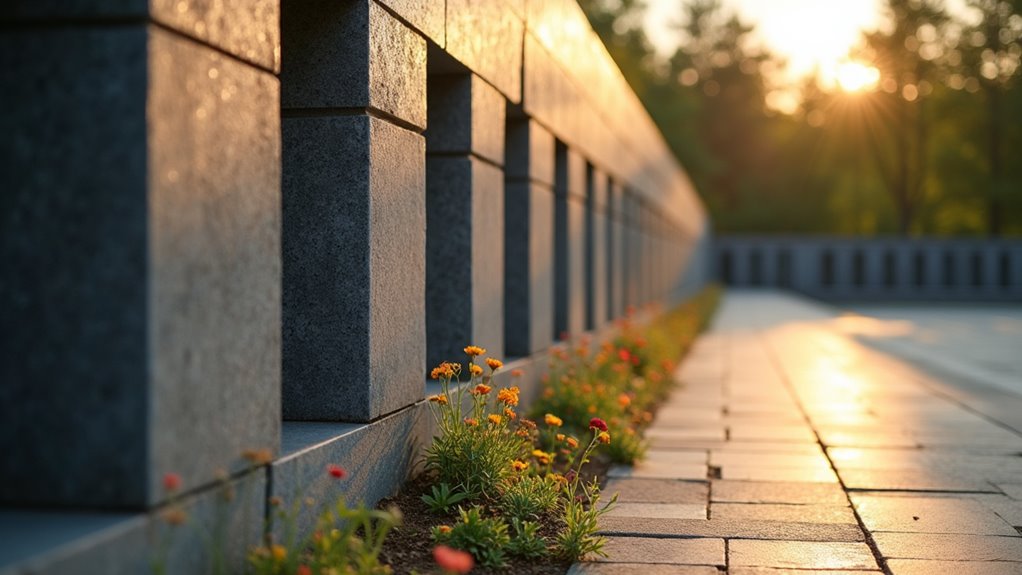
When visiting Holocaust memorial sites with older children, you’ll find Auschwitz-Birkenau in Poland offers the most extensive experience, while Berlin’s Memorial to the Murdered Jews of Europe provides powerful visual impact. Sachsenhausen near Berlin and Majdanek in Poland preserve authentic structures, and Theresienstadt in Czech Republic showcases children’s artwork from the ghetto. Lithuania’s Ponar Forest memorial honors mass execution victims. Proper preparation helps children process these emotional yet essential educational experiences that teach empathy and historical understanding.
- Auschwitz-Birkenau: Poland’s Most Significant Memorial Site
- Sachsenhausen: Exploring History Near Berlin
- Majdanek: A Preserved Testament in Lublin
- Theresienstadt: Art and Memory in the Czech Republic
- Ponar Forest: Lithuania’s Hidden Memorial
- Berlin’s Memorial to the Murdered Jews of Europe
- Preparing Your Family for These Educational Visits
- Age-Appropriate Discussions About Holocaust History
- Making Memorial Visits Meaningful Learning Experiences
- The Sum Up
Auschwitz-Birkenau: Poland’s Most Significant Memorial Site
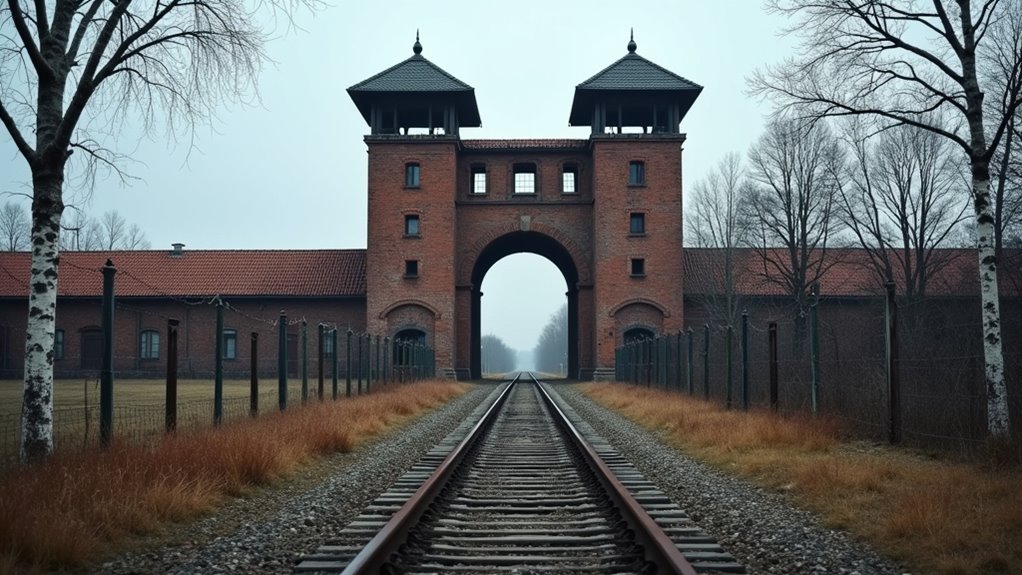
When planning an educational visit to Poland with older children, Auschwitz-Birkenau stands as the most significant Holocaust memorial site you can explore together. Located 50 kilometers from Kraków, this preserved complex includes two main sections: Auschwitz I and Auschwitz II-Birkenau, spanning nearly 192 hectares with 155 original structures.
You’ll witness authentic evidence of Nazi Germany’s systematic genocide, where approximately 1.1 million people died. The museum displays preserved personal belongings and exhibits that document victims’ lives before deportation.
Established in 1947 by former prisoners, it’s recognized as a UNESCO World Heritage Site. Entry to both Auschwitz I and II is free, though passes are required and can be purchased online or at the site.
Prepare older children for this emotionally challenging experience by discussing the historical context beforehand. The site serves as vital education about the Holocaust’s realities and humanity’s responsibility to prevent future genocides.
Sachsenhausen: Exploring History Near Berlin
If you’re staying in Berlin and want to visit a Holocaust memorial site without traveling far, Sachsenhausen concentration camp offers a powerful educational experience just 35 kilometers north in Oranienburg.
Opened in July 1936, this camp served as the prototype for the entire Nazi concentration camp system and housed approximately 200,000 prisoners during its operation.
Your visit will reveal how Sachsenhausen functioned as both an administrative center and training facility for SS officers.
You’ll see remnants of forced labor operations, including the brick factory where 2,000 prisoners worked daily.
The site preserves Station Z, the execution facility completed in 1942, where thousands were murdered. Casualties included Dutch freedom fighters, Russian POWs, and political leaders from Nazi-invaded countries.
When Soviet forces liberated the camp on April 22, 1945, only 3,400 inmates remained alive.
Majdanek: A Preserved Testament in Lublin
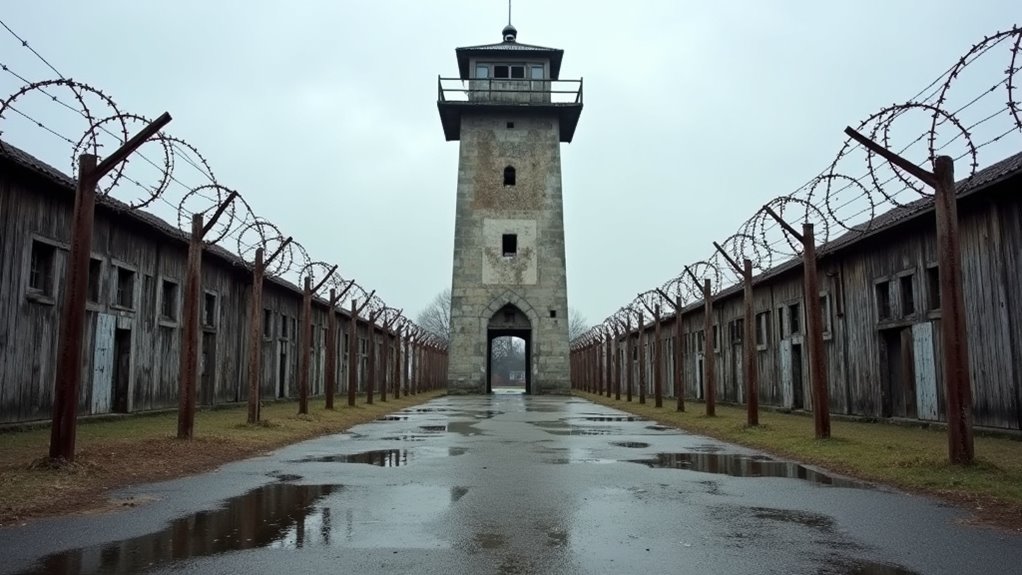
Moving from Germany to Poland, Majdanek near Lublin offers you and your family an extraordinarily preserved look at Nazi camp operations. Unlike other sites, the Soviet Red Army captured Majdanek virtually intact in July 1944, making it the first major concentration camp liberated with its infrastructure preserved.
You’ll find original barracks, gas chambers, and crematoriums that provide stark evidence of the horrors that occurred here. Between 1941 and 1944, approximately 500,000 prisoners passed through Majdanek, with around 360,000 murdered through starvation, disease, and systematic killing.
The camp’s preservation allows your family to understand the scale and brutality of the Holocaust. Inmates were forced to endure twelve-hour workdays during summer months alongside inadequate nutrition and overcrowded conditions. Plan adequate time for reflection, as the site’s authenticity creates a particularly powerful educational experience.
Theresienstadt: Art and Memory in the Czech Republic
Though established as a “model ghetto” to deceive the world, Theresienstadt reveals one of history’s most complex Holocaust sites where art became resistance. Located 30-40 miles northwest of Prague, this former 18th-century fortress housed over 150,000 Jews who passed through en route to extermination camps.
You’ll discover how prisoners created remarkable cultural works despite horrific conditions—overcrowding, disease, and starvation that killed 35,440 people. The SS used “Operation Embellishment” to fool Red Cross inspectors, building fake shops and cafés while secretly deporting 18,401 to Auschwitz. The controversial Jewish Council played a complex role in managing daily life and making the agonizing decisions about deportation selections.
Today’s memorial includes the ghetto remnants, Small Fortress prison, and crematorium. The 1989 museum displays preserved children’s artwork and cultural artifacts, making this site particularly meaningful for understanding how creativity survived amid unimaginable darkness.
Ponar Forest: Lithuania’s Hidden Memorial
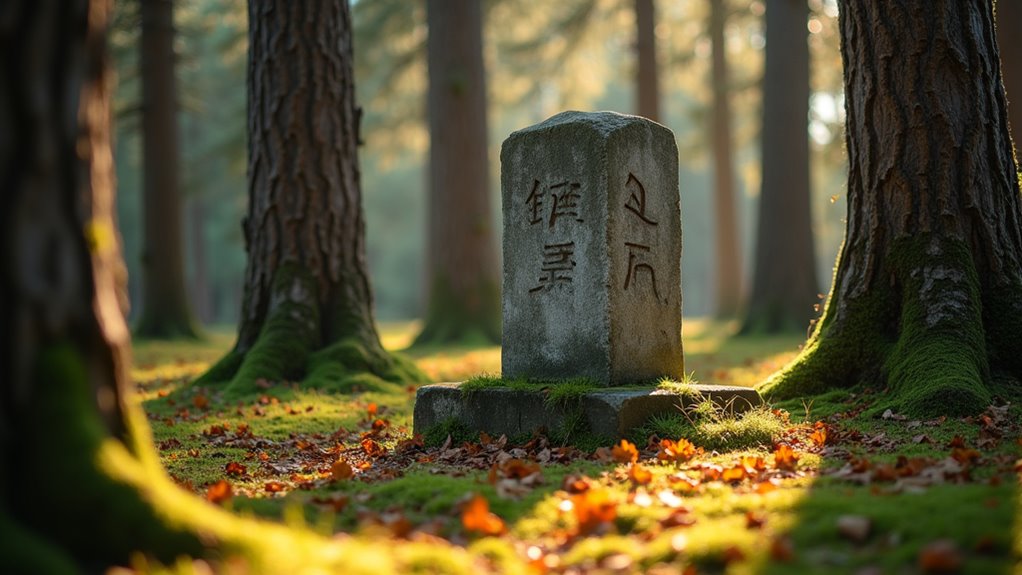
While Vilnius draws visitors to its charming Old Town, few realize that just ten kilometers southwest lies one of Europe’s most significant yet lesser-known Holocaust sites. Ponar Forest became Lithuania’s largest mass grave after German forces occupied Vilnius in June 1941. Up to 100,000 people perished here, including 70,000 Jews from the Vilna Ghetto.
You’ll find the Paneriai Memorial complex in a forest park setting, featuring preserved killing pits, multiple monuments, and a small on-site museum. The site can feel disorienting due to various memorials scattered throughout the grounds. SS guards and Lithuanian collaborators systematically forced groups of Jewish men into the forest for execution.
When visiting with older children, prepare them for the emotional weight of seeing where 90% of Lithuanian Jews were murdered—the highest rate in Nazi-occupied Europe.
Berlin’s Memorial to the Murdered Jews of Europe
When you step into Berlin’s Memorial to the Murdered Jews of Europe, you’ll encounter one of the world’s most powerful and unconventional Holocaust memorials. Located near Brandenburg Gate, this striking site features 2,711 concrete pillars of varying heights across 19,000 square meters.
Architect Peter Eisenman designed the abstract memorial to create disorientation as you walk through uneven pathways between towering stelae.
The memorial’s open design allows 24-hour access from all sides. You’ll find the underground Information Centre particularly meaningful for older children, featuring four themed rooms with family stories and victim biographies. The centre displays photographs, diaries, and farewell letters from Holocaust victims to illustrate the personal impact of this tragedy.
The centre’s open Tuesday through Sunday, 10:00-18:00, with free admission. This central location in Germany’s political heart makes it an essential educational stop for understanding Holocaust remembrance.
Preparing Your Family for These Educational Visits
Before visiting Holocaust sites with older children, you’ll need to prepare them emotionally and intellectually for these powerful experiences. Start with age-appropriate resources like the USHMM Learning Site or Holocaust Life Stories, which offer survivor testimonies and historical context for ages 7-18.
Connect the Holocaust to concepts older children understand, like fairness and human rights principles.
Prepare them for strong emotions by explaining that feeling sad or scared is normal. Teach coping strategies like taking breaks and deep breathing. Many sites display content warnings to help manage expectations.
Link your visit to their school curriculum for deeper understanding. Consider incorporating stories of Jewish resistance and resilience to provide a more balanced perspective beyond victimization narratives.
Plan post-visit discussions to process emotions and connect historical lessons to today’s world. This preparation transforms potentially overwhelming experiences into meaningful learning opportunities that foster empathy and critical thinking.
Age-Appropriate Discussions About Holocaust History
Since older children need concrete foundations before exploring complex historical events, start Holocaust discussions with a complete, clear definition that includes the timeline (1933-1945), geographic scope across Nazi-occupied Europe, and the systematic persecution of six million Jews alongside other targeted groups.
Focus on middle-school appropriate topics like Jewish life before the war, the impact of anti-Jewish measures such as wearing yellow stars, and themes of hiding, escape, and rescue. Delay graphic details about concentration camps until high school.
Use survivor stories and first-person accounts to build empathy while maintaining historical context. When incorporating visual materials, prioritize resources created from Jewish perspectives such as survivor drawings, poetry, and art rather than relying on perpetrator-created imagery. Connect lessons to your children’s curriculum through timelines and individual experiences, helping them understand this history’s significance without overwhelming their emotional development.
Making Memorial Visits Meaningful Learning Experiences
Although Holocaust memorial visits can profoundly impact older children, they’ll gain deeper understanding when you prepare them thoroughly beforehand. Start with virtual classroom tools and historic timeline activities to contextualize events. Watch Holocaust documentaries together, then explore survivor testimonies and multimedia resources from museums’ learning sites.
During visits, use museum apps for guided audio tours and encourage active engagement with exhibits. The real learning continues afterward through creative expression projects like recreating museum artifacts at home or developing comic strips based on survivor stories.
Foster meaningful reflection through structured discussions about human behavior impacts and essay writing about their experience. Students can also write letters to docents or Holocaust survivors to express how the museum experience affected them personally. Consider dramatic presentations or social-emotional learning activities that explore upstander roles, helping children process complex emotions while developing empathy and historical understanding.
The Sum Up
You’ve now discovered meaningful ways to introduce your older children to Holocaust history through these important memorial sites. Remember that you’re helping them understand one of history’s darkest chapters while building empathy and critical thinking skills. Take your time, follow their emotional cues, and don’t rush through these experiences. These visits will create lasting educational memories that’ll shape their understanding of human rights, tolerance, and the importance of standing against hatred.