

You’ll need to first verify your eligibility under Italy’s reformed citizenship laws—if you missed the March 2025 deadline, you’re limited to two generations back. Next, trace your Italian ancestor’s bloodline, confirm they didn’t naturalize before your next descendant’s birth, then gather essential records from Italian communes and apostille all foreign documents. Submit your complete package at your consulate appointment, then monitor status updates. The process becomes much smoother when you understand these crucial timing requirements.
- Determine Your Eligibility Under Current or Reformed Rules
- Identify Your Italian Ancestor and Trace the Bloodline
- Verify Your Ancestor’s Citizenship Status and Naturalization History
- Gather Required Civil Records for Each Generation
- Obtain Official Apostilles for Foreign Documents
- Secure Certified Italian Translations of All Documentation
- Research Consulate Requirements and Processing Times
- Book Your Appointment Before the March 27, 2025 Deadline
- Prepare Your Complete Application Package
- Submit Documents and Attend Your Consulate Interview
- Monitor Application Status and Respond to Additional Requests
- Receive Your Italian Citizenship Recognition and Register With AIRE
- The Sum Up
Determine Your Eligibility Under Current or Reformed Rules

Since Italy recently overhauled its citizenship laws, you’ll need to figure out which set of rules applies to your situation before diving into the application process.
Here’s the good news: if you filed your application or booked a consulate appointment before March 27, 2025, you’re grandfathered under the old system with no generational limits. You can trace back to great-grandparents or even further, as long as your ancestor was alive in 1861.
However, applications after May 24, 2025, face stricter requirements. You’ll need Italian-born parents or grandparents who held exclusively Italian citizenship when you were born.
Don’t panic if you don’t qualify—you can still pursue citizenship through Italy’s streamlined residency pathway. Another option exists if your parent or grandparent held Italian nationality at their death and maintained that status throughout their lifetime.
Identify Your Italian Ancestor and Trace the Bloodline
Once you’ve confirmed which rules apply to your case, the real detective work begins—tracking down your Italian ancestor and mapping out every generation that connects you to them. You’ll need to prove an unbroken bloodline through direct descendants, meaning no citizenship breaks along the way.
Start by identifying your Italian-born ancestor who emigrated after March 17, 1861. Here’s the pivotal part: they couldn’t have naturalized in another country before your next family member was born. If Great-Grandpa Giuseppe became an American citizen in 1920 but your grandmother was born in 1915, you’re golden.
Gather birth, marriage, and death certificates for everyone in your direct line. Each document needs official Italian translation and proper legalization—no shortcuts here. Remember that Italy recognizes no generational limits for citizenship by descent, so even distant Italian ancestors can potentially qualify you as long as the bloodline remains unbroken.
Verify Your Ancestor’s Citizenship Status and Naturalization History

After you’ve mapped out your family tree, the next essential step is proving your Italian ancestor never broke the citizenship chain through naturalization. This can make or break your application—if your ancestor became a U.S. citizen before their child was born, you’re out of luck.
Here’s what you’ll need to track down: For ancestors who arrived before 1906, check local and state courts where they lived.
Post-1906? Head to NARA for federal records.
Can’t find anything? That’s actually good news—request a Letter of No Record from USCIS.
Pro tip: Don’t overlook census records showing citizenship status or alien registration documents. ITAMCAP can help reconstruct your ancestor’s complete naturalization timeline by reviewing multiple sources including ship manifests, draft registrations, and civil documents to ensure you have the full picture.
Italian consulates require certified copies with official seals, so those family photocopies won’t cut it.
Gather Required Civil Records for Each Generation
While proving your ancestor maintained their Italian citizenship sets the foundation, you’ll now face the more tedious task of hunting down civil records from multiple countries and generations.
You’ll need birth certificates from each ancestor’s specific Italian commune—not just any records office. Contact the Civil Records Office directly in Italian, as they typically don’t respond to English correspondence. Request “extract summaries” that include parents’ names and birth dates; these work perfectly for citizenship applications.
Don’t forget marriage certificates for every generation, plus death certificates if your ancestor died in Italy. Your personal documents—birth certificate, marriage certificate, and any divorce records—complete the package.
Be prepared for potential delays as response times can vary significantly—some towns respond promptly while others may take weeks to process your request.
Every document needs apostilles and certified Italian translations before submission. It’s exhausting but absolutely essential.
Obtain Official Apostilles for Foreign Documents

Before you celebrate gathering all those precious civil records, you’ll hit another bureaucratic wall: apostilles. Think of apostilles as your documents’ passport stamps – they authenticate your records for international use under the Hague Convention. You’ll need them stapled to every foreign document: birth certificates, marriage records, death certificates, and divorce papers.
Here’s your game plan: contact your state’s Secretary of State office (they handle vital records apostilles). Submit official certified copies – never abstracts or short forms.
New York’s extra demanding, requiring notarization plus County Clerk authentication first. Federal documents from NARA or USCIS get apostilled through the U.S. Department of State. Processing times typically range from 1 to 4 weeks depending on the issuing authority and current workload.
Pro tip: scan everything before apostilling for translation purposes. If you’re applying directly in Italy, even federal documents need apostilles.
Secure Certified Italian Translations of All Documentation
Your freshly apostilled documents might as well be written in ancient hieroglyphics to Italian officials – they need certified Italian translations to process your citizenship application.
Here’s the tricky part: translation requirements vary wildly depending on where you’re applying. US consulates often accept simple, accurate translations without prior certification – they’ll verify and stamp them during your appointment.
But if you’re applying in Italy through a comune or Rome court, every single non-Italian document needs certified translation beforehand.
Don’t wing this yourself unless you’re fluent. I’ve seen applications rejected for grammar errors in verb tenses and gender concordance.
Professional translators understand technical essential statistics terminology that’ll save you headaches. Your translator must include their certificate with personal details, contacts, and signature for authenticity.
Remember that document discrepancies can derail your entire application, so ensuring translations accurately reflect the original documentation is crucial for meeting legal compliance standards.
Research Consulate Requirements and Processing Times

How dramatically will Law 74/2025 impact your citizenship timeline? If you booked your consulate appointment before March 27, 2025, you’re golden—your case follows the old unlimited generation rules.
But here’s what I’ve learned from helping friends navigate this maze: each consulate has quirky requirements beyond the standard list. Rome’s consulate might want specific church records, while New York demands extra apostilles.
You’ll need that essential birth certificate extract from your ancestor’s Italian municipality, plus negative certificates proving they never renounced citizenship. Don’t forget the non-refundable €600 fee that you’ll need to pay regardless of your application’s outcome.
Processing times vary wildly—I’ve seen six months in some locations, three years in others. Check your specific consulate’s website religiously; requirements change faster than Italian governments.
Book through Prenot@mi immediately once you’re document-ready.
Book Your Appointment Before the March 27, 2025 Deadline
Since Law 74/2025 created a hard cutoff that’ll forever change Italian citizenship eligibility, getting your appointment booked before March 27, 2025, at 11:59 PM Rome time became the most essential step in your entire application process.
I can’t stress this enough—your booking timestamp determines everything. If you secured that confirmation email before the deadline, you’re golden. You’ll get evaluated under the old unlimited generations rule, meaning you can claim citizenship through any Italian ancestor alive in 1861.
Miss the deadline? You’re stuck with the brutal two-generation limit. Only parents or grandparents count now.
Here’s what worked: obsessively checking consulate websites for last-minute cancellations, booking multiple family members separately, and screenshotting your confirmation as proof. That timestamp is your lifeline.
Even if you already hold multiple citizenships at birth, the new law automatically denies citizenship recognition for those born abroad with other nationalities.
Prepare Your Complete Application Package
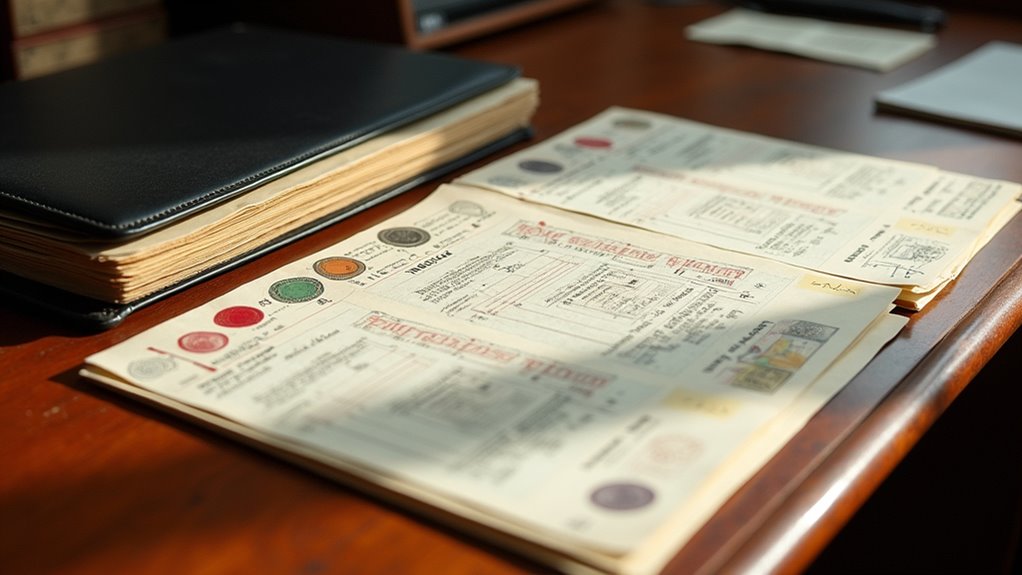
Booking your appointment was just the first victory—now comes the paperwork marathon that’ll make or break your application. You’ll need every ancestor’s birth, marriage, and death certificates in original format from Italian *comuni*, plus proof your Italian ancestor never naturalized before your next descendant’s birth.
For your side, gather long-form birth and marriage certificates for yourself and every direct descendant, complete with apostilles. Don’t forget divorce records if applicable and your kids’ birth certificates if they’re under 18.
Here’s the kicker: everything non-Italian needs certified Italian translations and apostille authentication. Cross-reference your consulate’s specific requirements—they’re pickier than Italian grandmothers about pasta sauce.
Applications are submitted at the Italian municipality’s civil register or Italian consulate abroad depending on your location and preference.
Organize chronologically and triple-check completeness before submission.
Submit Documents and Attend Your Consulate Interview
After you’ve wrestled your paperwork mountain into submission, it’s showtime at the consulate—and trust me, this isn’t your typical government office experience. You’ll confirm your appointment through the Prenot@mi portal between the 10th and 3rd day before your date.
Then show up with your picture ID, passport, and proof of residency. Arrive at least 30 minutes early to avoid cancellation, as there may be queuing and security checks before entry.
Here’s what happens: they’ll call your number, you’ll state your Italian-born ancestor’s name, then slide your entire document collection under the glass partition. The clerk will meticulously verify everything to confirm your entitlement.
Don’t worry about speaking Italian—this process relies purely on documentary evidence. Remember, you’re submitting originals that won’t be returned, so make peace with that beforehand.
Monitor Application Status and Respond to Additional Requests

Once your documents disappear behind that consulate glass partition, you’ll enter what I like to call the “citizenship limbo”—a period where patience becomes your most valuable asset.
Your consulate will provide specific guidelines on how often you can inquire about status updates—follow them religiously to avoid delays. Most have dedicated contact forms or email addresses for citizenship inquiries. Don’t bombard them with daily calls.
If you applied in Italy, contact your comune directly through their website or visit in person. Some offer online tracking systems with your application ID, though not all do.
Watch for documentation requests from the prefecture. They might need additional certificates like negative citizenship proof or historical residency records. Submit these promptly—delays here extend your entire timeline considerably. You’ll receive email notifications prompting you to check the portal for important communications throughout the process.
Receive Your Italian Citizenship Recognition and Register With AIRE
When that long-awaited email finally arrives confirming your Italian citizenship recognition, you’ll feel a mix of elation and “now what?” Don’t let the celebration cloud an important next step—AIRE registration isn’t optional paperwork you can tackle someday.
Here’s the good news: if you applied through a US consulate, they’ve already handled your provisional AIRE registration automatically. Your application’s been forwarded to your ancestor’s comune for final confirmation. You’re essentially in the system already.
However, you’ll still need to update your registration within 90 days if you move. Use the FAST IT portal or your consulate’s website under “Consular and AIRE Registry.” Upload your Italian passport and current residence proof—utility bills work perfectly.
This registration opens up voting rights, streamlined consular services, and hassle-free passport renewals. Remember that AIRE registration is both a right and duty for eligible Italian nationals, ensuring you maintain proper connection with the Italian government while living abroad.
The Sum Up
You’ve navigated the maze of documents, waited through countless bureaucratic delays, and finally hold that precious Italian passport. I’ll be honest—it’s exhausting, but worth every frustrating moment. Don’t let small setbacks derail you; I’ve seen people give up right before approval. Stay organized, be patient with consulate staff, and remember you’re claiming what’s rightfully yours. Your Italian ancestor would be proud you’re reconnecting with your heritage.