

Your family holidays will completely transform as your kids grow from babies to teens. You’ll shift from beach resorts with baby-proofed rooms to adventure destinations with zip-lining and cultural exploration. Planning evolves from your solo decisions to collaborative itinerary-building with teenagers who research destinations themselves. Accommodation needs change from cribs and soundproof rooms to private bathrooms and WiFi access. Entertainment preferences move from sensory play to historical landmarks and mythology-rich destinations that spark deeper conversations and independence.
- From Safety-First Resorts to Thrill-Seeking Adventures
- Planning Power Shifts From Parents to Co-Pilots
- Entertainment Preferences Transform With Age
- Accommodation Needs Change as Children Grow
- Educational Focus Evolves From Wonder to History
- Multi-Generational Travel Becomes More Complex
- Destination Types Shift With Development Stages
- Independence Levels Increase Throughout Childhood
- Bonding Opportunities Adapt to Life Stages
- Travel’s Impact on Development Changes Over Time
- Last Words
From Safety-First Resorts to Thrill-Seeking Adventures

As your children grow from wobbly toddlers to confident teenagers, your family vacation preferences will shift dramatically from bubble-wrapped safety to heart-pumping adventures. When your kids are ages 1-4, you’ll prioritize all-inclusive resorts with storytelling and fantasy experiences. Like 83% of millennial parents, you’ll choose worry-free destinations where safety trumps excitement.
Once your children hit ages 8-11, you’ll notice the shift. They’ll crave interactive experiences and educational variety during their identity quest years. With 74% of parents reporting that children over 7 love to travel, this age group becomes genuinely enthusiastic about vacation planning.
By ages 12-17, they’ll demand authentic thrills and historical adventures. You’ll find yourself moving from controlled resort environments to off-the-beaten-track destinations.
What started as supervised pool time evolves into zip-lining and cultural exploration, with your teens becoming co-pilots in planning these adrenaline-fueled family experiences.
Planning Power Shifts From Parents to Co-Pilots
While you once held complete control over vacation decisions, your school-aged children are now claiming their seats at the planning table as genuine co-pilots. This shift isn’t just about keeping kids happy—74% of parents report children aged 7-18 actively serve as co-pilots in trip planning, and it’s transforming family dynamics entirely.
Your digitally native kids are discovering destinations through social media and inspiring family adventures you’d never have considered.
When you involve them in planning, 84% of parents find their children become more adaptable and open to new experiences. Plus, 61% report that this collaboration directly boosts kids’ happiness and engagement during actual trips. Families are also embracing longer planning horizons, with many booking trips several months in advance to accommodate everyone’s input and preferences.
You’re not losing control—you’re gaining enthusiastic travel partners who bring fresh perspectives to your family adventures.
Entertainment Preferences Transform With Age

From those first mesmerizing baby videos to teenage TikTok binges, your family’s entertainment journey reveals a fascinating evolution that reshapes how you connect across the years.
During those precious infant months, you’ll find yourself co-viewing simple YouTube nursery rhymes together 89% of the time, sharing childhood favorites that spark nostalgic bonding moments.
As toddlers discover tablets, Netflix and Disney+ become your go-to platforms for educational content that entertains while teaching. Nearly half of families now embrace gaming together on platforms like Roblox and Minecraft as children develop their digital skills.
School-age years bring peak co-viewing satisfaction—77% of kids genuinely enjoy family screen time, making video content your third most important bonding activity.
But preteens shift toward TikTok and Instagram, while you might find yourself gaming alongside them on Roblox or Minecraft.
Teenagers still value family time, yet increasingly choose independent viewing, leaving you balancing connection with their growing autonomy.
Accommodation Needs Change as Children Grow
Just as your entertainment needs shift with each developmental stage, your accommodation requirements undergo equally dramatic changes that’ll reshape how you approach family travel planning.
When you’re traveling with infants, you’ll prioritize cribs, high chairs, and soundproofed rooms near medical facilities for those essential nap schedules.
Toddlers demand secure play areas with gated spaces and soft flooring for safety.
School-age children need dedicated homework spaces and prefer accommodations near outdoor play areas rather than cramped apartments.
As your kids become preteens, individual privacy becomes essential – they’ll want separate bedrooms with study desks and tech outlets. Understanding household characteristics helps accommodation providers better design family-friendly spaces that meet these evolving developmental needs.
Teenagers completely transform your booking criteria, requiring private bathrooms, strong WiFi, cooking facilities for independence, and locations near social hubs that support their growing autonomy.
Educational Focus Evolves From Wonder to History
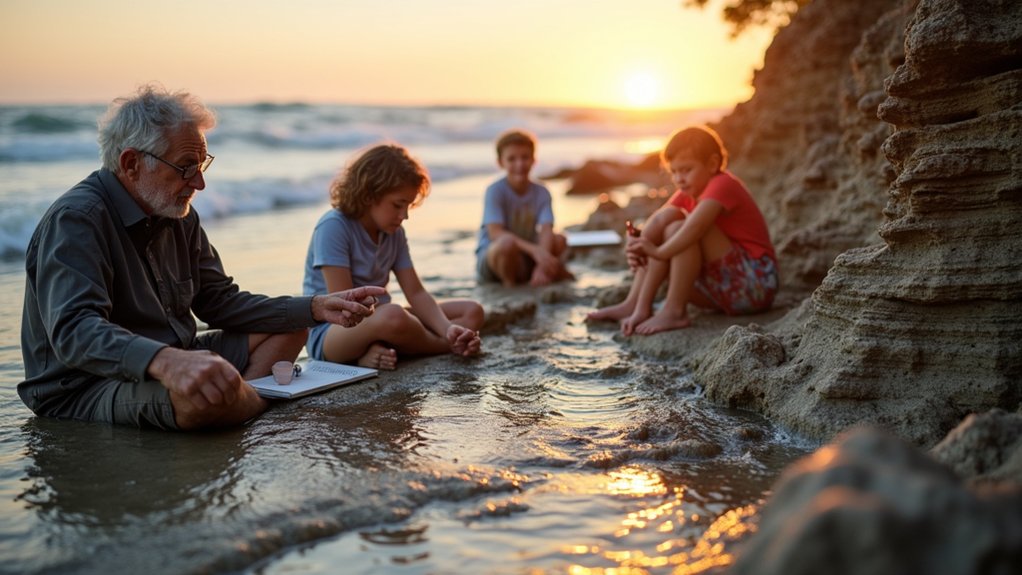
As your family’s travel experiences accumulate over the years, you’ll notice a fascinating shift in how your children engage with educational opportunities during vacations. Your baby’s wonder begins through simple sensory exploration—touching sand or feeling grass while you provide security in unfamiliar settings.
As toddlers emerge, they’ll start learning basic geography through map reading and wildlife observation during nature hikes.
School-age children transform abstract concepts into reality at historical landmarks and interactive museum exhibits. The U.S. Department of Education shows traveling kids score higher on achievement tests, thanks to these immersive experiences.
Teenagers can dive deeper into cultural understanding by learning basic phrases in the local language, which helps them connect more authentically with destinations and locals they encounter.
Multi-Generational Travel Becomes More Complex
While educational opportunities remain important throughout your family’s travel journey, the dynamics become substantially more intricate when you decide to include grandparents, aunts, uncles, and cousins in your vacation plans. You’re not alone—74% of parents now embrace vacations involving extended family, and 58% of Millennial and Gen Z parents plan to include extended family in 2025.
However, you’ll face significant challenges. Affordability tops the list, with 73% of parents citing cost as the biggest obstacle. The average family spent $8,052 on travel in 2024—a 20% increase.
You’ll need accommodations balancing connection and privacy, considering all-inclusive resorts or large vacation rentals. Many luxury resorts now offer flexible accommodations such as private villas alongside family-friendly spaces and adults-only zones to meet these diverse needs. Sixty-one percent of parents turn to travel advisors for these complex itineraries, recognizing that coordinating multiple generations requires professional expertise.
Destination Types Shift With Development Stages

Your destination choices will transform dramatically as your children grow, moving from simple, low-stimulation environments great for infants to culturally-rich adventures that capture teenagers’ imaginations.
During the infant stage, you’ll gravitate toward familiar beachfront spots like Florida’s Gulf Coast or easy Caribbean getaways that prioritize your relaxation.
Toddlers open up European possibilities—Spain and Italy’s walkable cities become viable with their kid-friendly dining scenes.
Once your kids hit school age, nature destinations like Costa Rica or Colorado ski resorts introduce mild adventure. Many families now choose destinations that emphasize sustainability and conservation, reflecting the growing trend toward eco-tourism.
Pre-teens develop interests in places like Greece, where mythology comes alive, while cultural cities gain appeal.
Independence Levels Increase Throughout Childhood
When your baby first grasps a toy and transfers it between tiny hands, you’re witnessing the beginning of a remarkable independence journey that’ll reshape every family vacation for the next two decades.
At first, you’ll carry everything while your toddler discovers “I can do it myself” with simple tasks like pushing their arm through sleeves.
By age three, they’re asking “why” about every destination detail and solving small problems independently.
Your school-age child will confidently navigate hotel pools and help with packing, while your teenager wants input on itinerary planning.
Each developmental stage brings new freedoms—from your preschooler riding scooters to your adolescent exploring gift shops alone.
You’ll gradually shift from managing every detail to becoming their travel consultant, watching them build the confidence that’ll eventually fuel their own adventures. This foundation of early brain development established during these formative travel experiences creates lasting patterns for how they’ll approach new environments and challenges throughout their lives.
Bonding Opportunities Adapt to Life Stages

As your children grow, the moments that bring you closest together shift dramatically from snuggling during story time to conquering hiking trails as a team. When your kids are preschoolers, you’re their “gatekeeper” to activities—teaching them to ride bikes or playing physical games that build trust through shared accomplishments. These early co-activities create lasting memories where they’ll remember you taught them foundational skills.
As children become reserved tweens, nature settings often discover deeper conversations that don’t happen at home. Adventure activities like kayaking or zip-lining work especially well for disconnected teens, encouraging role shifts where you become equals tackling challenges together. These shared experiences help establish long-term health patterns that extend far beyond the immediate fun.
Fathers particularly excel at roughhousing with younger kids, while camping rituals like sharing daily highlights foster emotional literacy across all ages.
Travel’s Impact on Development Changes Over Time
Beyond these meaningful connections, family travel actually rewires your child’s brain in measurable ways that shift dramatically as they grow. During infancy, novel sights, sounds, and smells from travel literally build your baby’s brain architecture, laying foundations for future learning as their auditory system matures.
As toddlers, your child develops emotional tolerance and mental agility traversing unfamiliar places—32% of parents report kids becoming more relaxed in new environments. Managing unexpected travel delays and routine changes during this stage helps develop crucial patience and self-control skills.
Early childhood brings cognitive boosts through environmental enrichment, with traveling children scoring higher on academic tests according to U.S. Department of Education research.
School-age travel builds empathy and communication skills through diverse social interactions, while adolescent brains—in their sensitive developmental period—benefit from complex travel environments that catalyze healthy changes extending into adulthood.
Last Words
You’ll find that each stage brings its own magic – from your toddler’s wonder at simple beach waves to your teenager’s Instagram-worthy mountain summit shots. Don’t mourn the lost simplicity of early family trips; instead, embrace how your adventures deepen and expand. You’re not just creating vacation memories anymore – you’re building lifelong travelers, confident explorers, and young adults who’ll treasure these evolving experiences long after they’ve left your nest.