
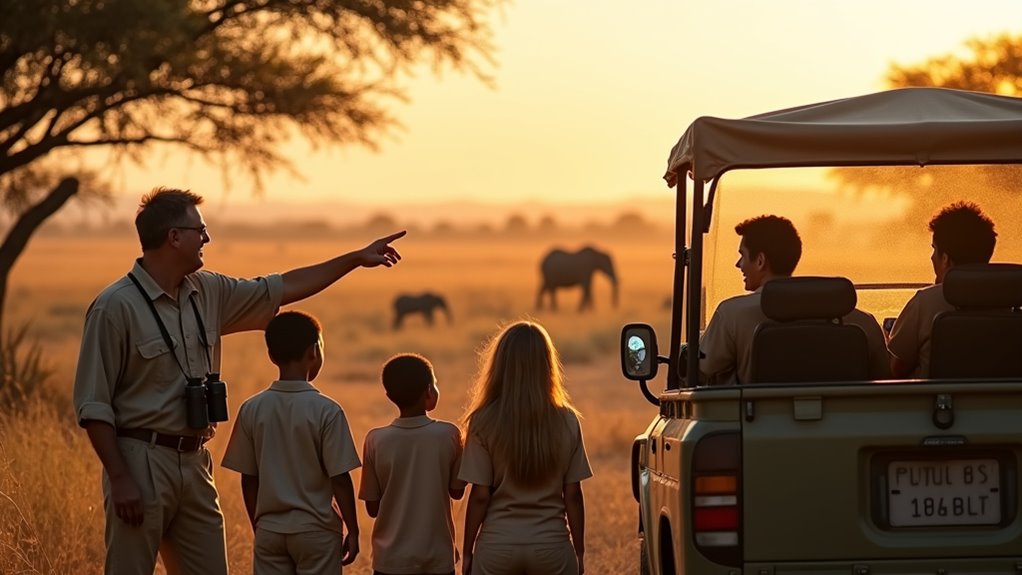
Choose Kruger’s southern region for the highest wildlife densities, entering through Crocodile Bridge Gate for quick animal encounters. Book family-friendly accommodations with spacious rooms and opt for self-drive safaris to maintain flexibility with children. Drive slowly below speed limits, take detours like H11’s “leopard alley,” and plan regular picnic stops every two hours. Bring quality binoculars, assign map navigation tasks to kids, and book guided night drives to spot nocturnal predators. These strategic choices will transform your family’s safari experience.
- Choose the Southern Region of Kruger Park for Best Game Viewing
- Enter Through Crocodile Bridge Gate for Quick Wildlife Sightings
- Select Family-Friendly Accommodations With Open Movement Areas
- Opt for Self-Drive Safaris to Maintain Flexibility With Children
- Drive Slowly and Take Detours for Maximum Animal Spotting
- Pack Essential Comfort Items and Sun Protection
- Bring Educational Materials and Wildlife Identification Tools
- Provide Quality Binoculars for Enhanced Viewing Experiences
- Book at Least One Guided Safari Drive
- Experience Nocturnal Wildlife on Nighttime Guided Drives
- Assign Navigation Tasks and Map Activities to Children
- Plan Regular Rest Stops at Picnic Areas Throughout the Park
- The Sum Up
Choose the Southern Region of Kruger Park for Best Game Viewing
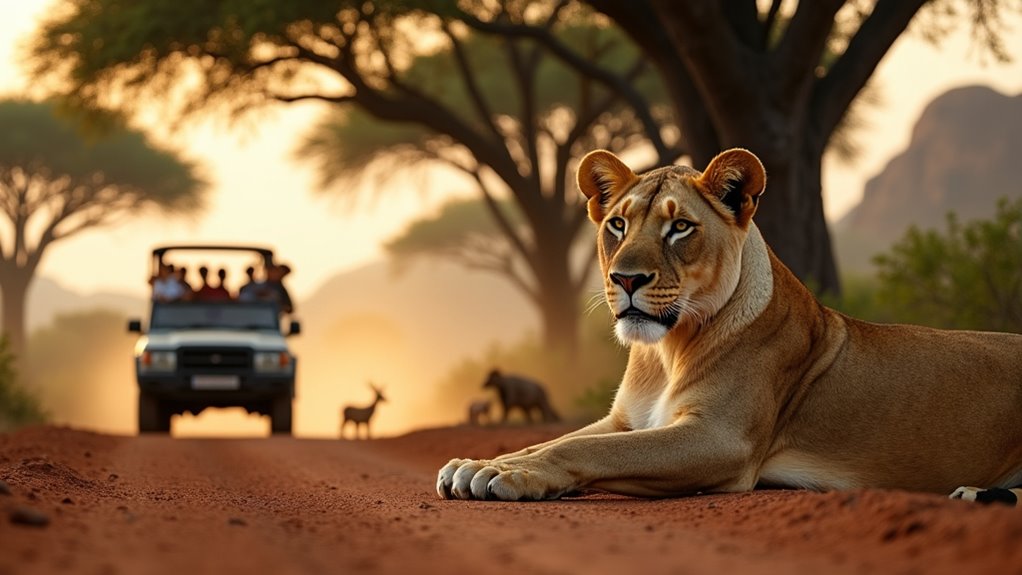
When planning your family’s Kruger adventure, you’ll want to focus on the southern region where wildlife congregates in the highest densities throughout the park. You’ll encounter all of the Big Five here, including rhinos, leopards, and elephants in abundance.
The permanent water sources from the Sabie, Sand, and Crocodile Rivers draw animals year-round, making sightings more predictable for families with young children.
This region offers the park’s best leopard and wild dog viewing opportunities, with predator concentrations far exceeding northern areas.
You’ll find convenient access from Johannesburg through main camps like Skukuza and Lower Sabie.
The excellent road network supports safe self-driving, while open savannah landscapes provide better visibility for spotting wildlife during your family safari. However, be prepared to exercise patience for sightings as the southern regions can get busy, especially during peak seasons.
Enter Through Crocodile Bridge Gate for Quick Wildlife Sightings
For families seeking immediate wildlife encounters, Crocodile Bridge Gate serves as Kruger’s most rewarding eastern entrance. You’ll find high game concentrations in grasslands right near the gate, making it great for families with young children who can’t wait long for sightings.
Head straight to nearby waterholes like Gezamtombi and Gomondwane, where herbivores gather regularly. The adjacent Crocodile Bridge Rest Camp offers essential supplies and fuel, while Hippo Pools sits just 8 km away for guaranteed hippo and crocodile viewing.
Start your drive early morning on the S25 Crocodile River Road for raptors and riverside wildlife. The H4-2 toward Lower Sabie promises Big Five encounters and offers excellent opportunities to spot cheetahs on the open savannah grassland.
Select Family-Friendly Accommodations With Open Movement Areas
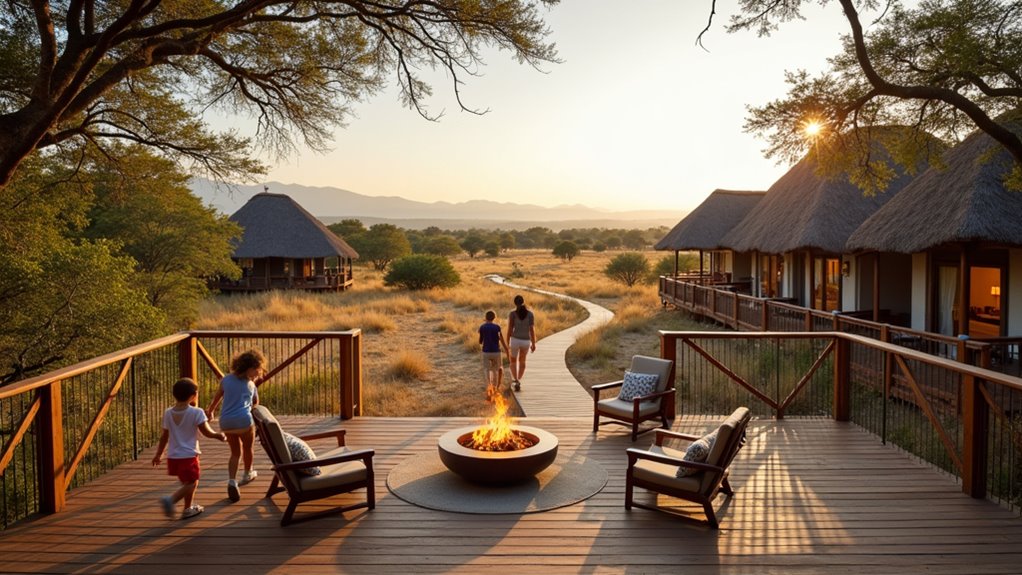
Your accommodation choice dramatically impacts your family’s comfort and freedom throughout your Kruger safari experience. Suite-based lodging offers spacious rooms with interconnecting options, letting families stay close while maintaining privacy. You’ll find additional beds in lounge areas great for younger children, plus private decks for outdoor relaxation.
Consider tent accommodations if you’re seeking adventure. Family chalets provide curtain-divided sleeping areas, while larger tents accommodate everyone together. You can book adjacent tented suites for expanded groups. Keep in mind that tents are usually spaced apart from each other, so consider your family’s comfort level with this separation.
Check age restrictions carefully. Some lodges welcome all ages with ground-level access, while others restrict children under eight. Look for properties with kids’ programs, swimming pools, and craft activities.
For ultimate flexibility, choose exclusive-use villas with private guides and dedicated vehicles.
Opt for Self-Drive Safaris to Maintain Flexibility With Children
Self-drive safaris give you complete control over your family’s game viewing experience, letting you adapt to children’s needs without the constraints of group tours or guide schedules. You’ll have freedom to depart and return within gate hours, pause for extended wildlife viewing, and adjust routes based on your children’s comfort levels and energy.
Maintain strict speed limits: 50 km/h on tar roads and 40 km/h on gravel roads. This prevents accidents and animal strikes that result in heavy fines. Keep all passengers inside vehicles except at designated safe zones. Children must keep limbs fully contained, and close windows when monkeys or baboons approach to prevent theft. Keep conversations soft and quiet to avoid disturbing wildlife and increase your chances of spotting animals.
Stay on designated roads only—off-road driving is illegal and damages ecosystems. Maintain 20-30 meter distances from animals.
Drive Slowly and Take Detours for Maximum Animal Spotting
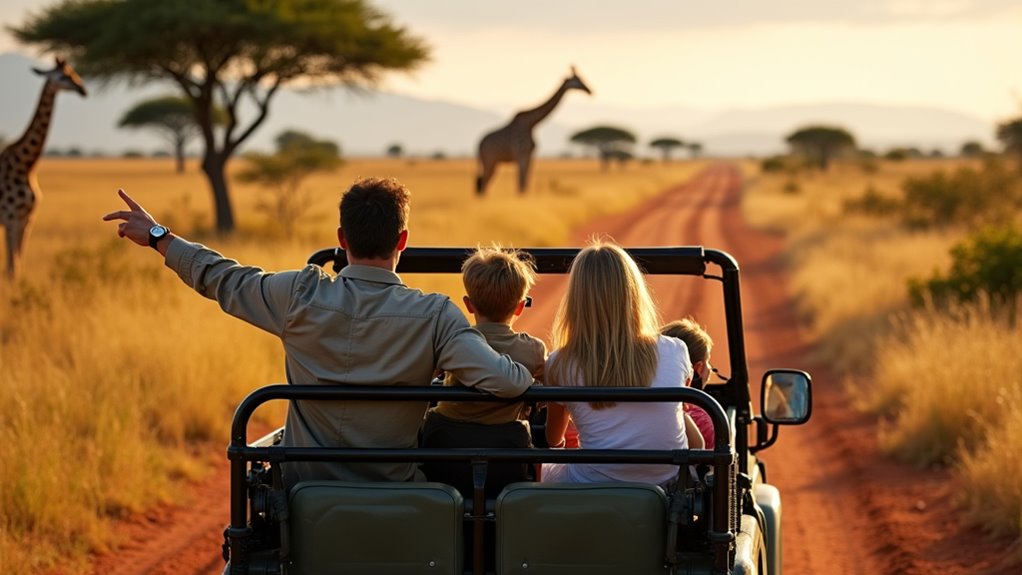
When you slow down your driving speed well below Kruger’s speed limits, you’ll dramatically increase your chances of spotting wildlife while keeping your family safe. Slower speeds prevent spooking animals and give you better vehicle control during unexpected encounters.
Focus your family’s attention on prime roads like H1-2 and H1-3 for lions, or H7’s 44km stretch for cheetahs. Take strategic detours down H11’s first 8km—guides call it “leopard alley”—and explore S110’s 22km loop around Berg En Dal for consistent leopard sightings. During the wet months from November to March, drive even slower through the thicker bush to navigate safely and improve your spotting chances of elusive animals.
Don’t rush between locations. Instead, plan morning and afternoon drives through central grasslands north of Tshokwane, where you’ll find the park’s largest herds and big cats. Remember, deliberate pacing shows respect for wildlife while creating memorable family moments.
Pack Essential Comfort Items and Sun Protection
Before you head out on your first game drive, pack strategically to keep your family comfortable and protected throughout those long safari hours. Choose lightweight cotton or linen clothing in neutral earth tones like khaki and olive green – they’ll keep you cool while blending into the landscape. Pack layers for chilly morning drives and long-sleeved options for sun and mosquito protection.
Don’t forget essential sun protection: SPF 30-50 sunscreen, wide-brimmed hats, and quality sunglasses. Bring comfortable closed-toe shoes for bush walks and sandals for lodge relaxation. Pack a basic first aid kit with pain relievers and anti-motion sickness tablets. Consider anti-malarial prophylaxis if you’re visiting malaria hotspots within the park.
Carry reusable water bottles, portable power banks for your camera, and lightweight daypacks to organize everything efficiently during those extended wildlife viewing sessions.
Bring Educational Materials and Wildlife Identification Tools
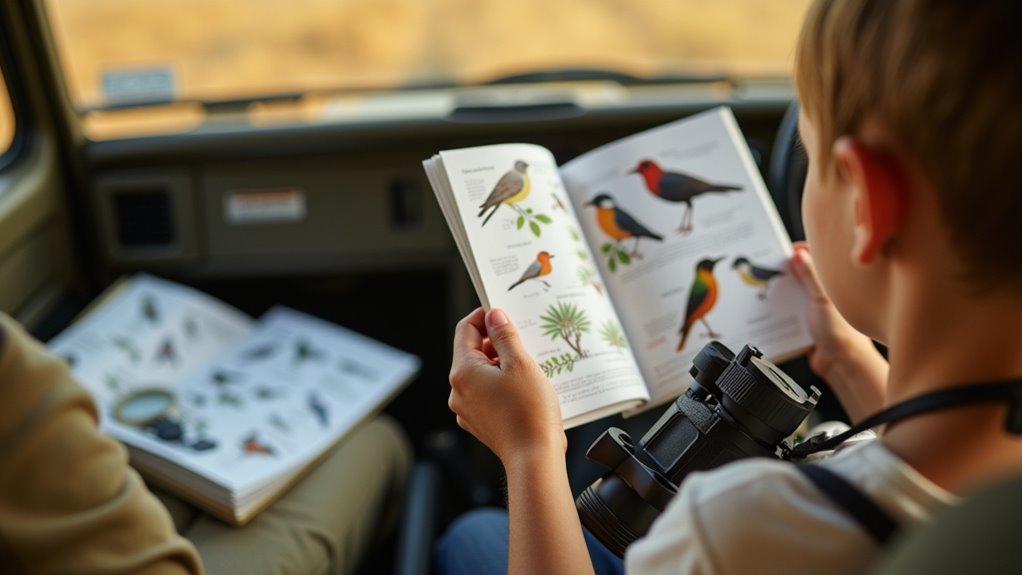
Beyond packing the right gear, you’ll want to arm your family with knowledge that transforms random animal sightings into meaningful wildlife encounters. Pick up wildlife identification books in Hoedspruit or Nelspruit before entering the park, or download Kindle versions for easy access during drives. These guides help distinguish antelope species and explain animal behaviors your kids will witness.
Once inside, check rest camp sightings boards daily—they’re updated with recent animal locations and can direct your drives toward active wildlife areas. Download park maps for navigation and route planning.
Consider booking a guided safari on your first day; rangers teach spotting techniques and share conservation stories that’ll improve your family’s self-drive success throughout the trip. Plan your wildlife viewing during the cooler parts of early morning and late afternoon when animals are most active and easier to spot.
Provide Quality Binoculars for Enhanced Viewing Experiences
Since Kruger’s wildlife often appears at considerable distances, quality binoculars transform fleeting glimpses into detailed observations that’ll captivate your entire family.
Choose 8×42 or 10×42 configurations for *ideal* magnification and light-gathering capability. The 8x option provides wider fields of view, great for tracking fast-moving animals, while 10x offers enhanced detail for spotting distant wildlife.
Invest in one pair per couple minimum – you won’t want to miss action while sharing. Quality binoculars also enhance safety by allowing you to observe potentially dangerous animals from a secure distance.
Look for rubber-armored, waterproof models with fully multi-coated optics to handle Kruger’s dusty, humid conditions. Brands like Nikon Prostaff, Vortex Viper HD, or Swarovski NL Pure deliver exceptional clarity and durability.
Compact 8×32 models work well for children, being lighter and easier to handle during extended game drives and walking safaris.
Book at Least One Guided Safari Drive
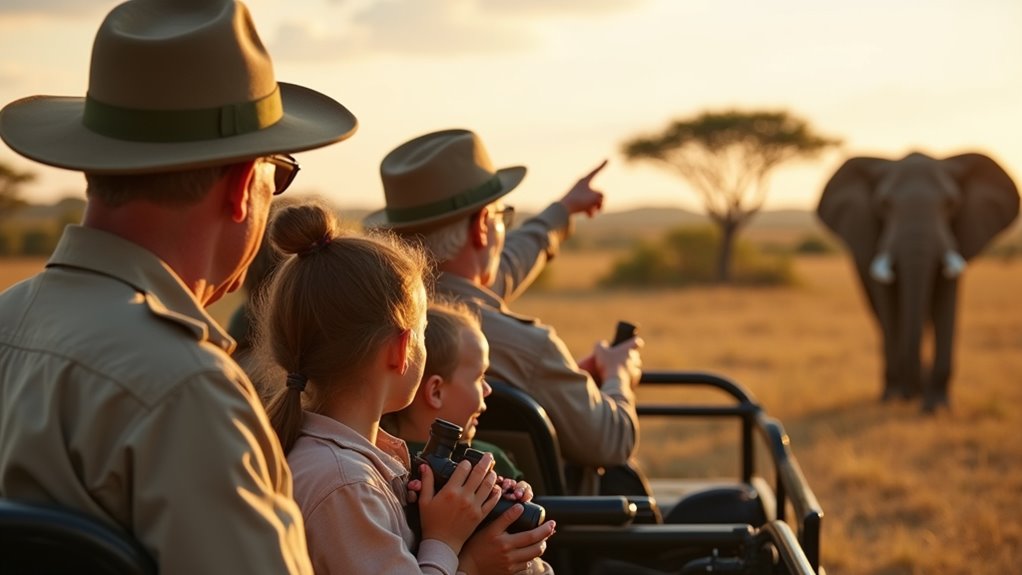
While personal binoculars will help you spot wildlife, you’ll maximize your family’s safari experience by booking at least one guided drive with an expert ranger. These experienced guides possess intimate knowledge of animal behavior and terrain, dramatically increasing your chances of spotting elusive species like cheetahs and rhinos.
They share real-time sightings with other guides and park staff, creating a network that leads to more wildlife encounters than you’d achieve self-driving.
Open safari vehicles provide elevated visibility and immersive sensory experiences your family can’t get from regular cars. Professional guides handle all safety logistics while sharing fascinating insights about ecology and animal behavior.
You’ll eliminate driving stress and focus entirely on wildlife spotting. These guided experiences also offer excellent birding opportunities due to Kruger’s incredible avian diversity, adding another layer of discovery for nature-loving families. Book early for popular family-friendly options, choosing between full-day adventures or convenient half-day drives from Hazyview.
Experience Nocturnal Wildlife on Nighttime Guided Drives
After sunset in Kruger, an entirely different world awakens that most visitors never witness. You’ll experience more action at night than during day drives, as hunters stalk under darkness cover while grazers and browsers feed actively with less energy loss.
Book guided night drives to safely observe nocturnal specialists. Watch serval cats leap three meters for birds, listen for bushbabies’ high-pitched cries echoing through darkness, and spot hyenas beginning their hunts. Leopards glide silently through dense foliage, while porcupines emerge from burrows to forage up to 15 kilometers nightly. These spotted hyenas live in a matriarchal society, making them unique among carnivores you might encounter.
Your guide’s spotlight reveals creatures you’d never see otherwise—civets following well-trodden paths, aardvarks digging for termites with their 30-centimeter tongues, and African spotted eagle owls hunting near Skukuza. Night drives unveil Kruger’s hidden wildlife theater.
Assign Navigation Tasks and Map Activities to Children
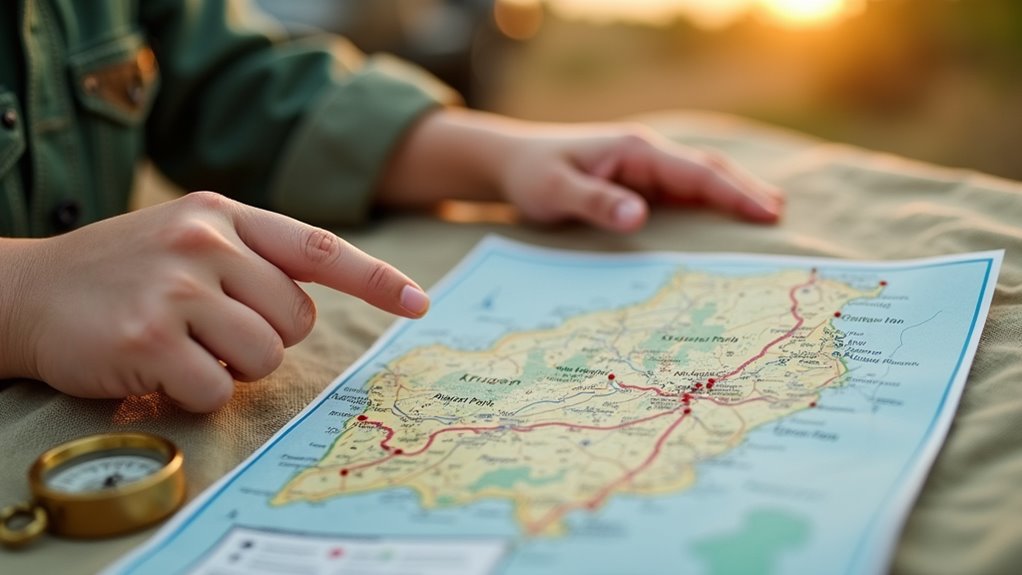
Transform your children into active safari participants by assigning them navigator duties using Kruger’s detailed park maps. Give older kids the official “Navigator for the Day” title and tasks like spotting waterholes and suggesting safari routes. This involvement builds genuine excitement during self-drive journeys while teaching valuable navigation skills.
Access Kruger’s map menu to toggle layers showing points of interest and routes. Click icons for location details, then save maps to your Google Maps account for easy phone access. Plan routes that include loops like Mlambane for off-main-road sightings, driving slowly between camps. Remember to always respect speed limits while exploring with your family for both safety and optimal wildlife viewing opportunities.
Combine map work with tracking activities—have children identify animal footprints at rest stops and plot locations on their maps. Tailor tasks to each child’s age for sustained engagement throughout your safari adventure.
Plan Regular Rest Stops at Picnic Areas Throughout the Park
Since children’s attention spans naturally wane during long game drives, strategic rest stops at Kruger’s well-equipped picnic areas will refresh your family and create memorable moments away from the vehicle.
Tshokwane offers the most convenient central location between major camps, though expect crowds during peak times. For quieter experiences, head to Makhadzi near Mozambique’s border or Babalala between Punda Maria and Shingwedzi camps. N’khulu provides excellent river views and wildlife watching opportunities along the Sabie River.
You’ll find gas braai facilities and hired “Skottels” at all sites, with attendants handling cleanup. Plan stops every two hours to prevent restlessness. Keep food secured during your visit, as monkeys and baboons may attempt to steal items from unattended picnic tables.
Wheelchair-accessible facilities are available at northern locations like Babalala, ensuring comfortable breaks for all family members while maximizing wildlife viewing opportunities.
The Sum Up
You’ll create unforgettable memories by following these practical safari tips. Remember, safety comes first—keep car doors locked, don’t feed animals, and stay alert on the roads. Pack plenty of water, snacks, and entertainment for the kids. Most importantly, embrace the unexpected moments when wildlife surprises you. Kruger’s magic lies in its unpredictability, so stay flexible with your plans and enjoy every second of this incredible family adventure together.