

When your family’s delayed flight disrupts your vacation, you’re entitled to €250-€600 per passenger under EU261 rules. First, verify your flight departed from or arrived in the EU with at least a 3-hour delay. Document everything: boarding passes, arrival times, and airline communications. Submit claims within six months, request pre-filled forms from customer service, and track responses within 14 days. If denied, escalate to Alternative Dispute Resolution for expert evaluation and guidance on maximizing your compensation recovery.
- Determine Your Flight’s Eligibility for Compensation Under EU261 Rules
- Calculate the Required Delay Threshold Based on Flight Distance
- Gather Essential Flight Documentation and Booking Records
- Document Your Arrival Time at the Final Destination Airport
- Verify the Delay Was Not Due to Extraordinary Circumstances
- Submit Your Compensation Claim Within the Legal Deadline
- Request Pre-Filled Compensation Forms From Your Airline
- Track Your Airline’s Response Within the 14-Day Window
- Escalate to Alternative Dispute Resolution if Initial Claim Is Denied
- The Sum Up
Determine Your Flight’s Eligibility for Compensation Under EU261 Rules

Before you start gathering receipts and drafting compensation letters, you’ll need to confirm your flight actually qualifies under EU261 regulations.
Your flight’s covered if it departed from any EU airport, regardless of which airline operated it. If you flew into the EU from outside, only EU carriers like Lufthansa, British Airways, or Ryanair qualify you for compensation.
Check that your delay or cancellation wasn’t caused by extraordinary circumstances like severe weather or air traffic control issues. The airline must prove these were beyond their control.
You’ll also need a confirmed reservation with proper check-in completed by the deadline. Both paid tickets and frequent flyer awards count, but free employee tickets don’t qualify for compensation. Plus, you must have checked in at least 45 minutes before the scheduled departure time to maintain your eligibility for compensation under these regulations.
Calculate the Required Delay Threshold Based on Flight Distance
Once you’ve confirmed your flight qualifies for EU261 protection, you’ll need to measure your delay against specific distance-based thresholds that determine compensation amounts.
For short-haul flights under 1,500 km, you’ll need a 3-hour delay to claim €250 per passenger.
Medium-haul flights (1,500-3,500 km) require the same 3-hour threshold but offer €400 compensation.
Long-haul flights over 3,500 km also need 3 hours of delay, providing €600 per passenger. Remember that you can initiate your claim up to six years after your original scheduled departure date, giving you substantial time to pursue compensation even for older family trips.
Gather Essential Flight Documentation and Booking Records
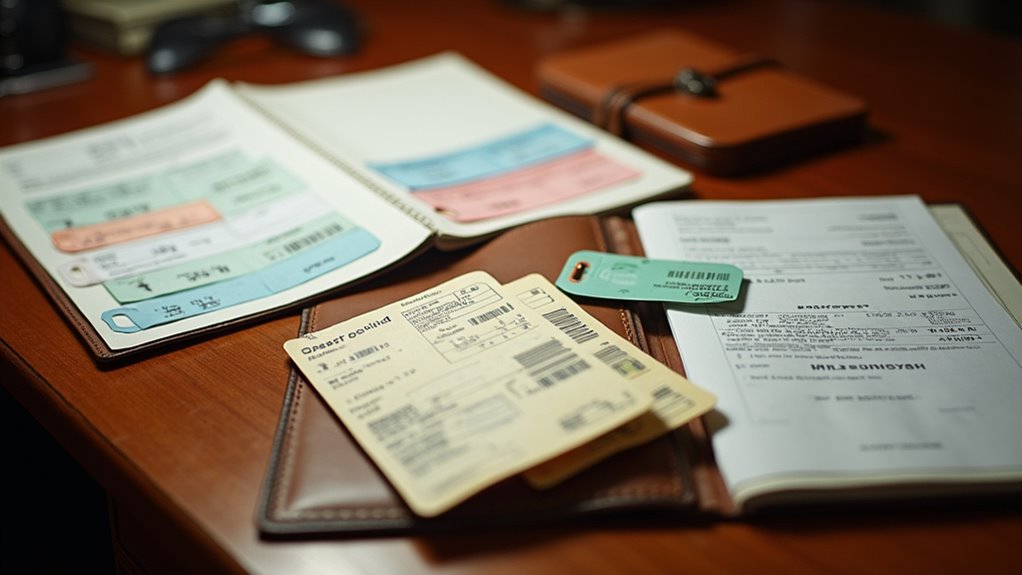
When your family’s vacation gets derailed by flight delays, you’ll need solid documentation to build a winning compensation claim. Start by securing your boarding passes—they’re your proof you were actually on that delayed flight. Grab your ticket confirmations, e-ticket receipts, and booking references to validate your reservation details.
Next, collect delay confirmation records. Screenshot airline notifications explaining the disruption, snap photos of departure boards showing delays, and document any official airline communications.
Don’t forget expense receipts for meals, accommodation, or alternative transportation during your wait. Keep both digital and physical copies of all documentation to ensure you have backup records in case one format becomes inaccessible.
Organize everything immediately while details are fresh. Include witness contact information from fellow passengers and notes about airline staff interactions. Match all documents against airline records for consistency—incomplete paperwork often leads to rejected claims.
Document Your Arrival Time at the Final Destination Airport
While gathering your initial flight documents sets the foundation, pinpointing your exact arrival time at your destination becomes the make-or-break factor for your compensation claim. You’ll need official proof from airline records or your boarding pass timestamp showing when you actually disembarked.
Don’t rely on memory—grab screenshots of departure boards displaying actual arrival times and snap photos of gate information. Request written confirmation from airline staff immediately, as they can provide documentation specifying the exact delay duration. Email communications from the airline about your disruption serve as timestamped evidence.
Calculate carefully: EU regulations require three hours minimum delay, while DOT rules need six hours for international flights. Your actual arrival time minus scheduled arrival time determines your €600 compensation eligibility. Keep in mind that compensation depends on delay at final destination, not departure delay, making your arrival documentation absolutely critical for successful claims.
Verify the Delay Was Not Due to Extraordinary Circumstances

After you’ve documented your arrival time, the airline’s next move will likely involve claiming “extraordinary circumstances” to dodge paying compensation. Don’t accept their word blindly—they must prove the delay was genuinely unavoidable and outside their control.
Airlines often blame technical issues, but courts consistently rule these don’t qualify as extraordinary. Your airline’s staff strike? That’s their internal problem, not your financial burden.
However, legitimate circumstances include severe weather that actually grounded flights, air traffic control strikes, or bird strikes.
Demand specific evidence from the airline. Vague explanations like “operational reasons” won’t cut it. Check weather reports for your departure day and verify if other airlines faced similar disruptions.
Remember that the burden of proof lies with the airline to demonstrate that extraordinary circumstances existed and that the event was unavoidable.
If their explanation seems fishy, challenge it—you’re likely entitled to compensation.
Submit Your Compensation Claim Within the Legal Deadline
Once you’ve established the airline’s responsibility, don’t let time slip away—you’ve got a generous window to file your claim, but it won’t stay open forever.
In the UK, you’ve got six years from your departure date (five in Scotland) to file your EU261 claim—much longer than most EU countries that typically allow two to three years. This means your delayed family holiday from 2020 is still claimable in 2025.
However, don’t wait until the last minute. Submit your claim as soon as possible, ideally within six months of your disruption.
Gather your boarding passes, delay confirmations, and receipts while they’re still fresh. Airlines process early claims more smoothly, and you’ll avoid the stress of racing against deadlines when evidence might be harder to retrieve. The UK Supreme Court’s 2014 decision in Dawson v Thomson officially confirmed these six-year time limits for passengers.
Request Pre-Filled Compensation Forms From Your Airline

Starting your claim becomes much easier when you request a pre-filled compensation form directly from your airline. You’ll contact customer service through phone, email, or their website to request the delay compensation application.
Have your flight details ready – flight number, date, departure and destination cities when you introduce your claim. Plus, gather your booking reference and ticket numbers as airlines require these for proper identification of your reservation.
EU airlines like Virgin Atlantic offer EC261 Compensation Application forms at virginatlantic.com/euclaimapplication, while Air Canada provides a Compensation Eligibility Tool available 72 hours after arrival.
You’ll specify your entitlement based on delay duration – over 3 hours for EU flights can net you €250-€600 depending on distance.
However, US airlines don’t provide cash compensation forms under DOT rules, offering only credits or refunds instead.
Track Your Airline’s Response Within the 14-Day Window
While you wait for your airline’s response, understanding the 14-day notification rule becomes essential for your compensation claim’s success. This threshold determines whether you’re eligible for inconvenience compensation – you must have received notice of your delay or cancellation 14 days or less before departure.
Track your claim’s progress through your airline’s online portal or confirmation emails. Take screenshots of your submitted claim and save all communications as proof.
Document your flight’s actual arrival time precisely, allowing for a 15-minute variance in calculations. Remember that compensation claims must be filed within one year of your disrupted flight to remain valid.
If you don’t hear back within the standard 30-day response window, it’s time to escalate. You can file complaints with the CTA for Canadian flights or use EU enforcement platforms for European routes.
Escalate to Alternative Dispute Resolution if Initial Claim Is Denied

When your airline denies your initial compensation claim or ignores it entirely, don’t give up – Alternative Dispute Resolution (ADR) offers a free, structured path forward. You can escalate after waiting eight weeks without a response or receiving an outright denial.
Submit your case to the appropriate ADR body for your situation. UK travelers use AviationADR or CEDR, Germans contact Schlichtungsstelle Reise und Verkehr, while French passengers work with DGAC.
You’ll need complete documentation, including all airline correspondence.
The process is straightforward: ADR evaluators review your case, seek the airline’s position, then give you a chance to respond before making their decision. These schemes handle various issues including denied boarding, delays, cancellations, and baggage problems. While decisions aren’t always binding on airlines, they’re delivered within 90 days and provide expert analysis of your claim’s validity.
The Sum Up
You’ve got the roadmap to recover what’s rightfully yours when airlines mess up your family plans. Don’t let carriers intimidate you with complex procedures or vague rejections. You’re entitled to compensation when they can’t deliver on their promises. Stay persistent, keep your documentation organized, and remember that thousands of families successfully claim their money every year. Your vacation might’ve been delayed, but your compensation doesn’t have to be.