Bonjour for daytime greetings and Bonsoir after 6 PM to show respect. When you’re lost, say “Excusez-moi, je suis un peu perdu(e)” followed by “Pouvez-vous m’aider?” Ask “Où est…” to find locations and “C’est loin?” to gauge distances. At restaurants, use “L’addition, s’il vous plaît” for the bill. For emergencies, “J’ai besoin d’aide” gets immediate attention. These essential phrases will transform your family holiday into meaningful connections with locals who’ll enthusiastically share their insider recommendations.
- Basic Greetings to Start Your French Adventure
- Essential Politeness Phrases Every Family Should Know
- Getting Help When You’re Lost or Confused
- Finding Your Way Around Tourist Destinations
- Booking Family-Friendly Accommodations
- Ordering Food and Drinks for the Whole Family
- Navigating Restaurants With Dietary Restrictions
- Shopping for Souvenirs and Local Goods
- Asking for Directions to Family Attractions
- Handling Transportation and Travel Logistics
- Emergency Phrases for Peace of Mind
- Sharing Your Holiday Experiences With Locals
- The Sum Up
Basic Greetings to Start Your French Adventure

Starting conversations in French doesn’t have to feel intimidating when you master these essential greetings. You’ll use “Bonjour” throughout your day for formal and casual situations until evening arrives. Switch to “Bonsoir” after 6 PM to show cultural awareness.
For relaxed family moments, “Salut” works perfectly as both hello and goodbye with friends you’ll meet. Let your kids try “Coucou” – it’s playful and endearing with other children. When answering your hotel phone, remember “Allô” is your go-to greeting.
Practice these phrases before your trip by using them at home. Your family will appreciate the effort, and locals will respond warmly to your attempts. Don’t worry about perfect pronunciation – your enthusiasm for their language matters more than flawless delivery. Making an effort shows interest in the local culture and creates more meaningful connections during your holiday.
Essential Politeness Phrases Every Family Should Know
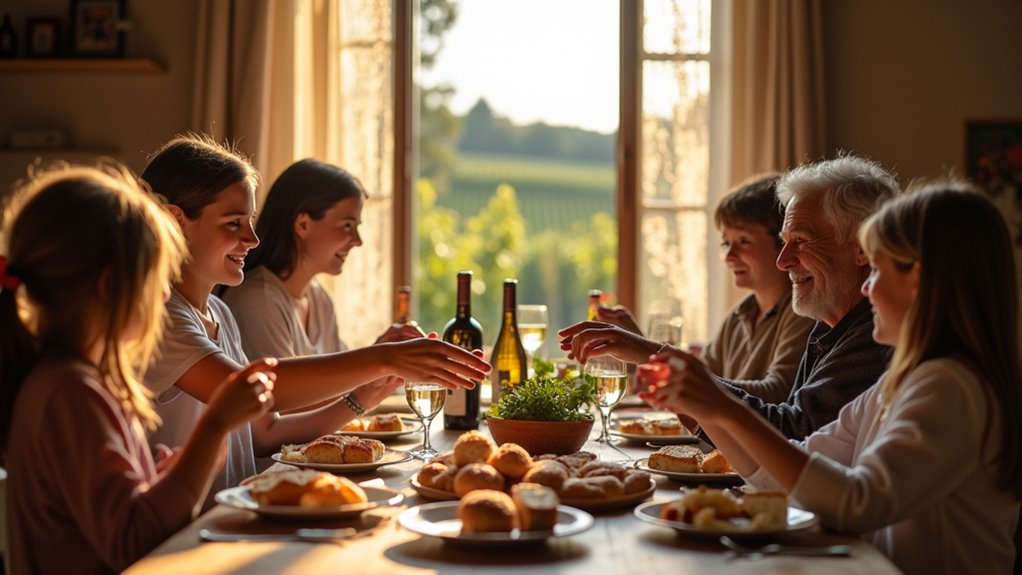
You’ll impress restaurant staff by saying “mille fois merci” for exceptional service. During family dinners, raise your glass with “à votre santé” for formal toasts or “à la tienne” among close relatives.
Don’t worry about perfection—French people appreciate your effort. Practice “pouvez-vous m’aider, s’il vous plaît?” for asking directions. Remember that understanding French cultural nuances through these expressions will deepen your connection with local families during your holiday.
Getting Help When You’re Lost or Confused
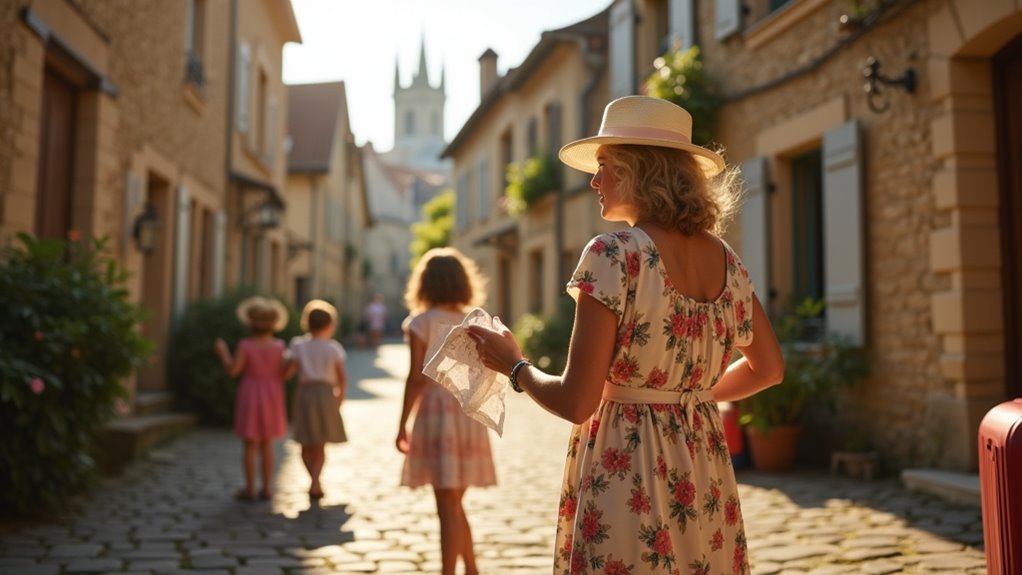
When family travel plans go awry and you find yourself wandering unfamiliar French streets, don’t panic—locals are generally happy to help visitors navigate their neighborhoods. Start politely with “Bonjour, Madame/Monsieur” before asking “Excusez-moi, je suis un peu perdu(e)” (Excuse me, I’m a bit lost).
Follow with “Pouvez-vous m’aider?” (Can you help me?) and “Je cherche…” (I’m looking for…). Ask practical questions like “C’est loin?” (Is it far?) or “C’est à combien de minutes à pied?” (How many minutes on foot?). Pay attention to visual aids like hand gestures that locals often use alongside their verbal directions to help you better understand.
If you don’t understand directions, say “Pardon, pouvez-vous répéter plus lentement?” (Sorry, could you repeat more slowly?) or “Pouvez-vous me montrer sur la carte?” (Can you show me on the map?).
Remember basic directions: “tout droit” (straight ahead), “à gauche” (left), “à droite” (right).
Finding Your Way Around Tourist Destinations
Once you’ve mastered basic help-seeking phrases, exploring France’s most popular tourist destinations becomes much more manageable with targeted vocabulary and directional expressions.
You’ll frequently need “Où est le musée?” (Where is the museum?) or “Comment puis-je aller à la cathédrale?” (How can I get to the cathedral?) when *orienteering* historic centers.
Essential destinations include la gare (train station), l’aéroport (airport), and le centre-ville (downtown).
When receiving directions, listen for “tout droit” (straight ahead), “à gauche” (left), and “à droite” (right).
Positional phrases like “près de” (near), “en face de” (across from), and “au coin de” (at the corner) help pinpoint locations precisely.
Opening your conversation with polite expressions like “Bonjour” and “Excusez-moi” significantly increases your chances of receiving helpful assistance from locals.
Always confirm distance with “Est-ce que c’est loin?” (Is it far?) before setting off on your tourist adventure.
Booking Family-Friendly Accommodations

Specify your room needs precisely: “avec un lit double” for double beds, “avec deux lits simples” for separate beds, or “une chambre familiale” for family suites.
When traveling with babies, request “un lit bébé” or “un berceau” and confirm availability beforehand.
Ask “Est-ce qu’il reste de la place?” to check availability.
For checkout inquiries, use “À quelle heure est le check-out?”
Remember that extra beds (“un lit d’appoint”) depend on room size and incur additional fees.
You’ll find hotel staff more accommodating when you demonstrate politeness through proper greetings and courteous phrasing.
Ordering Food and Drinks for the Whole Family
How do you navigate a French restaurant menu when you’re managing multiple family members with different tastes and dietary needs? Start with a polite “Bonjour” and signal you’re ready with “On est prêt à commander.” Use “Je voudrais” followed by each dish and “s’il vous plaît” for courteous ordering.
Don’t hesitate to ask “Qu’est-ce que vous recommandez?” for family-friendly suggestions or “Quel est le plat du jour?” for specials. When unsure about ingredients, ask “Qu’est-ce que [dish name]?” or “Est-ce qu’il y a de l’ail dans ce plat?” for allergies.
Request “Une carafe d’eau s’il vous plaît” for free water. When ordering drinks, try “Un verre de rosé” for wine or check out les boissons section on the menu for other beverage options. When finished, ask for “L’addition, s’il vous plaît” and clarify payment with “Vous voulez payer séparément ou ensemble?”
Navigating Restaurants With Dietary Restrictions
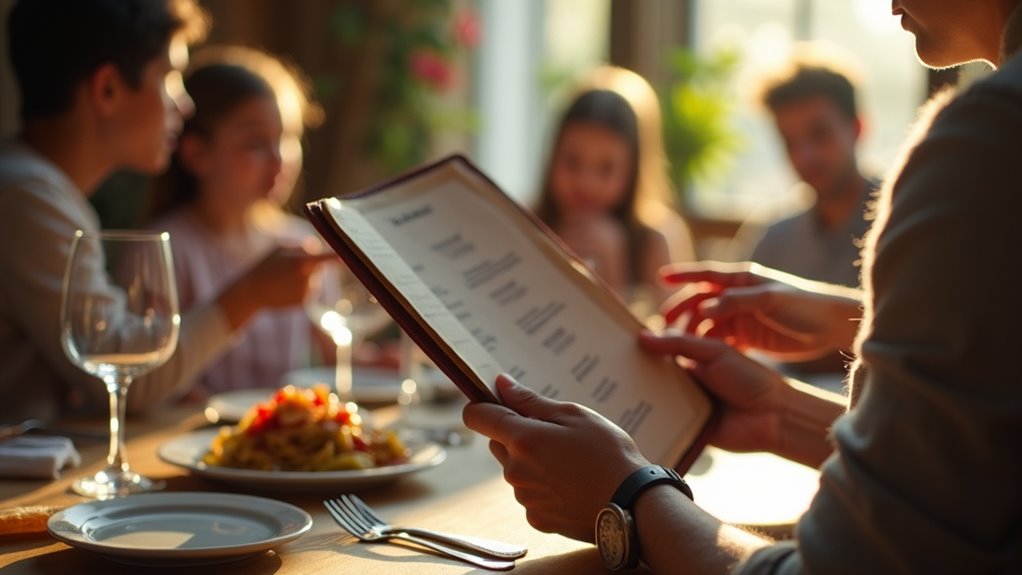
When family members have dietary restrictions or allergies, communicating these needs clearly in French restaurants becomes essential for everyone’s safety and enjoyment.
Start by declaring your dietary identity: “Je suis végétarien(ne)” for vegetarian or “Je suis diabétique” for diabetic. For specific food avoidances, say “Je ne mange pas de viande” (no meat) or “Pas trop épicé” (not too spicy). Mastering these phrases ensures confidence in navigating menus and ordering appropriately for your entire family.
Allergies require immediate attention—use “Je suis allergique aux fruits de mer” (allergic to seafood) or “Je suis allergique au gluten” (allergic to gluten).
Make specific requests with “Sans gluten, s’il vous plaît” (gluten-free, please) or ask “Est-ce qu’il y a de la viande dans ce plat?” (is there meat in this dish?).
Don’t hesitate to speak up—your family’s health matters.
Shopping for Souvenirs and Local Goods
Where can you find the perfect French souvenir that’ll make your friends back home jealous? Start by asking locals “Où est-ce que je peux acheter des souvenirs?” to discover hidden gems beyond tourist traps.
When browsing, use “Je regarde” if you’re just looking, or “Je cherche…” when seeking something specific. Don’t hesitate to ask “Est-ce que vous avez du fromage français?” for authentic local products that’ll transport you back to France with every taste.
Always inquire “Combien ça coûte?” and check “Est-ce qu’il y a des soldes?” for deals. If prices seem steep, remember “C’est trop cher” expresses your budget concerns diplomatically. For a more leisurely shopping experience, try faire du lèche-vitrine to explore what’s available without any pressure to purchase.
When you’ve found that perfect memento, confidently say “Je le prends” and ask about payment options with “Puis-je payer par carte de crédit?”
Asking for Directions to Family Attractions
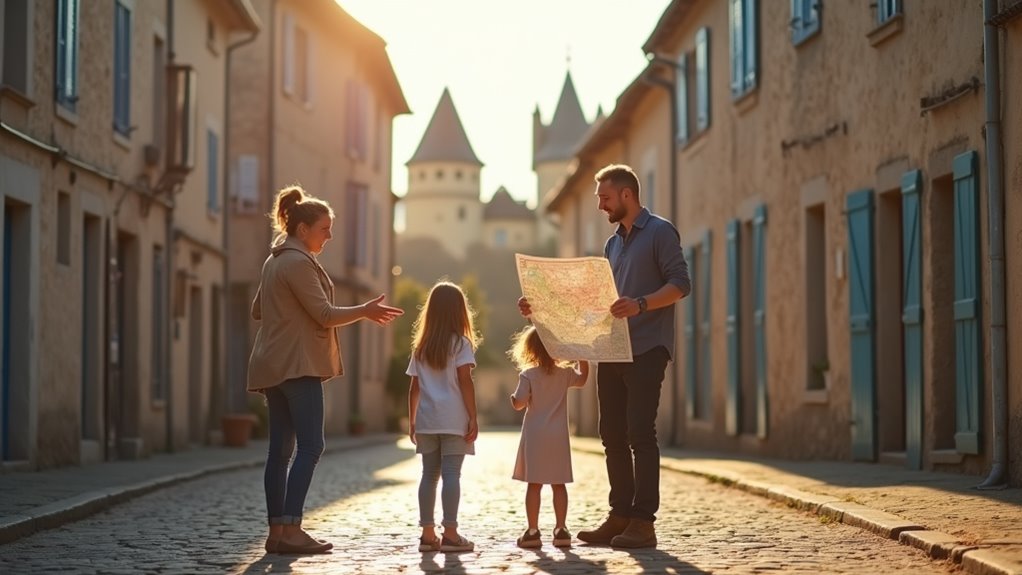
Getting lost with kids in tow can quickly turn a fun family outing into a stressful situation, but mastering a few key French phrases will help you navigate to any attraction with confidence.
Start with simple location questions: “Où est le parc le plus proche?” (Where’s the nearest park?) or “Comment aller à la plage?” (How do I get to the beach?). When locals give directions, you’ll hear “tournez à gauche” (turn left), “allez tout droit” (go straight), or “c’est à côté de…” (it’s next to…).
Always ask about distance with “Est-ce loin d’ici?” (Is it far from here?) and walking time using “Combien de temps cela prend-il à pied?” (How long does it take on foot?). For a more polite approach, use “Je voudrais aller à…” followed by your destination to express where you’d like to go.
Don’t hesitate to request clarification with “Pouvez-vous répéter, s’il vous plaît?” (Can you repeat, please?).
Handling Transportation and Travel Logistics
Navigate stations confidently by knowing “la gare” (train/bus station), “le quai” (platform), and “la voie” (tracks).
Stay updated on travel status with “à l’heure” (on time), “en retard” (delayed), or “supprimé” (canceled). French cities are designed with circular layouts, making public transit an efficient way to move around urban areas.
Don’t forget to “valider votre billet” before boarding, listen for “le prochain arrêt” announcements, and watch for “la correspondance” connections.
Emergency Phrases for Peace of Mind
While nobody wants to think about emergencies during a family vacation, knowing key French phrases can make all the difference when you need immediate help.
Start with the basics: “J’ai besoin d’aide” (I need help) and “Au secours!” (Help!) will get immediate attention.
For medical situations, memorize “Appelez une ambulance” (Call an ambulance) and “Où est l’hôpital le plus proche?” (Where is the nearest hospital?). If you’re feeling unwell, “Je ne me sens pas bien” (I don’t feel well) helps communicate your condition clearly.
If you’re dealing with theft or safety concerns, “Appelez la police!” (Call the police!) and “Mon passeport a été volé” (My passport has been stolen) are essential. When you need to locate essential services, knowing “Où est la pharmacie?” Where is the pharmacy? can help you find medication or first aid supplies quickly.
Don’t forget communication aids like “Je ne comprends pas” (I don’t understand) and “Pouvez-vous parler lentement?” (Can you speak slowly?) to help bridge language barriers during stressful moments.
Sharing Your Holiday Experiences With Locals
What better way to enrich your French holiday than by connecting with locals who can share insider tips and stories about their homeland? When chatting with friendly French people, you’ll find several phrases invaluable for meaningful exchanges.
Start conversations with “C’est une belle journée” to comment on lovely weather, instantly creating common ground. Share your search for attractions using “Je cherche…” followed by specific landmarks or experiences you’re seeking.
Express genuine appreciation with “C’est délicieux!” when locals recommend restaurants or dishes. Always begin these interactions politely with Excusez-moi Madame/Monsieur to show proper French etiquette.
Ask “Qu’est-ce que vous me recommandez?” to tap into their local knowledge about hidden gems and authentic experiences.
When minor travel hiccups occur, a casual “C’est la vie!” shows you’re embracing the adventure.
Respond enthusiastically with “Très bien!” to their suggestions, encouraging further conversation and building rapport.
The Sum Up
You’ve got the essential French phrases to make your family holiday memorable and stress-free. Don’t worry about perfect pronunciation – locals appreciate your effort to speak their language. Practice these phrases before you travel, and you’ll feel more confident maneuvering France with your family. Remember, communication isn’t just about words; gestures and smiles go a long way. Pack this linguistic toolkit and you’re ready for an amazing French adventure with your loved ones.