

You’ll survive long car journeys by timing your travel between 10 a.m. and 3 p.m. to avoid rush hour traffic, sticking to safer interstate highways, and limiting yourself to 8-10 hours of daily driving. Take breaks every two hours, pack protein-rich snacks and plenty of water, and complete a thorough vehicle inspection before departing. Keep emergency supplies handy and use upbeat music or engaging podcasts to combat monotony. These foundational strategies will transform your road trip experience into something far more manageable and enjoyable.
- Plan Your Route and Timing to Avoid Peak Traffic
- Choose Safer Highway Routes Over Smaller Roads
- Limit Daily Driving to 8-10 Hours Maximum
- Schedule Regular Breaks Every Two Hours
- Take Strategic Power Naps When Drowsiness Hits
- Ensure Everyone Wears Seatbelts at All Times
- Maintain Steady, Legal Speeds Throughout Your Journey
- Optimize Your Seat Position and Cabin Comfort
- Pack Smart Snacks and Stay Properly Hydrated
- Complete a Thorough Pre-Trip Vehicle Inspection
- Prepare an Emergency Kit for Unexpected Situations
- Use Audio Entertainment to Combat Road Monotony
- The Sum Up
Plan Your Route and Timing to Avoid Peak Traffic

Before you hit the road for that cross-country adventure, you’ll want to map out when you’re driving through major cities—not just where you’re going. Rush hour turns highways into parking lots, so avoid weekday mornings (6-9 a.m.) and evenings (3:30-6:30 p.m.) at all costs.
Use Google Maps to check “typical traffic” patterns for your route days ahead. This shows you exactly when congestion spikes and clears up. Traffic volume can reach 8,000 vehicles per hour during peak times on busy highways, creating significant delays.
Aim for that sweet spot between 10 a.m. and 3 p.m. on weekdays, or consider overnight drives if you’re comfortable with early morning arrivals.
Don’t forget about special events and tourist seasons—they’ll throw normal patterns out the window. Sometimes staying overnight near a major bottleneck saves hours of stress the next day.
Choose Safer Highway Routes Over Smaller Roads
Once you’ve mapped out your timing, your next smart move is picking the right type of roads to get there. Choose interstate highways over smaller roads whenever possible – they’re markedly safer for long journeys.
Highway fatality rates are less than half those of other roads, with interstate highways showing just 0.55 deaths per 100 million vehicle miles versus 1.3 on smaller routes.
You’ll face fewer hazards on highways thanks to physical barriers separating opposing traffic, controlled access points, and consistent design standards.
Unlike smaller roads with frequent intersections and driveways, highways eliminate cross-traffic conflicts and T-bone collisions.
The gentle curves, paved shoulders, and longer sight distances help you maintain steady speeds and react to hazards earlier, making your journey both safer and less stressful. These safety features helped save an estimated 6,555 lives in 2019 alone by providing safer travel conditions than other road types.
Limit Daily Driving to 8-10 Hours Maximum

While highways keep you safer, you’ll still face serious risks if you push yourself too hard behind the wheel. Your crash odds rise steadily after just 5 hours of continuous driving, and driving more than 8 hours increases your crash risk by 1.8 times compared to shorter trips.
Driver fatigue causes about one-third of fatal crashes, leading to slower reactions and poor decision-making. Commercial drivers often develop better fatigue recognition skills and take preventive actions like pulling over when drowsy.
Since most people drive only 60 minutes daily, those marathon 10+ hour days represent massive spikes in your risk exposure. Cumulative fatigue builds across multiple long driving days, especially when you’re pushing into evening hours when crashes peak.
Set a firm 8-10 hour daily limit and stick to it – your alertness and safety depend on adequate recovery time.
Schedule Regular Breaks Every Two Hours
Even though you’re sticking to that 8-10 hour daily limit, you’ll still need strategic breaks to maintain peak alertness behind the wheel. Stop every two hours or 100-150 miles for at least 15-20 minutes – your reaction time markedly deteriorates after two hours of continuous driving, nearly doubling your crash risk.
Make each break count by fully exiting your vehicle and walking for 5-10 minutes. Stretch your legs, hips, back, neck, and shoulders to restore circulation. Stay hydrated since mild dehydration impairs attention like low-level alcohol. Focus on distant objects to rest your eyes from constant dashboard scanning. Use each break to check your engine temperature, oil levels, and tire condition since vehicle issues can develop gradually during extended drives.
Every 4-6 hours, take longer 30-60 minute breaks for proper meals. During night driving or challenging conditions, break even more frequently.
Take Strategic Power Naps When Drowsiness Hits

Despite your best efforts with regular breaks, drowsiness can still creep up on you during long drives. When fatigue hits, pull over immediately at a well-lit rest stop and take a strategic 15-20 minute power nap. Set your alarm for 30 minutes total, giving yourself 10 minutes to fall asleep.
For maximum effectiveness, try the caffeine nap technique: drink coffee right before your nap. The caffeine takes 30 minutes to kick in, perfectly timing with your wake-up for enhanced alertness without grogginess.
Always lock your doors, limit noise and light, and park away from traffic. After napping, walk around and rehydrate before continuing. Being awake for 17 hours impairs your driving ability to a similar level as being over the legal alcohol limit. Remember, these short naps boost your alertness by 34% and dramatically reduce accident risk, but they’re never a substitute for proper nighttime sleep.
Ensure Everyone Wears Seatbelts at All Times
When was the last time you reminded everyone to buckle up before starting your engine? Make “belts on before drive-off” your non-negotiable rule for every journey, regardless of distance. Seat belts cut your risk of fatal injury by 45% and serious injuries by 50%, making them the single most effective safety measure available.
Ensure proper fit: lap belts should rest low across hips, not your stomach, while shoulder belts cross your chest and mid-shoulder. Never tuck the shoulder belt behind your back or under your arm. Parents who set clear safety rules and stay actively involved see twice the seat belt compliance rates among their teens.
Implement a “no belt, no ride” policy—it doubles compliance rates, especially with teens. Remember, 45% of crash fatalities involve unrestrained occupants, and ejection risks increase 30-fold without belts.
Maintain Steady, Legal Speeds Throughout Your Journey

While it’s tempting to push the pedal when you’re enthusiastic to reach your destination, maintaining steady, legal speeds protects your passengers and actually saves time over long distances.
Driving just 1.8 mph slower than your usual highway speed can save you 3.6 hours annually by avoiding traffic delays, accidents, and stops. You’ll dramatically reduce crash risk by staying near the median traffic flow rather than weaving between speed zones.
Speeding above 70 mph makes collisions potentially fatal, while speeds over 65 mph substantially increase crash involvement. Since 29% of traffic fatalities involve speeding, you’re protecting everyone aboard by respecting posted limits. Research analyzing millions of GPS data points reveals that drivers nationwide spend an average of 13% of driving time exceeding 70 mph, highlighting how common this dangerous behavior has become.
Optimize Your Seat Position and Cabin Comfort
Once you’ve settled into a steady driving rhythm, your body will start sending signals about comfort—or the lack of it. Start by adjusting your seat height so your hips sit slightly higher than your knees—this reduces pressure on your lower back and improves blood flow.
Position yourself so there’s a slight bend in your knees when reaching pedals, around 120-130 degrees.
Set your backrest to a moderate recline of 100-110 degrees rather than sitting bolt upright. This angle considerably reduces spinal disc loading.
Adjust your steering wheel so your elbows remain slightly flexed at about 120 degrees, keeping your shoulders relaxed against the backrest.
Don’t forget your headrest—position the top level with your head’s crown for proper neck support during long stretches. Consider that soft seat cushions provide better pressure distribution and lower pressure peaks compared to firm seats, which can help maintain comfort during extended driving periods.
Pack Smart Snacks and Stay Properly Hydrated
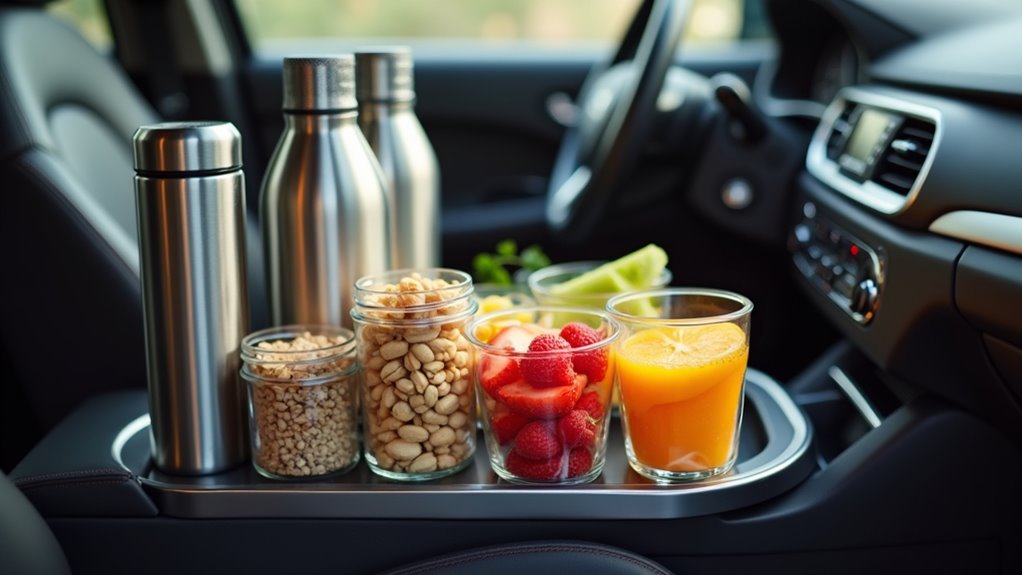
Getting comfortable in your seat sets you up for hours of driving, but your energy levels and focus depend just as much on what you put in your body. Even mild dehydration of 1–2% body weight impairs attention and increases fatigue, making monotonous routes feel endless.
Stick with plain water as your primary hydration source, taking frequent small sips rather than chugging large amounts. Skip sugar-sweetened beverages and high-caffeine energy drinks—they’ll cause energy crashes that’ll leave you drowsier than before.
For snacks, choose combinations of protein, fiber, and healthy fats. Fresh fruit, nuts, jerky, and cut vegetables with hummus provide steady energy without the blood sugar spikes. Air-popped popcorn makes an excellent whole grain option at just 110 calories per ounce while delivering over 4 grams of fiber to keep you satisfied.
Pre-portion everything into small containers to avoid mindless eating and keep your focus sharp.
Complete a Thorough Pre-Trip Vehicle Inspection
Before you turn the key and head out on your journey, spending fifteen minutes inspecting your vehicle can save you from roadside breakdowns that’ll turn your trip into a nightmare. Pop the hood and check your oil, coolant, and power steering fluid levels. Look for cracked belts and loose hoses that could fail miles from help.
Walk around your car and inspect tire pressure and tread depth—you’ll need at least 2/32″ to grip wet roads safely. Test all your lights, from headlights to brake lights, since visibility issues create dangerous situations. Inside, verify your gauges show normal readings and your windshield wipers work properly.
These simple checks prevent most common roadside emergencies. Remember that professional drivers typically log their pre-trip inspections as on-duty time rather than driving hours, reflecting the critical importance of this safety procedure.
Prepare an Emergency Kit for Unexpected Situations
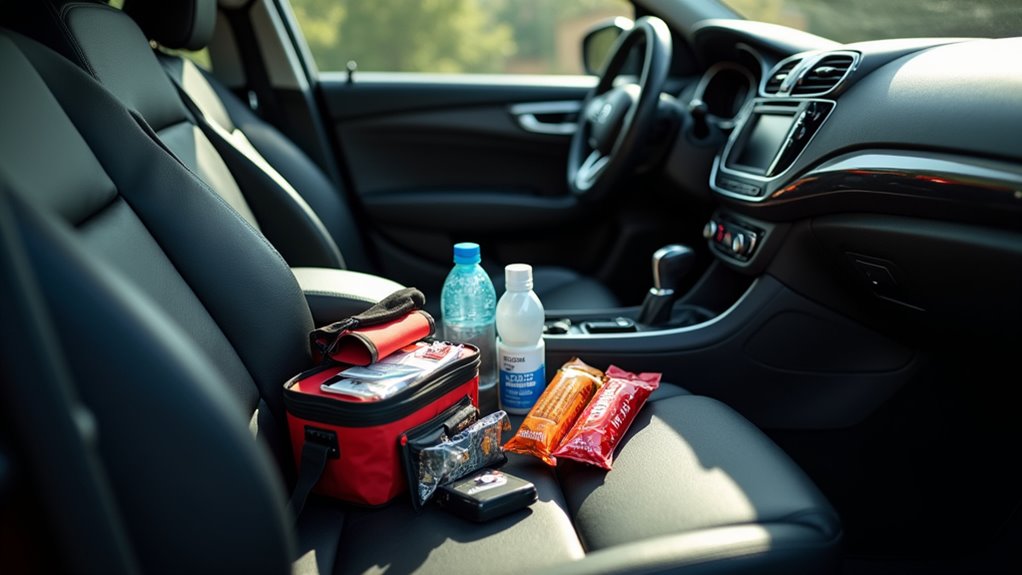
While mechanical problems are frustrating, being stranded without essential supplies transforms inconvenience into genuine danger. You’ll want to pack a thorough first-aid kit with bandages, antiseptic, and pain relievers, plus any personal medications like inhalers or EpiPens.
Store at least one gallon of water per person and non-perishable snacks for energy during extended delays. Consider packing water purification tablets to treat questionable water sources if your bottled supply runs low.
Include communication essentials like a phone charger, flashlight with extra batteries, and reflective warning triangles to alert other drivers. Pack a high-visibility vest so you’re seen when exiting your vehicle on dark roads.
Don’t forget multipurpose tools like a seatbelt cutter, window breaker, and duct tape for emergency repairs. Keep emergency contacts, paper maps, and cash readily accessible when technology fails.
Use Audio Entertainment to Combat Road Monotony
Once you’ve packed your emergency supplies and hit the road, the real challenge becomes staying alert and engaged during those endless stretches of highway. Audio entertainment is your secret weapon—nearly 90% of drivers rely on it to combat boredom and pass time effectively.
Mix up your content to avoid monotony. Start with music since 84% of drivers choose it as their primary audio, but don’t stick to one genre. Use upbeat playlists when energy dips and familiar favorites for comfort. About 47% of listeners report radio puts them in a good mood. With connected vehicles becoming increasingly common, you’ll have even more streaming options at your fingertips to customize your driving soundtrack.
Integrate podcasts and audiobooks for mental stimulation—one-third of drivers use podcasts to break up music-heavy stretches. This variety keeps your mind engaged and makes those long miles disappear faster.
The Sum Up
You’ve got the roadmap for conquering those marathon drives without losing your mind. Don’t try to be a hero—stick to your planned breaks, listen to your body, and keep that emergency kit handy. Remember, it’s not about getting there fastest; it’s about arriving safely and with your sanity intact. Trust these strategies, and you’ll transform those dreaded long hauls into manageable, maybe even enjoyable, adventures.